
Al descargar el documento usted acepta los términos establecidos en el copyright del documento y la política de uso de la plataforma.
Biblioteca
Residencia del tiburón punta blanca de arrecife, Triaenodon obesus, (Carcharhiniformes: Carcharhinidae) en las bahías Chatham y Wafer del Parque Nacional Isla del Coco, Costa Rica


Monitoreo de especies
Metodologías de monitoreo
Año de la publicación:
2020
Autor:
Andrés López-Garro
Ilena Zanella
Geiner Golfín-Duarte
Maikel Pérez-Montero
Lugar de incidencia:
Costa Rica
Región oceánica:
Pacífico - Centro Oriental
Residency of the whitetip reef shark (Triaenodon obesus) in Chatham and Wafer Bays, Isla del Coco National Park, Costa Rica. Introduction: The whitetip reef shark (Triaenodon obesus) is a non migratory tropical reef species that has shown no high coastal connectivity, as observed for other shark species. At the same time, has the widest distribution of all Indo-Pacific reef shark species. Triaenodon obesus is one of the most common shark species at Isla del Coco National Park (PNIC) and it is present year-round. In the bays located in the north of the PNIC, Chatham Bay and Wafer Bay, there is a large population of whitetip reef sharks. Despite that, information about its residency is scarce. Objective: The aim of this initiative is to study the hábitat use and the movements of the whitetip reef sharks, in order to improve the management of its population at the Isla del Coco National Park and other áreas of Eastern Tropical Pacific. A preliminary study on the residency in the Chatham and Wafer bays of the PNIC was conducted, using acoustic telemetry. Methods: A shark tag ging expedition was made to Isla del Coco National Park from November 25 to December 5, 2014. During this expedition, two night trips were made between 6:00 pm and 10:00 pm at Chatham Bay and Wafer Bay.
- Results:
A...
Etiquetas:
CC-BY
La estructura de clasificación de la lista de especies Blue Five para la biblioteca digital ha sido
elaborada siguiendo criterios tanto científicos como de accesibilidad para facilitar la búsqueda de
información. En primer lugar, se organizaron las especies basándose en la taxonomía aceptada por la
comunidad científica para garantizar precisión y coherencia. Simultáneamente, se han implementado
categorías y subcategorías, considerando características morfológicas, su distribución y el uso de los
nombres comunes, con el fin de optimizar la navegación y búsqueda de datos por parte de los usuarios.
Esta metodología equilibrada asegura que la lista no solo sea científicamente rigurosa, sino también
fácil de consultar para quienes necesiten acceder a información específica de manera eficiente.
ISBN/ISSN/DOI:
http://dx.doi.org/10.15517/rbt.v68is1.41203
Editor:
Revista de Biología Tropical
Idioma:
Español
Fuente:
Revista de Biología Tropical, 68(Supl. 1), S330-S339
Especies mencionadas:
- Categoría Blue Five: Tiburones
- Familia: Tiburones cazones
- Especies: Tintorera/Tiburón coralero ñato (Triaenodon obesus)
Documentos relacionados:

Monitoreo de especies
From coastal to offshore: The case of an inshore bottlenose...
The common bottlenose dolphin (Tursiops truncatus) is widely distributed across tropical and temperate waters worldwide (Wells et al...
Monitoreo de especies
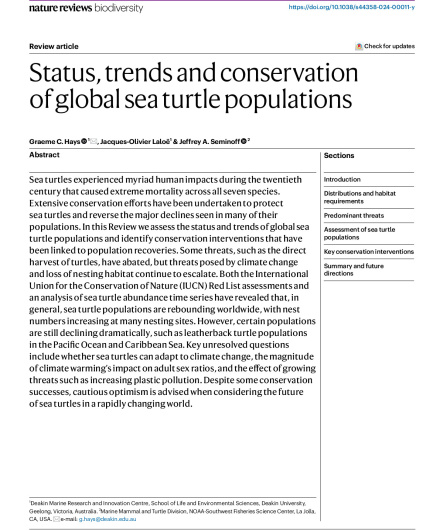
Status, trends and conservation of global sea turtle populations
Sea turtles experienced myriad human impacts during the twentieth century that caused extreme mortality across all seven species. Extensive conservation...

Monitoreo de especies
First confirmed record of the rough-toothed dolphin in ecuadorian mainland...
We report the first confirmed occurrence of the rough-toothed dolphin (Steno bredanensis) in mainland waters of Ecuador. The...