
Al descargar el documento usted acepta los términos establecidos en el copyright del documento y la política de uso de la plataforma.
Biblioteca
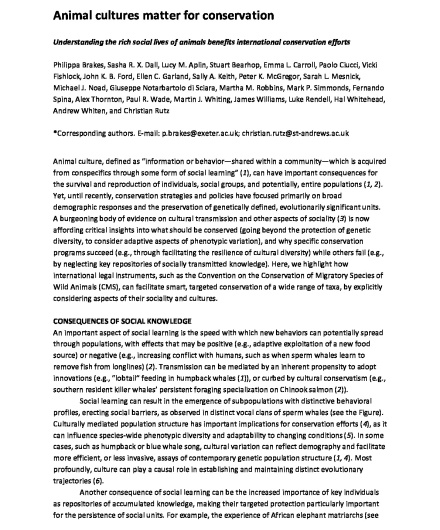
Animal cultures matter for conservation: Understanding the rich social lives of animals benefits international conservation efforts

Articulación multisectorial
Comunidad científica/academia
Año de la publicación:
2019
Autor:
Philippa Brakes
Sasha R. X. Dall
Lucy M. Aplin
Stuart Bearhop
Emma L. Carroll
Paolo Ciucci
Vicki Fishlock
John K. B. Ford
Ellen C. Garland
Sally A. Keith
Peter K. McGregor
Sarah L. Mesnick
Michael J. Noad,
Giuseppe Notarbartolo di Sciara
Martha M. Robbins
Mark P. Simmonds
Fernando Spina
Alex Thornton
Paul R. Wade
Martin J. Whiting
James Williams
Luke Rendell
Hal Whitehead
Andrew Whiten
Christian Rutz
Lugar de incidencia:
Global
Región oceánica:
Pacífico - Sudeste
Animal culture, defined as “information or behavior—shared within a community—which is acquired from conspecifics through some form of social learning” (1), can have important consequences for the survival and reproduction of individuals, social groups, and potentially, entire populations (1, 2). Yet, until recently, conservation strategies and policies have focused primarily on broad demographic responses and the preservation of genetically defined, evolutionarily significant units. A burgeoning body of evidence on cultural transmission and other aspects of sociality (3) is now affording critical insights into what should be conserved (going beyond the protection of genetic diversity, to consider adaptive aspects of phenotypic variation), and why specific conservation programs succeed (e.g., through facilitating the resilience of cultural diversity) while others fail (e.g., by neglecting key repositories of socially transmitted knowledge). Here, we highlight how international legal instruments, such as the Convention on the Conservation of Migratory Species of Wild Animals (CMS), can facilitate smart, targeted conservation of a wide range of taxa, by explicitly considering aspects of their sociality and cultures.
Etiquetas:
La estructura de clasificación de la lista de especies Blue Five para la biblioteca digital ha sido
elaborada siguiendo criterios tanto científicos como de accesibilidad para facilitar la búsqueda de
información. En primer lugar, se organizaron las especies basándose en la taxonomía aceptada por la
comunidad científica para garantizar precisión y coherencia. Simultáneamente, se han implementado
categorías y subcategorías, considerando características morfológicas, su distribución y el uso de los
nombres comunes, con el fin de optimizar la navegación y búsqueda de datos por parte de los usuarios.
Esta metodología equilibrada asegura que la lista no solo sea científicamente rigurosa, sino también
fácil de consultar para quienes necesiten acceder a información específica de manera eficiente.
Editor:
Published by AAAS
Idioma:
Inglés
Fuente:
St Andrews Research Repository
Especies mencionadas:
- Categoría Blue Five: Ballenas
- Familia: Cachalotes
- Especies: Cachalote (Physeter macrocephalus)
Documentos relacionados:
Articulación multisectorial
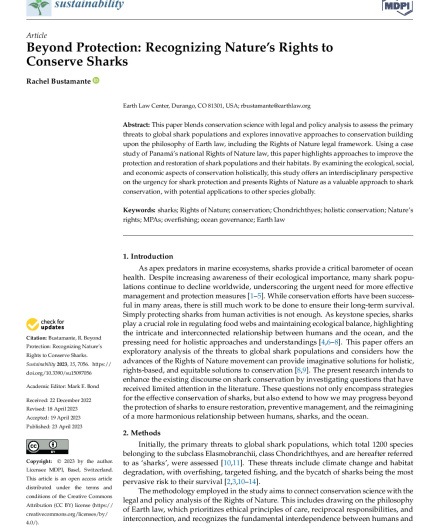
Beyond protection: Recognizing nature’s rights to conserve sharks
This paper blends conservation science with legal and policy analysis to assess the primary
threats to global shark populations and...

Articulación multisectorial
Incidencia de elasmobranquios en la pesca artesanal en los golfos...
Las interacciones entre elasmobranquios y artes de pesca es un tema controversial debido al nivel de impacto que ocasiona la...

Articulación multisectorial
Engaging communities to safeguard ocean life: UNESCO Environmental DNA Expeditions
Citizens can help protect ocean biodiversity As climate change heats the ocean, marine conservation is hindered by how little is...