
Al descargar el documento usted acepta los términos establecidos en el copyright del documento y la política de uso de la plataforma.
Biblioteca
Global collision-risk hotspots of marine traffic and the world’s largest fish, the whale shark


Monitoreo de especies
Metodologías de monitoreo
Año de la publicación:
2022
Autor:
Freya C. Womersley
Nicolas E. Humphries
Nuno Queiroz
David W. Sims
Lugar de incidencia:
Global
Región oceánica:
Cosmopolita
Marine traffic is increasing globally yet collisions with endangered megafauna such as whales, sea turtles, and planktivorous sharks go largely undetected or unreported. Collisions leading to mortality can have population-level consequences for endangered species. Hence, identifying simultaneous space use of megafauna and shipping throughout ranges may reveal as-yet-unknown spatial targets requiring conservation. However, global studies tracking megafauna and shipping occurrences are lacking. Here we combine satellite-tracked movements of the whale shark, Rhincodon typus, and vessel activity to show that 92% of sharks’ horizontal space use and nearly 50% of vertical space use overlap with persistent large vessel (>300 gross tons) traffic. Collision-risk estimates correlated with reported whale shark mortality from ship strikes, indicating higher mortality in areas with greatest overlap. Hotspots of potential collision risk were evident in all major oceans, predominantly from overlap with cargo and tanker vessels, and were concentrated in gulf regions, where dense traffic co-occurred with seasonal shark movements. Nearly a third of whale shark hotspots overlapped with the highest collision-risk areas, with the last known locations of tracked sharks coinciding with busier shipping...
Etiquetas:
La estructura de clasificación de la lista de especies Blue Five para la biblioteca digital ha sido
elaborada siguiendo criterios tanto científicos como de accesibilidad para facilitar la búsqueda de
información. En primer lugar, se organizaron las especies basándose en la taxonomía aceptada por la
comunidad científica para garantizar precisión y coherencia. Simultáneamente, se han implementado
categorías y subcategorías, considerando características morfológicas, su distribución y el uso de los
nombres comunes, con el fin de optimizar la navegación y búsqueda de datos por parte de los usuarios.
Esta metodología equilibrada asegura que la lista no solo sea científicamente rigurosa, sino también
fácil de consultar para quienes necesiten acceder a información específica de manera eficiente.
ISBN/ISSN/DOI:
https://doi.org/10.1073/pnas.2117440119
Editor:
The Proceedings of the National Academy of Sciences (PNAS)
Idioma:
Inglés
Fuente:
PNAS
Especies mencionadas:
- Categoría Blue Five: Tiburones
- Familia: Tiburones ballena
- Especies: Tiburón ballena (Rhincodon typus)
Documentos relacionados:

Monitoreo de especies
From coastal to offshore: The case of an inshore bottlenose...
The common bottlenose dolphin (Tursiops truncatus) is widely distributed across tropical and temperate waters worldwide (Wells et al...
Monitoreo de especies
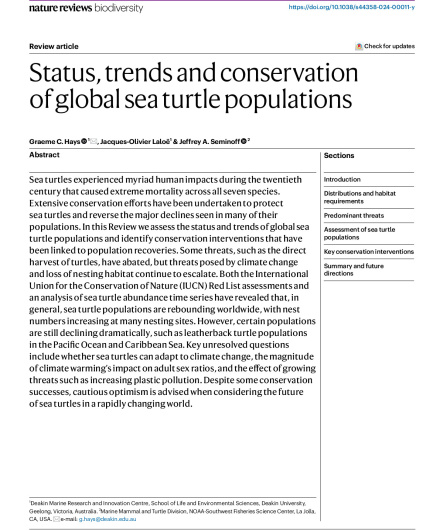
Status, trends and conservation of global sea turtle populations
Sea turtles experienced myriad human impacts during the twentieth century that caused extreme mortality across all seven species. Extensive conservation...

Monitoreo de especies
First confirmed record of the rough-toothed dolphin in ecuadorian mainland...
We report the first confirmed occurrence of the rough-toothed dolphin (Steno bredanensis) in mainland waters of Ecuador. The...