
Al descargar el documento usted acepta los términos establecidos en el copyright del documento y la política de uso de la plataforma.
Biblioteca
Sperm whale clans and human societies


Monitoreo de especies
Metodologías de monitoreo
Año de la publicación:
2024
Autor:
Hal Whitehead
Lugar de incidencia:
Chile
Ecuador
Región oceánica:
Pacífico - Sudeste
Sperm whale society is structured into clans that are primarily distinguished by vocal dialects, which may be symbolic markers of clan identity. However, clans also differ in non-vocal behaviour. These distinctive behaviours, as well as clan membership itself, are learned socially, largely within matrilines. The clans can contain thousands of whales and span thousands of kilometres. Two or more clans typically use an area, but the whales only socialize with members of their own clan. In many respects the closest parallel may be the ethno-linguistic groups of humans. Patterns and processes of human prehistory that may be instructive in studying sperm whale clans include: the extreme variability of human societies; no clear link between modes of resource acquisition and social structure; that patterns of vocalizations may not map well onto other behavioural distinctions; and that interacting societies may deliberately distinguish their behaviour (schismogenesis). Conversely, while the two species and their societies are very different, the existence of very large-scale social structures in both sperm whales and humans supports some primary drivers of the phenomenon that are common to both species (such as cognition, cooperation, culture and mobility) and contraindicates others (e.g...
Etiquetas:
© 2024 The Authors.
Published by the Royal Society under the terms of the Creative Commons Attribution License http://creativecommons.org/licenses/by/4.0/, which permits unrestricted use, provided the original author and source are credited.
La estructura de clasificación de la lista de especies Blue Five para la biblioteca digital ha sido
elaborada siguiendo criterios tanto científicos como de accesibilidad para facilitar la búsqueda de
información. En primer lugar, se organizaron las especies basándose en la taxonomía aceptada por la
comunidad científica para garantizar precisión y coherencia. Simultáneamente, se han implementado
categorías y subcategorías, considerando características morfológicas, su distribución y el uso de los
nombres comunes, con el fin de optimizar la navegación y búsqueda de datos por parte de los usuarios.
Esta metodología equilibrada asegura que la lista no solo sea científicamente rigurosa, sino también
fácil de consultar para quienes necesiten acceder a información específica de manera eficiente.
Editor:
The Royal Society Publishing
Idioma:
Inglés
Fuente:
Royal Society Open Science
Especies mencionadas:
- Categoría Blue Five: Ballenas
- Familia: Cachalotes
Documentos relacionados:

Monitoreo de especies
From coastal to offshore: The case of an inshore bottlenose...
The common bottlenose dolphin (Tursiops truncatus) is widely distributed across tropical and temperate waters worldwide (Wells et al...
Monitoreo de especies
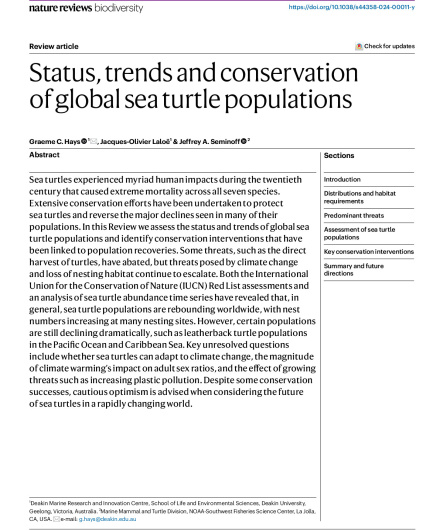
Status, trends and conservation of global sea turtle populations
Sea turtles experienced myriad human impacts during the twentieth century that caused extreme mortality across all seven species. Extensive conservation...

Monitoreo de especies
First confirmed record of the rough-toothed dolphin in ecuadorian mainland...
We report the first confirmed occurrence of the rough-toothed dolphin (Steno bredanensis) in mainland waters of Ecuador. The...