
Al descargar el documento usted acepta los términos establecidos en el copyright del documento y la política de uso de la plataforma.
Biblioteca
Fisheries, trade, and conservation of manta and devil rays in Peru

Monitoreo de especies
Metodologías de monitoreo
Año de la publicación:
2025
Autor:
Stefany Rojas Perea
Nidhi G. D’Costa
Keny Kanagusuku
Rosario Escobedo
Frida Rodríguez
Alejandra Mendoza
Rossana Maguiño
Renan Flores
Betty J. L. Laglbauer
Guy M. W. Stevens
Shaleyla Kelez
Lugar de incidencia:
Perú
Región oceánica:
Pacífico - Sudeste
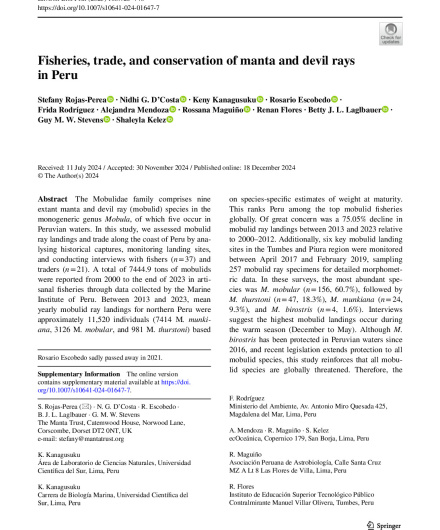
The Mobulidae family comprises nine extant manta and devil ray (mobulid) species in the monogeneric genus Mobula, of which five occur in Peruvian waters. In this study, we assessed mobulid ray landings and trade along the coast of Peru by analysing historical captures, monitoring landing sites, and conducting interviews with fishers (n = 37) and traders (n = 21). A total of 7444.9 tons of mobulids were reported from 2000 to the end of 2023 in artisanal fisheries through data collected by the Marine Institute of Peru. Between 2013 and 2023, mean yearly mobulid ray landings for northern Peru were approximately 11,520 individuals (7414 M. munkiana, 3126 M. mobular, and 981 M. thurstoni) based on species-specific estimates of weight at maturity. This ranks Peru among the top mobulid fisheries globally. Of great concern was a 75.05% decline in mobulid ray landings between 2013 and 2023 relative to 2000–2012. Additionally, six key mobulid landing sites in the Tumbes and Piura region were monitored between April 2017 and February 2019, sampling 257 mobulid ray specimens for detailed morphometric data. In these surveys, the most abundant species was M. mobular (n = 156, 60.7%), followed by M. thurstoni (n = 47, 18.3%), M. munkiana (n = 24, 9.3%), and M. birostris (n = 4, 1.6%)...
Etiquetas:
This article is licensed under a Creative Commons Attribution-NonCommercial-NoDerivatives 4.0 International License, which permits any non-commercial use, sharing, distribution and reproduction in any medium or format, as long as you give appropriate credit to the original author(s) and the source, provide a link to the Creative Commons licence, and indicate if you modified the licensed material. You do not have permission under this licence to share adapted material derived from this article or parts of it. The images or other third party material in this article are included in the article’s Creative Commons licence, unless indicated otherwise in a credit line to the material. If material is not included in the article’s Creative Commons licence and your intended use is not permitted by statutory regulation or exceeds the permitted use, you will need to obtain permission directly from the copyright holder. To view a copy of this licence, visit http://creativecommons.org/licenses/by-nc-nd/4.0/.
La estructura de clasificación de la lista de especies Blue Five para la biblioteca digital ha sido
elaborada siguiendo criterios tanto científicos como de accesibilidad para facilitar la búsqueda de
información. En primer lugar, se organizaron las especies basándose en la taxonomía aceptada por la
comunidad científica para garantizar precisión y coherencia. Simultáneamente, se han implementado
categorías y subcategorías, considerando características morfológicas, su distribución y el uso de los
nombres comunes, con el fin de optimizar la navegación y búsqueda de datos por parte de los usuarios.
Esta metodología equilibrada asegura que la lista no solo sea científicamente rigurosa, sino también
fácil de consultar para quienes necesiten acceder a información específica de manera eficiente.
ISBN/ISSN/DOI:
https://doi.org/10.1007/s10641-024-01647-7
Editor:
Environ Biol Fish
Idioma:
Inglés
Fuente:
Springer
Especies mencionadas:
- Categoría Blue Five: Mantarrayas
- Familia: Mantarrayas y móbulas
- Especies: Mantarraya de espina (Mobula mobular) Mantarraya pigmea (Mobula munkiana) Mantarraya Bentfin (Mobula thurstoni)
Documentos relacionados:
Monitoreo de especies
Status, trends and conservation of global sea turtle populations
Sea turtles experienced myriad human impacts during the twentieth century that caused extreme mortality across all seven species. Extensive conservation...
Monitoreo de especies
First confirmed record of the rough-toothed dolphin in ecuadorian mainland...
We report the first confirmed occurrence of the rough-toothed dolphin (Steno bredanensis) in mainland waters of Ecuador. The...
Monitoreo de especies
Genomic signatures of migratory preference and historical whaling in eastern...
Understanding the genetic consequences of migratory behavior and drastic population contractions is essential for the conservation of baleen whales. Here...