
Al descargar el documento usted acepta los términos establecidos en el copyright del documento y la política de uso de la plataforma.
Biblioteca
The importance of migratory connectivity for global ocean policy

Gestión de áreas marinas
Gobernanza regional
Año de la publicación:
2019
Autor:
Daniel C. Dunn
Harrison Autumn Lynn
Corrie Curtice
Sarah DeLand
Ben Donnelly
Ei Fujioka
Eleanor Heywood
Connie Y. Kot
Sarah Poulin
Meredith Whitten
Susanne Åkesson
Amalia Alberini
Ward Appeltans
José Manuel Arcos
Helen Bailey
Lisa T. Ballance
Barbara Block
Hannah Blondin
Andre M. Boustany
Jorge Brenner
Paulo Catry
Daniel Cejudo
Jesse Cleary
Peter Corkeron
Daniel P. Costa
Michael Coyne
Guillermo Ortuño Crespo
Tammy E. Davies
Maria P. Dias
Fanny Douvere
Francesco Ferretti
Angela Formia
David Freestone
Ari S. Friedlaender
Heidrun Frisch Nwakanma
Christopher Barrio Froján
Kristina M. Gjerde
Lyle Glowka
Brendan J. Godley
Jacob Gonzalez Solis
José Pedro Granadeiro
Vikki Gunn
Yuriko Hashimoto
Lu M . Hawkes
Graeme C. Hays
Carolina Hazin
Jorge Jimenez
David E. Johnson
Paolo Luschi
Sara M. Maxwell
Catherine McClellan
Michelle Modest
Giuseppe Notarbartolo di Sciara
Alejandro Herrero Palacio
Daniel M. Palacios
Andrea Pauly
Matt Rayner
Alan F. Rees
Erick Ross Salazar
David Secor
Ana M. M. Sequeira,
Mark Spalding
Fernando Spina
Sofie Van Parijs
Bryan Wallace
Nuria Varo-Cruz
Melanie Virtue
Henri Weimerskirch
Laurie pin Wilson
Bill Woodward
Patrick N. Halpin
Lugar de incidencia:
Global
Región oceánica:
Cosmopolita
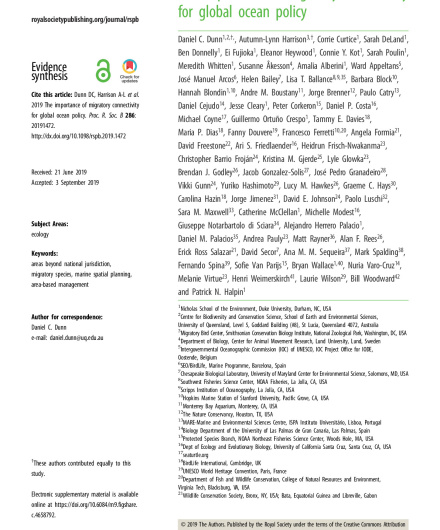
The distributions of migratory species in the ocean span local, national and international jurisdictions. Across these ecologically interconnected regions, migratory marine species interact with anthropogenic stressors throughout their lives. Migratory connectivity, the geographical linking of individuals and populations throughout their migratory cycles, influences how spatial and temporal dynamics of stressors affect migratory animals and scale up to influence population abundance, distribution and species persistence. Population declines of many migratory marine species have led to calls for connectivity knowledge, especially insights from animal tracking studies, to be more systematically and synthetically incorporated into decision-making. Inclusion of migratory connectivity in the design of conservation and management measures is critical to ensure they are appropriate for the level of risk associated with various degrees of connectivity. Three mechanisms exist to incorporate migratory connectivity into international marine policy which guides conservation implementation: site-selection criteria, network design criteria and policy recommendations. Here, we review the concept of migratory connectivity and its use in international policy, and describe the Migratory...
Etiquetas:
© 2019 The Authors. Published by the Royal Society under the terms of the Creative Commons Attribution License http://creativecommons.org/licenses/by/4.0/, which permits unrestricted use, provided the original author and source are credited.
La estructura de clasificación de la lista de especies Blue Five para la biblioteca digital ha sido
elaborada siguiendo criterios tanto científicos como de accesibilidad para facilitar la búsqueda de
información. En primer lugar, se organizaron las especies basándose en la taxonomía aceptada por la
comunidad científica para garantizar precisión y coherencia. Simultáneamente, se han implementado
categorías y subcategorías, considerando características morfológicas, su distribución y el uso de los
nombres comunes, con el fin de optimizar la navegación y búsqueda de datos por parte de los usuarios.
Esta metodología equilibrada asegura que la lista no solo sea científicamente rigurosa, sino también
fácil de consultar para quienes necesiten acceder a información específica de manera eficiente.
ISBN/ISSN/DOI:
https://doi.org/10.1098/rspb.2019.1472
Editor:
The Royal Society Publishing
Idioma:
Inglés
Fuente:
The Royal Society Publishing
Especies mencionadas:
- Categoría Blue Five: Ballenas
- Familia: Rocuales
- Especies: Ballena de Bryde (Balaenoptera edeni)
Documentos relacionados:
Gestión de áreas marinas
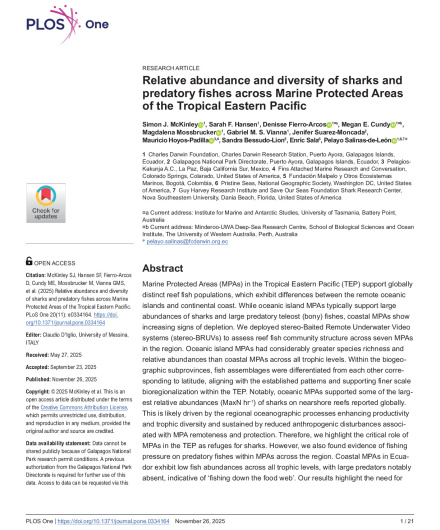
Relative abundance and diversity of sharks and predatory fishes across...
Marine Protected Areas (MPAs) in the Tropical Eastern Pacific (TEP) support globally distinct reef fish populations, which exhibit differences between...
Gestión de áreas marinas
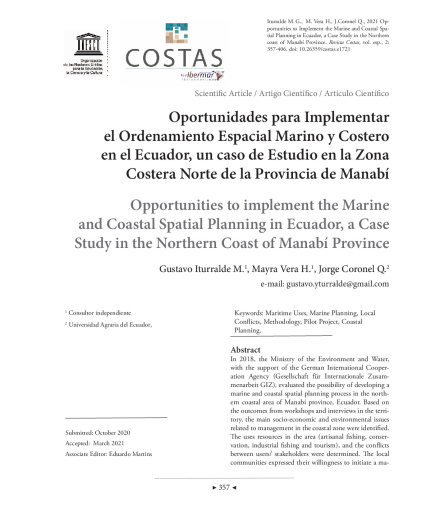
Oportunidades para implementar el ordenamiento espacial marino y costero en...
En el 2018, el Ministerio del Ambiente y Agua con el apoyo de la Agencia de Cooperación Internacional Alemana(Gesellschaft für...
Gestión de áreas marinas
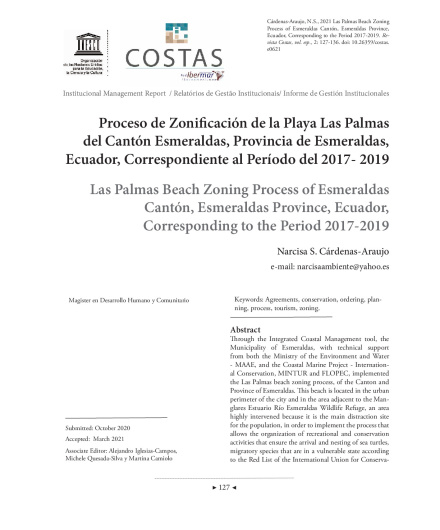
Proceso de zonificación de la playa Las Palmas del Cantón...
Mediante la herramienta de Manejo Costero Integrado, la Municipalidad de Esmeraldas con el apoyo técnico tanto del Ministerio del Ambiente...