
Al descargar el documento usted acepta los términos establecidos en el copyright del documento y la política de uso de la plataforma.
Biblioteca
Detection of the elusive dwarf sperm whale (Kogia sima) using environmental DNA at Malpelo island (Eastern Pacific, Colombia)

Monitoreo de especies
Metodologías de monitoreo
Año de la publicación:
2021
Autor:
Jean-Baptiste Juhel
Virginie Marques
Andrea Polanco Fernández
Giomar H. Borrero Pérez
Maria Mutis Martinezguerra
Alice Valentini
Tony Dejean
Stéphanie Manel
Nicolas Loiseau
Laure Velez
Régis Hocdé
Tom B. Letessier
Eilísh Richards
Florine Hadjadj
Sandra Bessudo
Felipe Ladino
Camille Albouy
David Mouillot
Loïc Pellissier
Lugar de incidencia:
Colombia
Región oceánica:
Pacífico - Sudeste
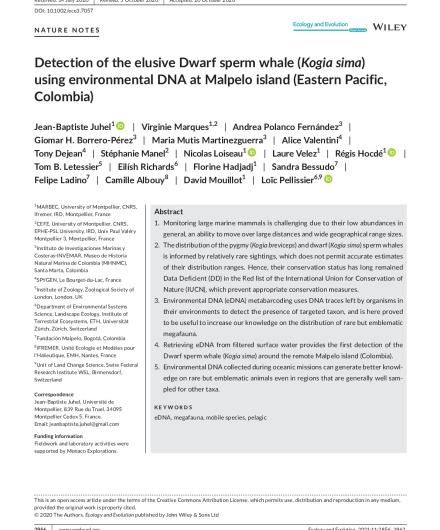
Monitoring large marine mammals is challenging due to their low abundances in general, an ability to move over large distances and wide geographical range sizes. The distribution of the pygmy (Kogia breviceps) and dwarf (Kogia sima) sperm whales is informed by relatively rare sightings, which does not permit accurate estimates of their distribution ranges. Hence, their conservation status has long remained Data Deficient (DD) in the Red list of the International Union for Conservation of Nature (IUCN), which prevent appropriate conservation measures. Environmental DNA (eDNA) metabarcoding uses DNA traces left by organisms in their environments to detect the presence of targeted taxon, and is here proved to be useful to increase our knowledge on the distribution of rare but emblematic megafauna. Retrieving eDNA from filtered surface water provides the first detection of the Dwarf sperm whale (Kogia sima) around the remote Malpelo island (Colombia). Environmental DNA collected during oceanic missions can generate better knowledge on rare but emblematic animals even in regions that are generally well sampled for other taxa.
Etiquetas:
© 2020 The Authors. Ecology and Evolution published by John Wiley & Sons Ltd
La estructura de clasificación de la lista de especies Blue Five para la biblioteca digital ha sido
elaborada siguiendo criterios tanto científicos como de accesibilidad para facilitar la búsqueda de
información. En primer lugar, se organizaron las especies basándose en la taxonomía aceptada por la
comunidad científica para garantizar precisión y coherencia. Simultáneamente, se han implementado
categorías y subcategorías, considerando características morfológicas, su distribución y el uso de los
nombres comunes, con el fin de optimizar la navegación y búsqueda de datos por parte de los usuarios.
Esta metodología equilibrada asegura que la lista no solo sea científicamente rigurosa, sino también
fácil de consultar para quienes necesiten acceder a información específica de manera eficiente.
ISBN/ISSN/DOI:
https://doi.org/10.1002/ece3.7057
Editor:
John Wiley & Sons
Idioma:
Inglés
Fuente:
People and Nature
Especies mencionadas:
- Categoría Blue Five: Ballenas
- Familia: Cachalotes
- Especies: Cachalote pigmeo (Kogia breviceps) Cachalote enano (Kogia sima)
Documentos relacionados:
Monitoreo de especies
Status, trends and conservation of global sea turtle populations
Sea turtles experienced myriad human impacts during the twentieth century that caused extreme mortality across all seven species. Extensive conservation...
Monitoreo de especies
First confirmed record of the rough-toothed dolphin in ecuadorian mainland...
We report the first confirmed occurrence of the rough-toothed dolphin (Steno bredanensis) in mainland waters of Ecuador. The...
Monitoreo de especies
Genomic signatures of migratory preference and historical whaling in eastern...
Understanding the genetic consequences of migratory behavior and drastic population contractions is essential for the conservation of baleen whales. Here...