
Al descargar el documento usted acepta los términos establecidos en el copyright del documento y la política de uso de la plataforma.
Biblioteca
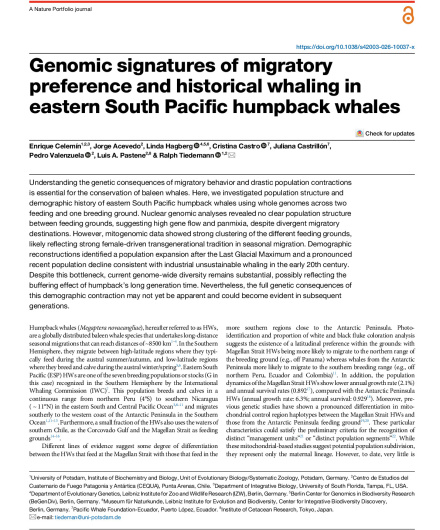
Genomic signatures of migratory preference and historical whaling in eastern South Pacific humpback whales

Monitoreo de especies
Metodologías de monitoreo
Año de la publicación:
2026
Autor:
Enrique Celemín
Jorge Acevedo
Linda Hagberg
Cristina Castro
Juliana Castrillón
Pedro Valenzuela
Luis A. Pastene
Ralph Tiedemann
Lugar de incidencia:
Regional
Región oceánica:
Cosmopolita
Understanding the genetic consequences of migratory behavior and drastic population contractions is essential for the conservation of baleen whales. Here, we investigated population structure and demographic history of eastern South Pacific humpback whales using whole genomes across two feeding and one breeding ground. Nuclear genomic analyses revealed no clear population structure between feeding grounds, suggesting high gene flow and panmixia, despite divergent migratory destinations. However, mitogenomic data showed strong clustering of the different feeding grounds, likely reflecting strong female-driven transgenerational tradition in seasonal migration. Demographic reconstructions identified a population expansion after the Last Glacial Maximum and a pronounced recent population decline consistent with industrial unsustainable whaling in the early 20th century. Despite this bottleneck, current genome-wide diversity remains substantial, possibly reflecting the buffering effect of humpback’s long generation time. Nevertheless, the full genetic consequences of this demographic contraction may not yet be apparent and could become evident in subsequent generations.
Etiquetas:
© The Author(s) 2026
La estructura de clasificación de la lista de especies Blue Five para la biblioteca digital ha sido
elaborada siguiendo criterios tanto científicos como de accesibilidad para facilitar la búsqueda de
información. En primer lugar, se organizaron las especies basándose en la taxonomía aceptada por la
comunidad científica para garantizar precisión y coherencia. Simultáneamente, se han implementado
categorías y subcategorías, considerando características morfológicas, su distribución y el uso de los
nombres comunes, con el fin de optimizar la navegación y búsqueda de datos por parte de los usuarios.
Esta metodología equilibrada asegura que la lista no solo sea científicamente rigurosa, sino también
fácil de consultar para quienes necesiten acceder a información específica de manera eficiente.
ISBN/ISSN/DOI:
Open Access This article is licensed under a Creative Commons Attribution 4.0 International License, which permits use, sharing, adaptation, distribu
Editor:
Communications Biology
Idioma:
Inglés
Fuente:
Nature Portfolio journal
Especies mencionadas:
- Categoría Blue Five: Ballenas
- Familia: Rocuales
- Especies: Ballena jorobada (Megaptera novaeangliae)
Documentos relacionados:
Monitoreo de especies
Status, trends and conservation of global sea turtle populations
Sea turtles experienced myriad human impacts during the twentieth century that caused extreme mortality across all seven species. Extensive conservation...
Monitoreo de especies
First confirmed record of the rough-toothed dolphin in ecuadorian mainland...
We report the first confirmed occurrence of the rough-toothed dolphin (Steno bredanensis) in mainland waters of Ecuador. The...
Monitoreo de especies
Vessel strikes of large whales in the Eastern Tropical Pacific...
Vessel strike is recognized as a major modern threat to the recovery of large whale populations globally, but the issue...