
Al descargar el documento usted acepta los términos establecidos en el copyright del documento y la política de uso de la plataforma.
Biblioteca
The global network of ports supporting high seas fishing

Gestión de áreas marinas
Vigilancia y control
Año de la publicación:
2021
Autor:
Jorge P. Rodríguez
Juan Fernández Gracia
Carlos M. Duarte
Xabier Irigoien
Víctor M. Eguíluz
Lugar de incidencia:
Global
Región oceánica:
Cosmopolita
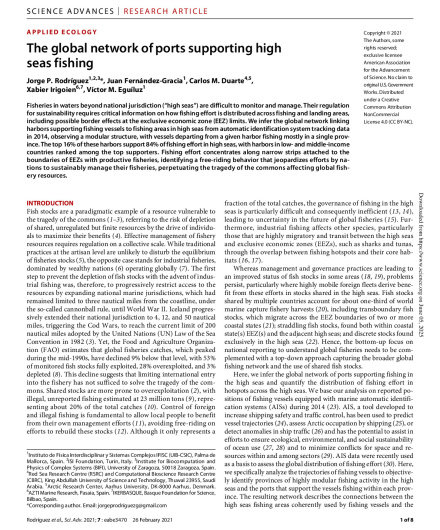
Fisheries in waters beyond national jurisdiction (“high seas”) are difficult to monitor and manage. Their regulation for sustainability requires critical information on how fishing effort is distributed across fishing and landing areas, including possible border effects at the exclusive economic zone (EEZ) limits. We infer the global network linking harbors supporting fishing vessels to fishing areas in high seas from automatic identification system tracking data in 2014, observing a modular structure, with vessels departing from a given harbor fishing mostly in a single province.
The top 16% of these harbors support 84% of fishing effort in high seas, with harbors in low- and middle-income countries ranked among the top supporters. Fishing effort concentrates along narrow strips attached to the boundaries of EEZs with productive fisheries, identifying a free-riding behavior that jeopardizes efforts by nations to sustainably manage their fisheries, perpetuating the tragedy of the commons affecting global fishery resources.
Etiquetas:
Copyright © 2021 The Authors, some rights reserved; exclusive licensee American Association for the Advancement of Science. No claim to original U.S. Government Works. Distributed under a Creative Commons Attribution NonCommercial License 4.0 (CC BY-NC).
La estructura de clasificación de la lista de especies Blue Five para la biblioteca digital ha sido
elaborada siguiendo criterios tanto científicos como de accesibilidad para facilitar la búsqueda de
información. En primer lugar, se organizaron las especies basándose en la taxonomía aceptada por la
comunidad científica para garantizar precisión y coherencia. Simultáneamente, se han implementado
categorías y subcategorías, considerando características morfológicas, su distribución y el uso de los
nombres comunes, con el fin de optimizar la navegación y búsqueda de datos por parte de los usuarios.
Esta metodología equilibrada asegura que la lista no solo sea científicamente rigurosa, sino también
fácil de consultar para quienes necesiten acceder a información específica de manera eficiente.
ISBN/ISSN/DOI:
DOI: 10.1126/sciadv.abe3470
Editor:
Science Advances
Idioma:
Inglés
Fuente:
Science
Especies mencionadas:
- Categoría Blue Five: Tiburones
Documentos relacionados:
Gestión de áreas marinas
Putting sharks on the map: A global standard for improving...
Area-based conservation is essential to safeguard declining biodiversity. Several approaches have been developed for identifying networks of globally important areas...
Gestión de áreas marinas
Climate change impacts on living marine resources in the Eastern...
Simulation results indicated that species' habitat suitability increased or remained the same in the northern and southern margins of the...
Gestión de áreas marinas
Adaptive spatiotemporal management to reduce shark bycatch in tuna fisheries
La pesca con cerco del atún tropical en el Pacífico Tropical Oriental (PTO) resulta en la captura incidental de varios...