
Al descargar el documento usted acepta los términos establecidos en el copyright del documento y la política de uso de la plataforma.
Biblioteca
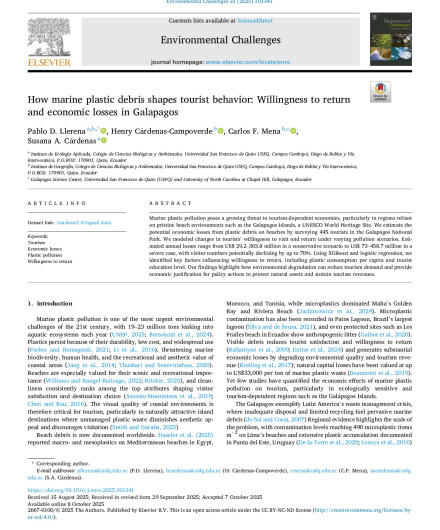
How marine plastic debris shapes tourist behavior: Willingness to return and economic losses in Galapagos

Iniciativas sostenibles
Sectores productivos
Año de la publicación:
2025
Autor:
Pablo D. Llerena
Henry Cárdenas Campoverde
Carlos F. Mena
Susana A. Cárdenas
Lugar de incidencia:
Ecuador
Región oceánica:
Pacífico - Sudeste
Marine plastic pollution poses a growing threat to tourism-dependent economies, particularly in regions reliant on pristine beach environments such as the Galapagos Islands, a UNESCO World Heritage Site. We estimate the potential economic losses from plastic debris on beaches by surveying 445 tourists in the Galapagos National Park. We modeled changes in tourists’ willingness to visit and return under varying pollution scenarios. Estimated annual losses range from US$ 29.2–303.8 million in a conservative scenario to US$ 73–458.7 million in a severe case, with visitor numbers potentially declining by up to 70%. Using XGBoost and logistic regression, we identified key factors influencing willingness to return, including plastic consumption per capita and tourist education level. Our findings highlight how environmental degradation can reduce tourism demand and provide economic justification for policy actions to protect natural assets and sustain tourism revenues.
Etiquetas:
© 2025 The Authors. Published by Elsevier B.V. This is an open access article under the CC BY-NC-ND license
La estructura de clasificación de la lista de especies Blue Five para la biblioteca digital ha sido
elaborada siguiendo criterios tanto científicos como de accesibilidad para facilitar la búsqueda de
información. En primer lugar, se organizaron las especies basándose en la taxonomía aceptada por la
comunidad científica para garantizar precisión y coherencia. Simultáneamente, se han implementado
categorías y subcategorías, considerando características morfológicas, su distribución y el uso de los
nombres comunes, con el fin de optimizar la navegación y búsqueda de datos por parte de los usuarios.
Esta metodología equilibrada asegura que la lista no solo sea científicamente rigurosa, sino también
fácil de consultar para quienes necesiten acceder a información específica de manera eficiente.
ISBN/ISSN/DOI:
https://doi.org/10.1016/j.envc.2025.101341
Editor:
Elsevier/ Enviromental Challengues
Idioma:
Inglés
Fuente:
Science Direct
Documentos relacionados:
Iniciativas sostenibles
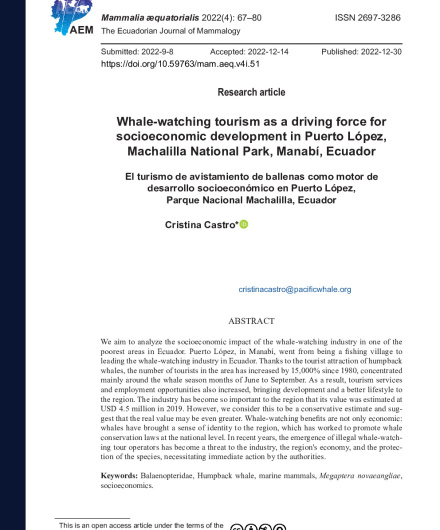
Whale-watching tourism as a driving force for socioeconomic development in...
We aim to analyze the socioeconomic impact of the whale-watching industry in one of the poorest areas in Ecuador. Puerto...
Iniciativas sostenibles
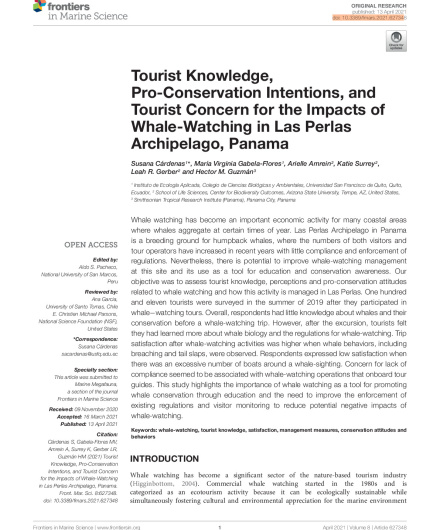
Tourist knowledge, pro-conservation intentions, and tourist concern for the impacts...
Whale watching has become an important economic activity for many coastal areas where whales aggregate at certain times of year...
Iniciativas sostenibles
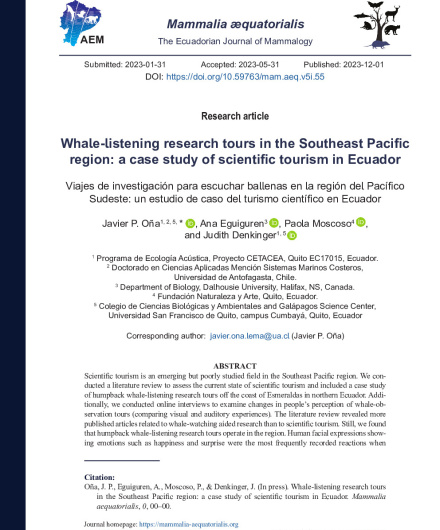
Whale-listening research tours in the Southeast Pacific region: A case...
El turismo científico es un campo emergente pero poco estudiado en la región del Pacífico sudeste. Realizamos una revisión bibliográfica...