
Al descargar el documento usted acepta los términos establecidos en el copyright del documento y la política de uso de la plataforma.
Biblioteca
Imminent risk of extirpation for two bottlenose dolphin communities in the Gulf of Guayaquil, Ecuador

Monitoreo de especies
Metodologías de monitoreo
Año de la publicación:
2020
Autor:
Fernando Félix
Santiago F. Burneo
Lugar de incidencia:
Ecuador
Región oceánica:
Pacífico - Sudeste
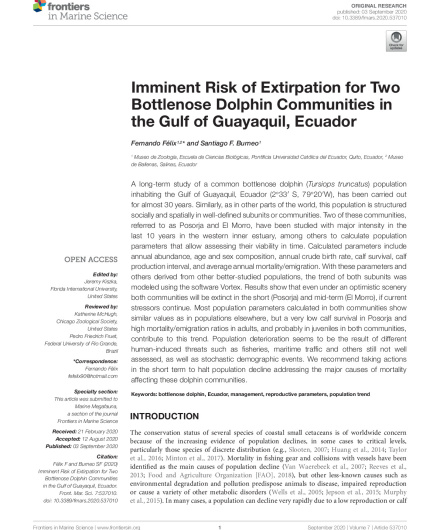
A long-term study of a common bottlenose dolphin (Tursiops truncatus) population inhabiting the Gulf of Guayaquil, Ecuador (2°33′ S, 79°20′W), has been carried out for almost 30 years. Similarly, as in other parts of the world, this population is structured socially and spatially in well-defined subunits or communities. Two of these communities, referred to as Posorja and El Morro, have been studied with major intensity in the last 10 years in the western inner estuary, among others to calculate population parameters that allow assessing their viability in time. Calculated parameters include annual abundance, age and sex composition, annual crude birth rate, calf survival, calf production interval, and average annual mortality/emigration. With these parameters and others derived from other better-studied populations, the trend of both subunits was modeled using the software Vortex. Results show that even under an optimistic scenery both communities will be extinct in the short (Posorja) and mid-term (El Morro), if current stressors continue. Most population parameters calculated in both communities show similar values as in populations elsewhere, but a very low calf survival in Posorja and high mortality/emigration ratios in adults, and probably in juveniles in both communities...
Etiquetas:
© 2020 Félix y Burneo. Este artículo es de acceso abierto y se distribuye bajo los términos de la Licencia Creative Commons Atribución (CC BY) . Se permite su uso, distribución y reproducción en otros foros, siempre que se cite al autor original y al titular de los derechos de autor, y se cite la publicación original en esta revista, de acuerdo con la práctica académica aceptada. No se permite ningún uso, distribución ni reproducción que no cumpla con estos términos.
La estructura de clasificación de la lista de especies Blue Five para la biblioteca digital ha sido
elaborada siguiendo criterios tanto científicos como de accesibilidad para facilitar la búsqueda de
información. En primer lugar, se organizaron las especies basándose en la taxonomía aceptada por la
comunidad científica para garantizar precisión y coherencia. Simultáneamente, se han implementado
categorías y subcategorías, considerando características morfológicas, su distribución y el uso de los
nombres comunes, con el fin de optimizar la navegación y búsqueda de datos por parte de los usuarios.
Esta metodología equilibrada asegura que la lista no solo sea científicamente rigurosa, sino también
fácil de consultar para quienes necesiten acceder a información específica de manera eficiente.
ISBN/ISSN/DOI:
doi: 10.3389/fmars.2020.537010
Editor:
Frontiers in Marine Science
Idioma:
Inglés
Fuente:
This article was submitted to Marine Megafauna, a section of the journal Frontiers in Marine Science
Especies mencionadas:
- Categoría Blue Five: Delfines
- Familia: Delfines
- Especies: Delfín nariz de botella (Tursiops truncatus)
Documentos relacionados:
Monitoreo de especies
Vulnerability of Eastern Tropical Pacific chondrichthyan fish to climate change
El cambio climático es una emergencia medioambiental que amenaza a especies y ecosistemas en todo el mundo. Los océanos han...
Monitoreo de especies
Cranial variation between coastal and offshore bottlenose dolphins, Tursiops truncatus...
Skull shape analysis provides useful information on wildlife ecology and potential local adaptations. Common bottlenose dolphins (Tursiops truncatus)...
Monitoreo de especies
New records of odontocete and mysticete predation by orcas in...
Orcas (Orcinus orca) are the top marine predators of the ocean, targeting multiple taxa including teleost fishes, elasmobranchs...