
Al descargar el documento usted acepta los términos establecidos en el copyright del documento y la política de uso de la plataforma.
Biblioteca
Living in relationship with the ocean to transform governance in the UN Ocean Decade

Normatividad
Políticas públicas
Año de la publicación:
2022
Autor:
Michelle Bender
Rachel Bustamante
Kelsey Leonard
Lugar de incidencia:
Global
Región oceánica:
Cosmopolita
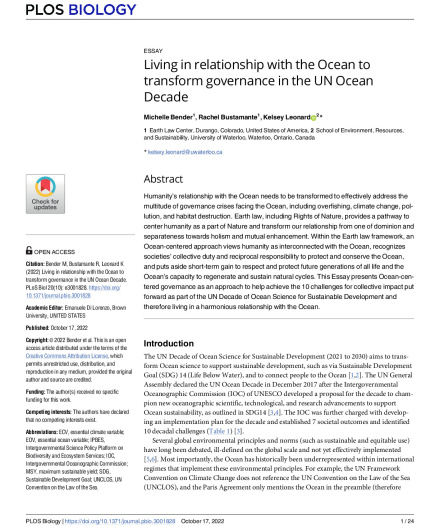
Humanity’s relationship with the Ocean needs to be transformed to effectively address the multitude of governance crises facing the Ocean, including overfishing, climate change, pollution, and habitat destruction. Earth law, including Rights of Nature, provides a pathway to center humanity as a part of Nature and transform our relationship from one of dominion and separateness towards holism and mutual enhancement. Within the Earth law framework, an Ocean-centered approach views humanity as interconnected with the Ocean, recognizes societies’ collective duty and reciprocal responsibility to protect and conserve the Ocean, and puts aside short-term gain to respect and protect future generations of all life and the Ocean’s capacity to regenerate and sustain natural cycles. This Essay presents Ocean-centered governance as an approach to help achieve the 10 challenges for collective impact put forward as part of the UN Decade of Ocean Science for Sustainable Development and therefore living in a harmonious relationship with the Ocean.
Etiquetas:
© 2022 Bender et al. This is an open access article distributed under the terms of the Creative Commons Attribution License, which permits unrestricted use, distribution, and reproduction in any medium, provided the original author and source are credited.
La estructura de clasificación de la lista de especies Blue Five para la biblioteca digital ha sido
elaborada siguiendo criterios tanto científicos como de accesibilidad para facilitar la búsqueda de
información. En primer lugar, se organizaron las especies basándose en la taxonomía aceptada por la
comunidad científica para garantizar precisión y coherencia. Simultáneamente, se han implementado
categorías y subcategorías, considerando características morfológicas, su distribución y el uso de los
nombres comunes, con el fin de optimizar la navegación y búsqueda de datos por parte de los usuarios.
Esta metodología equilibrada asegura que la lista no solo sea científicamente rigurosa, sino también
fácil de consultar para quienes necesiten acceder a información específica de manera eficiente.
ISBN/ISSN/DOI:
https://doi.org/10.1371/journal.pbio.3001828
Editor:
PLoS Biology
Idioma:
Inglés
Fuente:
https://journals.plos.org/
Documentos relacionados:
Normatividad
Contexto y desarrollo del ordenamiento ambiental marino costero en Colombia
En Colombia, con el fin de atender los retos frente la gestión marino costera y respondiendo a compromisos internacionales, se...
Normatividad
Planificación espacial marina en Colombia: Avances y retos de cara...
Los océanos presentan altos niveles de degradación y afectación por las actividades humanas y el calentamiento global, de ahí que...
Normatividad
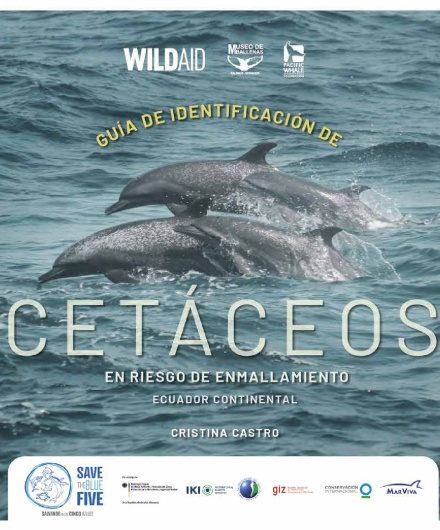
Guía de cetáceos del Ecuador continental: Especies en riesgo de...
Esta guía se presenta como un instrumento técnico de apoyo para la atención de incidentes de megafauna marina enredada en...