
Al descargar el documento usted acepta los términos establecidos en el copyright del documento y la política de uso de la plataforma.
Biblioteca
Overhauling ocean spatial planning to improve marine megafauna conservation

Participación Internacional
Coordinación técnica
Año de la publicación:
2019
Autor:
Ana Micaela Martins Sequeira
Graeme Clive Hays
David W. Sims
Víctor M. Eguíluz
Jorge P. Rodríguez
Michelle R. Heupel
Rob Harcourt
Hannah Calich
Nuno Queiroz
Daniel Paul Costa
Juan Fernández-Gracia
Luciana C. Ferreira
Simon David Goldsworthy
Mark A. Hindell
Mary-Anne Lea
Mark G. Meekan
Anthony M. Pagano
Scott A. Shaffer
Julia Reisser
Michele Thums
Michael Weise
Carlos M. Duarte
Lugar de incidencia:
Global
Región oceánica:
Cosmopolita
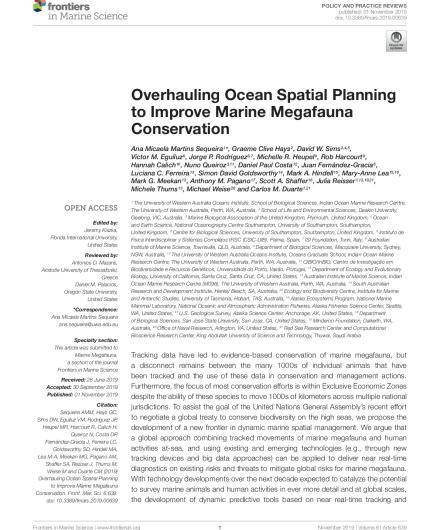
Tracking data have led to evidence-based conservation of marine megafauna, but a disconnect remains between the many 1000s of individual animals that have been tracked and the use of these data in conservation and management actions. Furthermore, the focus of most conservation efforts is within Exclusive Economic Zones despite the ability of these species to move 1000s of kilometers across multiple national jurisdictions. To assist the goal of the United Nations General Assembly’s recent effort to negotiate a global treaty to conserve biodiversity on the high seas, we propose the development of a new frontier in dynamic marine spatial management. We argue that a global approach combining tracked movements of marine megafauna and human activities at-sea, and using existing and emerging technologies (e.g., through new tracking devices and big data approaches) can be applied to deliver near real-time diagnostics on existing risks and threats to mitigate global risks for marine megafauna. With technology developments over the next decade expected to catalyze the potential to survey marine animals and human activities in ever more detail and at global scales, the development of dynamic predictive tools based on near real-time tracking and environmental data will become crucial to...
Etiquetas:
© 2019 Sequeira, Hays, Sims, Eguíluz, Rodríguez, Heupel, Harcourt, Calich, Queiroz, Costa, Fernández-Gracia, Ferreira, Goldsworthy, Hindell, Lea, Meekan, Pagano, Shaffer, Reisser, Thums, Weise y Duarte. Este es un artículo de acceso abierto distribuido bajo los términos de la Licencia Creative Commons Atribución (CC BY). Se permite el uso, distribución o reproducción en otros foros, siempre que se acredite al autor o autores originales y al propietario o propietarios de los derechos de autor y se cite la publicación original en esta revista, de acuerdo con la práctica académica aceptada. No se permite ningún uso, distribución o reproducción que no cumpla con estos términos.
La estructura de clasificación de la lista de especies Blue Five para la biblioteca digital ha sido
elaborada siguiendo criterios tanto científicos como de accesibilidad para facilitar la búsqueda de
información. En primer lugar, se organizaron las especies basándose en la taxonomía aceptada por la
comunidad científica para garantizar precisión y coherencia. Simultáneamente, se han implementado
categorías y subcategorías, considerando características morfológicas, su distribución y el uso de los
nombres comunes, con el fin de optimizar la navegación y búsqueda de datos por parte de los usuarios.
Esta metodología equilibrada asegura que la lista no solo sea científicamente rigurosa, sino también
fácil de consultar para quienes necesiten acceder a información específica de manera eficiente.
ISBN/ISSN/DOI:
doi: 10.3389/fmars.2019.00639
Editor:
Frontiers in Marine Science
Idioma:
Inglés
Fuente:
This article was submitted to Marine Megafauna, a section of the journal Frontiers in Marine Science
Especies mencionadas:
- Categoría Blue Five: Ballenas Tortugas marinas
- Familia: Rocuales Quelónidos Dermoquélidos
- Especies: Ballena azul (Balaenoptera musculus) Tortuga boba (Caretta caretta) Tortuga laúd (Dermochelys coriacea)
Documentos relacionados:

Participación Internacional
Ocean governance in the Southeast Pacific
The Southeast Pacific region is loosely defined here as the Eastern side of the South Pacific ocean adjacent to four...

Participación Internacional
I Encuentro virtual de buenas prácticas para el avistamiento de...
Desde la mesa de trabajo de turismo y con apoyo de la mesa de biodiversidad del Comité Técnico Nacional del...

Participación Internacional
The outlook for oceans, seas and marine resources in Latin...
In preparation for the launch of the United Nations Decade of Oceans Science for Sustainable Development 2021-2030, ECLAC seeks to...