
Al descargar el documento usted acepta los términos establecidos en el copyright del documento y la política de uso de la plataforma.
Biblioteca
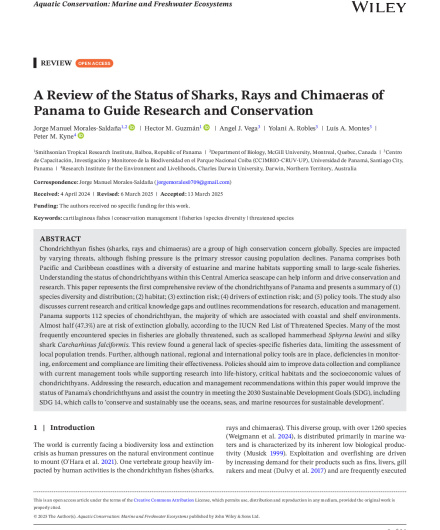
A Review of the status of sharks, rays and chimaeras of Panama to guide research and conservation

Monitoreo de especies
Metodologías de monitoreo
Año de la publicación:
2025
Autor:
Jorge Manuel Morales-Saldaña
Hector M. Guzmán
Angel J. Vega
Yolani A. Robles
Luis A. Montes
Peter M. Kyne
Lugar de incidencia:
Panamá
Región oceánica:
Pacífico - Centro Oriental
Chondrichthyan fishes (sharks, rays and chimaeras) are a group of high conservation concern globally. Species are impacted by varying threats, although fishing pressure is the primary stressor causing population declines. Panama comprises both Pacific and Caribbean coastlines with a diversity of estuarine and marine habitats supporting small to large-scale fisheries. Understanding the status of chondrichthyans within this Central America seascape can help inform and drive conservation and research. This paper represents the first comprehensive review of the chondrichthyans of Panama and presents a summary of (1) species diversity and distribution; (2) habitat; (3) extinction risk; (4) drivers of extinction risk; and (5) policy tools. The study also discusses current research and critical knowledge gaps and outlines recommendations for research, education and management. Panama supports 112 species of chondrichthyan, the majority of which are associated with coastal and shelf environments. Almost half (47.3%) are at risk of extinction globally, according to the IUCN Red List of Threatened Species. Many of the most frequently encountered species in fisheries are globally threatened, such as scalloped hammerhead Sphyrna lewini and silky shark Carcharhinus falciformis. This review...
Etiquetas:
This is an open access article under the terms of the Creative Commons Attribution License, which permits use, distribution and reproduction in any medium, provided the original work isproperly cited.
La estructura de clasificación de la lista de especies Blue Five para la biblioteca digital ha sido
elaborada siguiendo criterios tanto científicos como de accesibilidad para facilitar la búsqueda de
información. En primer lugar, se organizaron las especies basándose en la taxonomía aceptada por la
comunidad científica para garantizar precisión y coherencia. Simultáneamente, se han implementado
categorías y subcategorías, considerando características morfológicas, su distribución y el uso de los
nombres comunes, con el fin de optimizar la navegación y búsqueda de datos por parte de los usuarios.
Esta metodología equilibrada asegura que la lista no solo sea científicamente rigurosa, sino también
fácil de consultar para quienes necesiten acceder a información específica de manera eficiente.
ISBN/ISSN/DOI:
https://doi.org/10.1002/aqc.70122Digital Object Identifier (DOI)
Editor:
Aquatic Conservation: Marine and Freshwater Ecosystems/ Wiley
Fuente:
Wiley
Especies mencionadas:
- Categoría Blue Five: Tiburones Mantarrayas
- Familia: Tiburones zorro Tiburones cazones Tiburones martillo Mantarrayas y móbulas Rayas látigo Rayas redondas Peces guitarras Rayas de nariz dura
- Especies: Zorro pelágico (Alopias pelagicus) Tiburón jaquetón sedoso (Carcharhinus falciformis) Tiburón toro o sarda (Carcharhinus leucas) Tiburón martillo (Sphyrna zygaena) Mantarraya pigmea (Mobula munkiana) Raya látigo redonda (Hypanus dipterurus) Raya látigo (Hypanus longus) Raya-redonda chilena (Urotrygon chilensis) Raya-redonda reticulada (Urotrygon reticulata) Guitarra punteada (Pseudobatos glaucostigmus) Guitarra trompa blanca (Pseudobatos leucorhynchus) Raya bruja de dos manchas (Raja velezi)
Documentos relacionados:
Monitoreo de especies
Humpback whale breeding stock G: updated population estimate based on...
We report a new mark-recapture-based population estimate for the humpback whale Breeding Stock G (BSG), defined by breeding grounds on...
Monitoreo de especies
Migratory destinations and spatial structuring of humpback whales (Megaptera novaeangliae)...
Understanding the migratory patterns of large whales is of conservation importance, especially in identifying threats to specific populations. Migration ecology...
Monitoreo de especies
Evaluating humpback whale (Megaptera novaeangliae) behavioral responses to whale pingers...
This study evaluated the behavioral responses of humpback whales (Megaptera novaeangliae) to whale pingers (3-20 kHz) in northern...