
Al descargar el documento usted acepta los términos establecidos en el copyright del documento y la política de uso de la plataforma.
Biblioteca
Spatial distribution and abundance of baleen and sperm whales in the Peruvian sea: a historical review


Monitoreo de especies
Metodologías de monitoreo
Año de la publicación:
2022
Autor:
Sarai Cortez-Casamayor
Chiara Guidino
Aldo S. Pacheco
Lugar de incidencia:
Perú
Región oceánica:
Pacífico - Sudeste
Historical accounts of large whales in Peruvian waters existed before modern commercial whaling. Research on baleen and sperm (Physeter macrocephalus) whales was intense during whaling, thus producing essential knowledge on these species. The populations of large whales have declined considerably with whaling pressure since 1925 in Peruvian waters. After the whaling moratorium in 1985, research on these species decreased, and a considerable gap in knowledge exists until nowadays. This review aims to conduct a historical analysis of the spatial distribution and abundance of baleen and sperm whales in the waters of Peru. During whaling, sperm whale distribution and abundance received most of the research effort as this species was the most important target of the whaling fleet. Also, blue (Balaenoptera musculus) and Bryde’s whale (B. edeni brydei) were considered abundant in Peru. Changes in their distribution and abundance were evaluated mainly based on captures or climatic events. Following the cessation of whaling, sightings of these species were restricted to occasional surveys, limiting the assessment of possible current changes in their distribution and abundance, as well as the updating of existing information. Humpback whales (Megaptera novaeangliae) were considered...
Etiquetas:
Authors retain copyright and grant the journal right of first publication with the work simultaneously licensed under a Creative Commons Attribution License that allows others to share the work with an acknowledgement of the work's authorship and initial publication in this journal.
La estructura de clasificación de la lista de especies Blue Five para la biblioteca digital ha sido
elaborada siguiendo criterios tanto científicos como de accesibilidad para facilitar la búsqueda de
información. En primer lugar, se organizaron las especies basándose en la taxonomía aceptada por la
comunidad científica para garantizar precisión y coherencia. Simultáneamente, se han implementado
categorías y subcategorías, considerando características morfológicas, su distribución y el uso de los
nombres comunes, con el fin de optimizar la navegación y búsqueda de datos por parte de los usuarios.
Esta metodología equilibrada asegura que la lista no solo sea científicamente rigurosa, sino también
fácil de consultar para quienes necesiten acceder a información específica de manera eficiente.
ISBN/ISSN/DOI:
https://doi.org/10.5597/lajam00285
Editor:
Latin American Journal of Aquatic Mammals
Idioma:
Inglés
Fuente:
Latin American Journal of Aquatic Mammals
Especies mencionadas:
- Categoría Blue Five: Ballenas
- Familia: Ballenas francas Rocuales Cachalotes
- Especies: Ballena franca austral (Eubalaena australis) Ballena azul (Balaenoptera musculus) Ballena de Bryde (Balaenoptera edeni) Ballena jorobada (Megaptera novaeangliae) Cachalote (Physeter macrocephalus)
Documentos relacionados:

Monitoreo de especies
From coastal to offshore: The case of an inshore bottlenose...
The common bottlenose dolphin (Tursiops truncatus) is widely distributed across tropical and temperate waters worldwide (Wells et al...
Monitoreo de especies
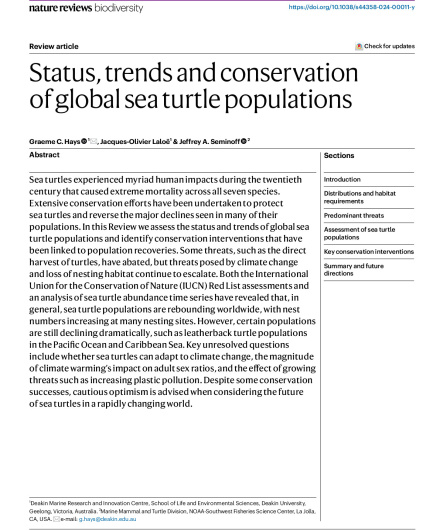
Status, trends and conservation of global sea turtle populations
Sea turtles experienced myriad human impacts during the twentieth century that caused extreme mortality across all seven species. Extensive conservation...

Monitoreo de especies
First confirmed record of the rough-toothed dolphin in ecuadorian mainland...
We report the first confirmed occurrence of the rough-toothed dolphin (Steno bredanensis) in mainland waters of Ecuador. The...