
Al descargar el documento usted acepta los términos establecidos en el copyright del documento y la política de uso de la plataforma.
Biblioteca
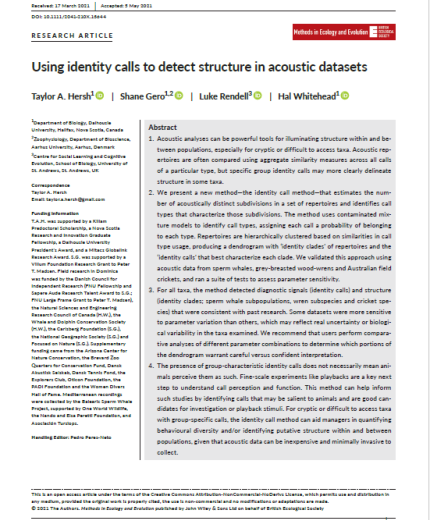
Using identity calls to detect structure in acoustic datasets

Monitoreo de especies
Metodologías de monitoreo
Año de la publicación:
2021
Autor:
Taylor A. Hersh
Shane Gero
Luke Rendell
Hal Whitehead
Lugar de incidencia:
Global
Región oceánica:
Cosmopolita
The natural world is inherently noisy, and animals that communicate acoustically must evolve ways of ensuring signal transmission
fidelity in the face of such noise. Variation in acoustic signals can provide information about the identity of individuals, groups, populations and species, as well as drivers of signal evolution (Wilkins et al., 2013). Biologists who want to understand animal communication systems need robust, efficient ways of classifying and comparing acoustic signals.
Etiquetas:
This is an open access article under the terms of the Creative Commons Attribution-NonCommercial-NoDerivs License, which permits use and distribution in any medium, provided the original work is properly cited, the use is non-commercial and no modifications or adaptations are made.
© 2021 The Authors. Methods in Ecology and Evolution published by John Wiley & Sons Ltd on behalf of British Ecological Society
La estructura de clasificación de la lista de especies Blue Five para la biblioteca digital ha sido
elaborada siguiendo criterios tanto científicos como de accesibilidad para facilitar la búsqueda de
información. En primer lugar, se organizaron las especies basándose en la taxonomía aceptada por la
comunidad científica para garantizar precisión y coherencia. Simultáneamente, se han implementado
categorías y subcategorías, considerando características morfológicas, su distribución y el uso de los
nombres comunes, con el fin de optimizar la navegación y búsqueda de datos por parte de los usuarios.
Esta metodología equilibrada asegura que la lista no solo sea científicamente rigurosa, sino también
fácil de consultar para quienes necesiten acceder a información específica de manera eficiente.
Editor:
Methods in Ecology and Evolution
Idioma:
Inglés
Fuente:
St Andrews Research Repository
Especies mencionadas:
- Categoría Blue Five: Ballenas
- Familia: Cachalotes
- Especies: Cachalote (Physeter macrocephalus)
Documentos relacionados:

Monitoreo de especies
From coastal to offshore: The case of an inshore bottlenose...
The common bottlenose dolphin (Tursiops truncatus) is widely distributed across tropical and temperate waters worldwide (Wells et al...
Monitoreo de especies
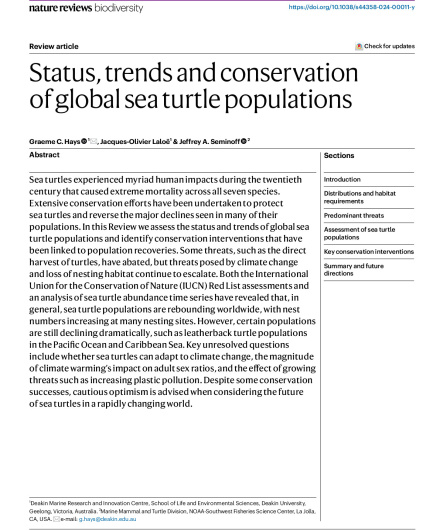
Status, trends and conservation of global sea turtle populations
Sea turtles experienced myriad human impacts during the twentieth century that caused extreme mortality across all seven species. Extensive conservation...

Monitoreo de especies
First confirmed record of the rough-toothed dolphin in ecuadorian mainland...
We report the first confirmed occurrence of the rough-toothed dolphin (Steno bredanensis) in mainland waters of Ecuador. The...