
Al descargar el documento usted acepta los términos establecidos en el copyright del documento y la política de uso de la plataforma.
Biblioteca
Context-dependent variability in blue whale acoustic behaviour


Monitoreo de especies
Metodologías de monitoreo
Año de la publicación:
2018
Autor:
Leah A. Lewis
John Calambokidis
Alison K. Stimpert
James Fahlbusch
Ari S. Friedlaender
Megan F. McKenna
Sarah L. Mesnick
Erin M. Oleson
Brandon L. Southall
Angela R Szesciorka
Ana Širović
Lugar de incidencia:
Estados Unidos
Región oceánica:
Pacífico - Noreste
Acoustic communication is an important aspect of reproductive, foraging and social behaviours for many marine species. Northeast Pacific blue whales (Balaenoptera musculus) produce three different call types—A, B and D calls. All may be produced as singular calls, but A and B calls also occur in phrases to form songs. To evaluate the behavioural context of singular call and phrase production in blue whales, the acoustic and dive profile data from tags deployed on individuals off southern California were assessed using generalized estimating equations. Only 22% of all deployments contained sounds attributed to the tagged animal. A larger proportion of tagged animals were female (47%) than male (13%), with 40% of unknown sex. Fifty per cent of tags deployed on males contained sounds attributed to the tagged whale, while only a few (5%) deployed on females did. Most calls were produced at shallow depths (less than 30 m). Repetitive phrasing (singing) and production of singular calls were most common during shallow, non-lunging dives, with the latter also common during surface behaviour. Higher sound production rates occurred during autumn than summer and they varied with time-of-day: singular call rates were higher at dawn and dusk, while phrase production rates were highest at dusk...
Etiquetas:
© 2018 The Authors.
Published by the Royal Society under the terms of the Creative Commons Attribution License http://creativecommons.org/licenses/by/4.0/, which permits unrestricted use, provided the original author and source are credited.
La estructura de clasificación de la lista de especies Blue Five para la biblioteca digital ha sido
elaborada siguiendo criterios tanto científicos como de accesibilidad para facilitar la búsqueda de
información. En primer lugar, se organizaron las especies basándose en la taxonomía aceptada por la
comunidad científica para garantizar precisión y coherencia. Simultáneamente, se han implementado
categorías y subcategorías, considerando características morfológicas, su distribución y el uso de los
nombres comunes, con el fin de optimizar la navegación y búsqueda de datos por parte de los usuarios.
Esta metodología equilibrada asegura que la lista no solo sea científicamente rigurosa, sino también
fácil de consultar para quienes necesiten acceder a información específica de manera eficiente.
ISBN/ISSN/DOI:
https://doi.org/10.1098/rsos.180241
Editor:
Royal Society
Idioma:
Inglés
Fuente:
Royal Society Open Science
Especies mencionadas:
- Categoría Blue Five: Ballenas
- Familia: Rocuales
- Especies: Ballena azul (Balaenoptera musculus) Ballena jorobada (Megaptera novaeangliae)
Documentos relacionados:
Monitoreo de especies
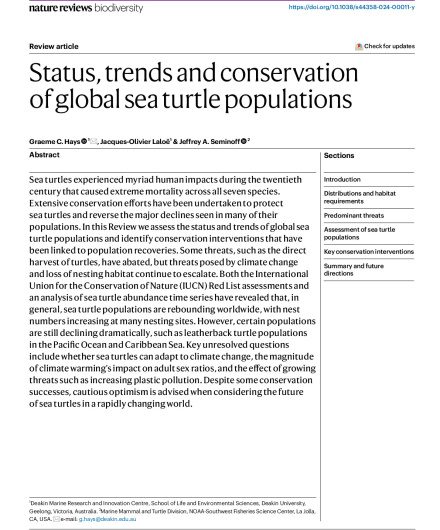
Status, trends and conservation of global sea turtle populations
Sea turtles experienced myriad human impacts during the twentieth century that caused extreme mortality across all seven species. Extensive conservation...
Monitoreo de especies
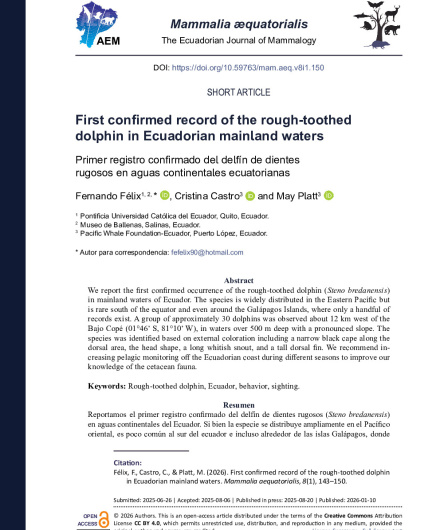
First confirmed record of the rough-toothed dolphin in ecuadorian mainland...
We report the first confirmed occurrence of the rough-toothed dolphin (Steno bredanensis) in mainland waters of Ecuador. The...
Monitoreo de especies
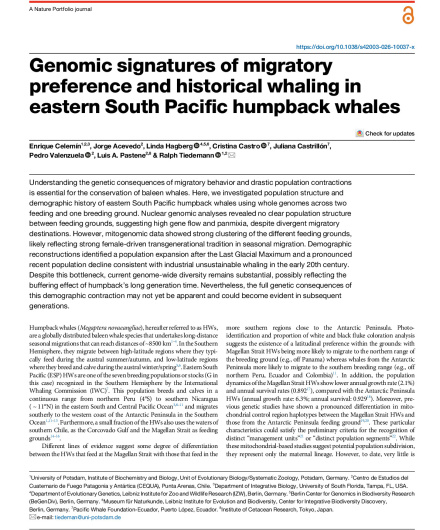
Genomic signatures of migratory preference and historical whaling in eastern...
Understanding the genetic consequences of migratory behavior and drastic population contractions is essential for the conservation of baleen whales. Here...