
Al descargar el documento usted acepta los términos establecidos en el copyright del documento y la política de uso de la plataforma.
Biblioteca
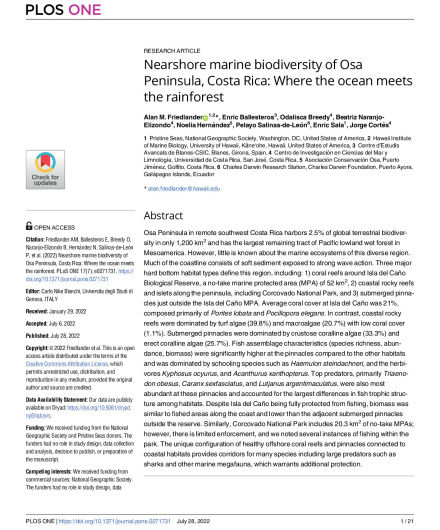
Nearshore marine biodiversity of Osa Peninsula, Costa Rica: Where the ocean meets the rainforest

Gestión de áreas marinas
Áreas Marinas Protegidas (AMP)
Año de la publicación:
2022
Autor:
Alan M. Friedlander
Enric Ballesteros
Odalisca Breedy
Beatriz Naranjo-Elizondo
Noelia Hernández
Pelayo Salinas de León
Enric Sala
Jorge Cortés
Lugar de incidencia:
Costa Rica
Región oceánica:
Pacífico - Centro Oriental
Osa Peninsula in remote southwest Costa Rica harbors 2.5% of global terrestrial biodiversity in only 1,200 km2 and has the largest remaining tract of Pacific lowland wet forest in Mesoamerica. However, little is known about the marine ecosystems of this diverse region. Much of the coastline consists of soft sediment exposed to strong wave action. Three major hard bottom habitat types define this region, including: 1) coral reefs around Isla del Caño Biological Reserve, a no-take marine protected area (MPA) of 52 km2 , 2) coastal rocky reefs and islets along the peninsula, including Corcovado National Park, and 3) submerged pinnacles just outside the Isla del Caño MPA. Average coral cover at Isla del Caño was 21%, composed primarily of Porites lobata and Pocillopora elegans. In contrast, coastal rocky reefs were dominated by turf algae (39.8%) and macroalgae (20.7%) with low coral cover (1.1%). Submerged pinnacles were dominated by crustose coralline algae (33.3%) and erect coralline algae (25.7%). Fish assemblage characteristics (species richness, abundance, biomass) were significantly higher at the pinnacles compared to the other habitats and was dominated by schooling species such as Haemulon steindachneri, and the herbivores Kyphosus ocyurus, and Acanthurus xanthopterus. Top...
Etiquetas:
© 2022 Friedlander et al. This is an open access article distributed under the terms of the Creative Commons Attribution License, which permits unrestricted use, distribution, and reproduction in any medium, provided the original author and source are credited
La estructura de clasificación de la lista de especies Blue Five para la biblioteca digital ha sido
elaborada siguiendo criterios tanto científicos como de accesibilidad para facilitar la búsqueda de
información. En primer lugar, se organizaron las especies basándose en la taxonomía aceptada por la
comunidad científica para garantizar precisión y coherencia. Simultáneamente, se han implementado
categorías y subcategorías, considerando características morfológicas, su distribución y el uso de los
nombres comunes, con el fin de optimizar la navegación y búsqueda de datos por parte de los usuarios.
Esta metodología equilibrada asegura que la lista no solo sea científicamente rigurosa, sino también
fácil de consultar para quienes necesiten acceder a información específica de manera eficiente.
ISBN/ISSN/DOI:
https://doi.org/10.1371/journal.pone.0271731
Editor:
PLoS ONE
Idioma:
Inglés
Fuente:
https://journals.plos.org/
Especies mencionadas:
- Categoría Blue Five: Ballenas Tiburones Tortugas marinas
- Familia: Rocuales Quelónidos Dermoquélidos
- Especies: Ballena jorobada (Megaptera novaeangliae) Tortuga verde (Chelonia mydas) Tortuga olivácea (Lepidochelys olivacea) Tortuga laúd (Dermochelys coriacea)
Documentos relacionados:
Gestión de áreas marinas
Opportunities and challenges for improving fisheries management through greater transparency...
When fisheries managers cannot see who is fishing or where fishing occurs, their scope for management interventions is limited. This...
Gestión de áreas marinas
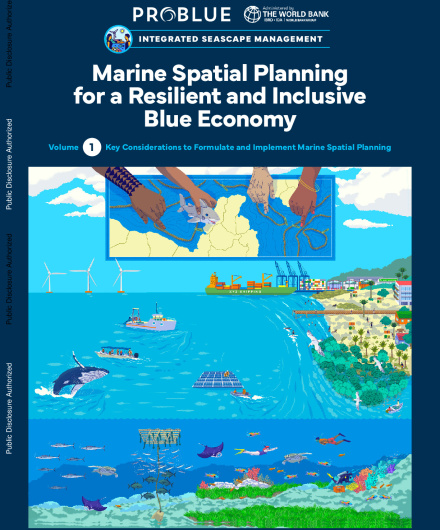
Marine spatial planning for a resilient and inclusive blue economy...
The World Bank defines the Blue Economy as the sustainable and integrated development of economic sectors in healthy oceans. It...
Gestión de áreas marinas
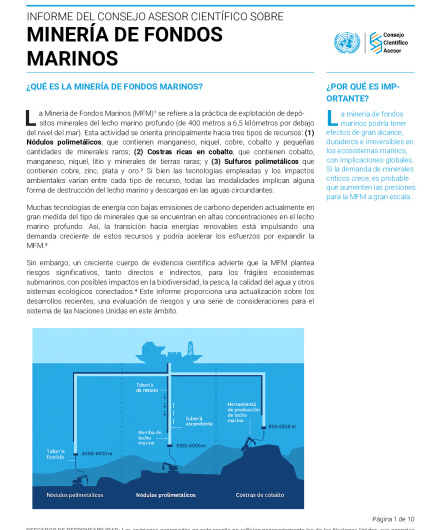
Informe del consejo asesor científico sobre minería de fondos marinos
Un creciente cuerpo de evidencia científica advierte que la MFM plantea riesgos significativos, tanto directos e indirectos, para los frágiles...