
Al descargar el documento usted acepta los términos establecidos en el copyright del documento y la política de uso de la plataforma.
Biblioteca
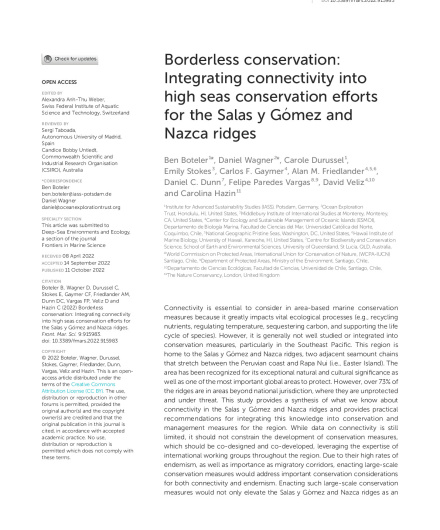
Borderless conservation: Integrating connectivity into high seas conservation efforts for the Salas y Gómez and Nazca ridges

Gestión de áreas marinas
Áreas Marinas Protegidas (AMP)
Año de la publicación:
2022
Autor:
Ben Boteler
Daniel Wagner
Carole Durussel
Emily Stokes
Carlos F. Gaymer
Alan M. Friedlander
Daniel C. Dunn
Felipe Paredes Vargas
David Veliz
Carolina Hazin
Lugar de incidencia:
Chile
Perú
Región oceánica:
Pacífico - Sudeste
Connectivity is essential to consider in area-based marine conservation measures because it greatly impacts vital ecological processes (e.g., recycling nutrients, regulating temperature, sequestering carbon, and supporting the life cycle of species). However, it is generally not well studied or integrated into conservation measures, particularly in the Southeast Pacific. This region is home to the Salas y Gómez and Nazca ridges, two adjacent seamount chains that stretch between the Peruvian coast and Rapa Nui (i.e., Easter Island). The area has been recognized for its exceptional natural and cultural significance as well as one of the most important global areas to protect. However, over 73% of the ridges are in areas beyond national jurisdiction, where they are unprotected and under threat. This study provides a synthesis of what we know about connectivity in the Salas y Gómez and Nazca ridges and provides practical recommendations for integrating this knowledge into conservation and management measures for the region. While data on connectivity is still limited, it should not constrain the development of conservation measures, which should be co-designed and co-developed, leveraging the expertise of international working groups throughout the region. Due to their high rates of...
Etiquetas:
© 2022 Boteler, Wagner, Durussel, Stokes, Gaymer, Friedlander, Dunn, Vargas, Veliz and Hazin. This is an openaccess article distributed under the terms of the Creative Commons Attribution License (CC BY). The use, distribution or reproduction in other forums is permitted, provided the original author(s) and the copyright owner(s) are credited and that the original publication in this journal is cited, in accordance with accepted academic practice. No use, distribution or reproduction is permitted which does not comply with these terms.
La estructura de clasificación de la lista de especies Blue Five para la biblioteca digital ha sido
elaborada siguiendo criterios tanto científicos como de accesibilidad para facilitar la búsqueda de
información. En primer lugar, se organizaron las especies basándose en la taxonomía aceptada por la
comunidad científica para garantizar precisión y coherencia. Simultáneamente, se han implementado
categorías y subcategorías, considerando características morfológicas, su distribución y el uso de los
nombres comunes, con el fin de optimizar la navegación y búsqueda de datos por parte de los usuarios.
Esta metodología equilibrada asegura que la lista no solo sea científicamente rigurosa, sino también
fácil de consultar para quienes necesiten acceder a información específica de manera eficiente.
ISBN/ISSN/DOI:
DOI 10.3389/fmars.2022.915983
Editor:
Frontiers in Marine Science
Idioma:
Inglés
Fuente:
This article was submitted to Deep-Sea Environments and Ecology, a section of the journal Frontiers in Marine Science
Especies mencionadas:
- Categoría Blue Five: Ballenas Delfines Tortugas marinas
- Familia: Rocuales Cachalotes Zifios Delfines Quelónidos Dermoquélidos
- Especies: Ballena azul (Balaenoptera musculus) Ballena minke antártica (Balaenoptera bonaerensis) Ballena jorobada (Megaptera novaeangliae) Cachalote (Physeter macrocephalus) Zifio de Blainville (Mesoplodon densirostris) Zifio de Cuvier (Ziphius cavirostris) Delfín común (Delphinus sp.) Delfín nariz de botella (Tursiops truncatus) Ballena piloto de aleta corta (Globicephala macrorhynchus) Falsa orca (Pseudorca crassidens) Tortuga verde (Chelonia mydas) Tortuga laúd (Dermochelys coriacea)
Documentos relacionados:
Gestión de áreas marinas
Putting sharks on the map: A global standard for improving...
Area-based conservation is essential to safeguard declining biodiversity. Several approaches have been developed for identifying networks of globally important areas...
Gestión de áreas marinas
Climate change impacts on living marine resources in the Eastern...
Simulation results indicated that species' habitat suitability increased or remained the same in the northern and southern margins of the...
Gestión de áreas marinas
Adaptive spatiotemporal management to reduce shark bycatch in tuna fisheries
La pesca con cerco del atún tropical en el Pacífico Tropical Oriental (PTO) resulta en la captura incidental de varios...