
Al descargar el documento usted acepta los términos establecidos en el copyright del documento y la política de uso de la plataforma.
Biblioteca
Global hotspots of shark interactions with industrial longline fisheries

Gestión de áreas marinas
Vigilancia y control
Año de la publicación:
2023
Autor:
Echelle S. Burns
Darcy Bradley
Lennon R. Thomas
Lugar de incidencia:
Global
Región oceánica:
Cosmopolita
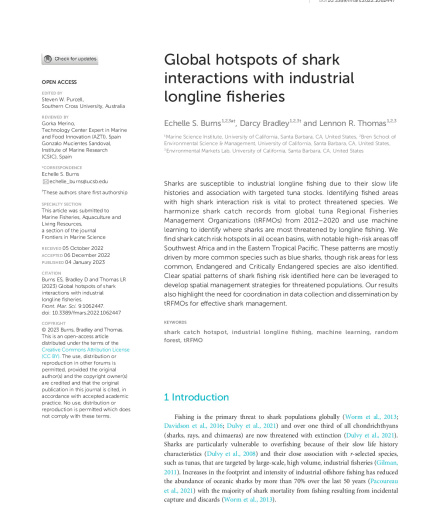
Sharks are susceptible to industrial longline fishing due to their slow life histories and association with targeted tuna stocks. Identifying fished areas with high shark interaction risk is vital to protect threatened species. We harmonize shark catch records from global tuna Regional Fisheries Management Organizations (tRFMOs) from 2012–2020 and use machine learning to identify where sharks are most threatened by longline fishing. We find shark catch risk hotspots in all ocean basins, with notable high-risk areas off Southwest Africa and in the Eastern Tropical Pacific. These patterns are mostly
driven by more common species such as blue sharks, though risk areas for less common, Endangered and Critically Endangered species are also identified.
Clear spatial patterns of shark fishing risk identified here can be leveraged to develop spatial management strategies for threatened populations. Our results also highlight the need for coordination in data collection and dissemination by tRFMOs for effective shark management.
Etiquetas:
© 2023 Burns, Bradley and Thomas. This is an open-access article distributed under the terms of the Creative Commons Attribution License (CC BY).
La estructura de clasificación de la lista de especies Blue Five para la biblioteca digital ha sido
elaborada siguiendo criterios tanto científicos como de accesibilidad para facilitar la búsqueda de
información. En primer lugar, se organizaron las especies basándose en la taxonomía aceptada por la
comunidad científica para garantizar precisión y coherencia. Simultáneamente, se han implementado
categorías y subcategorías, considerando características morfológicas, su distribución y el uso de los
nombres comunes, con el fin de optimizar la navegación y búsqueda de datos por parte de los usuarios.
Esta metodología equilibrada asegura que la lista no solo sea científicamente rigurosa, sino también
fácil de consultar para quienes necesiten acceder a información específica de manera eficiente.
ISBN/ISSN/DOI:
DOI 10.3389/fmars.2022.1062447
Editor:
Frontiers in Marine Science
Idioma:
Inglés
Fuente:
This article was submitted to Marine Fisheries, Aquaculture and Living Resources, a section of the journal Frontiers in Marine Science
Especies mencionadas:
- Categoría Blue Five: Tiburones
- Familia: Tiburones majarros Tiburones cazones
- Especies: Tiburón mako (Isurus oxyrinchus) Tiburón azul (Prionace glauca)
Documentos relacionados:
Gestión de áreas marinas
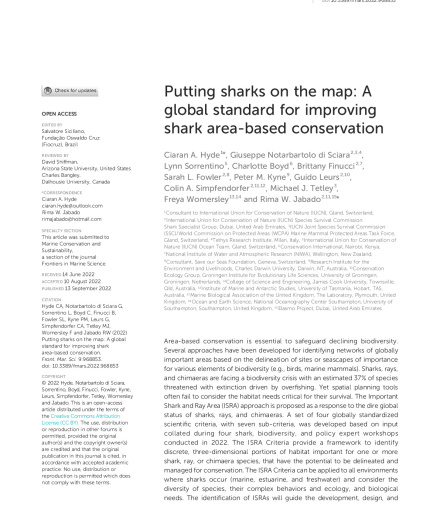
Putting sharks on the map: A global standard for improving...
Area-based conservation is essential to safeguard declining biodiversity. Several approaches have been developed for identifying networks of globally important areas...
Gestión de áreas marinas
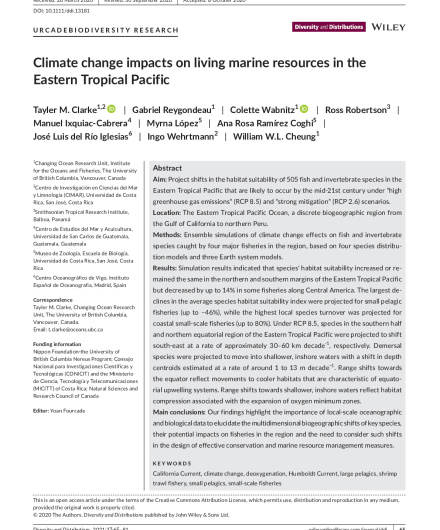
Climate change impacts on living marine resources in the Eastern...
Simulation results indicated that species' habitat suitability increased or remained the same in the northern and southern margins of the...
Gestión de áreas marinas
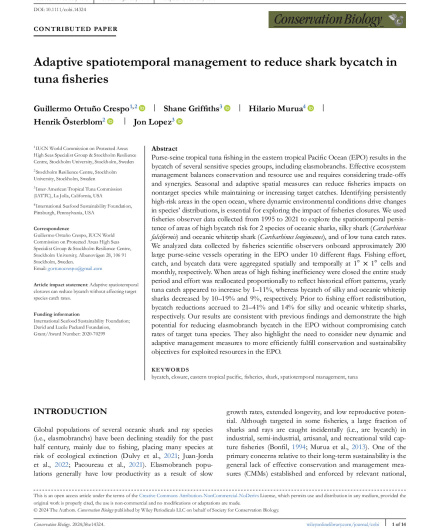
Adaptive spatiotemporal management to reduce shark bycatch in tuna fisheries
La pesca con cerco del atún tropical en el Pacífico Tropical Oriental (PTO) resulta en la captura incidental de varios...