
Al descargar el documento usted acepta los términos establecidos en el copyright del documento y la política de uso de la plataforma.
Biblioteca
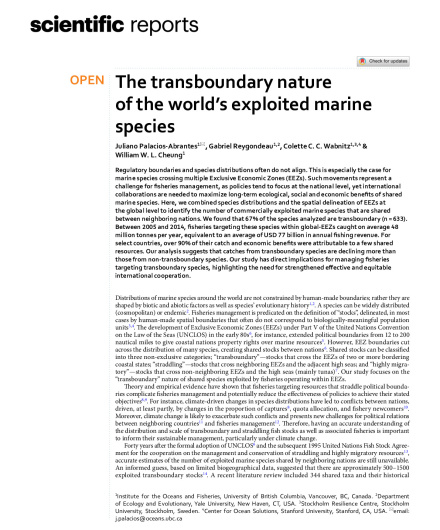
The transboundary nature of the world’s exploited marine species

Participación Internacional
Cooperación internacional
Año de la publicación:
2020
Autor:
Juliano Palacios Abrantes
Gabriel Reygondeau
Colette C. C. Wabnitz
William W. L. Cheung
Lugar de incidencia:
Global
Región oceánica:
Cosmopolita
Regulatory boundaries and species distributions often do not align. This is especially the case for marine species crossing multiple Exclusive Economic Zones (EEZs). Such movements represent a challenge for fisheries management, as policies tend to focus at the national level, yet international collaborations are needed to maximize long-term ecological, social and economic benefits of shared marine species. Here, we combined species distributions and the spatial delineation of EEZs at the global level to identify the number of commercially exploited marine species that are shared between neighboring nations. We found that 67% of the species analyzed are transboundary (n = 633). Between 2005 and 2014, fisheries targeting these species within global-EEZs caught on average 48 million tonnes per year, equivalent to an average of USD 77 billion in annual fishing revenue. For select countries, over 90% of their catch and economic benefits were attributable to a few shared resources. Our analysis suggests that catches from transboundary species are declining more than those from non-transboundary species. Our study has direct implications for managing fisheries targeting transboundary species, highlighting the need for strengthened effective and equitable international cooperation.
Etiquetas:
This article is licensed under a Creative Commons Attribution 4.0 International License, which permits use, sharing, adaptation, distribution and reproduction in any medium or format, as long as you give appropriate credit to the original author(s) and the source, provide a link to the Creative Commons licence, and indicate if changes were made.
La estructura de clasificación de la lista de especies Blue Five para la biblioteca digital ha sido
elaborada siguiendo criterios tanto científicos como de accesibilidad para facilitar la búsqueda de
información. En primer lugar, se organizaron las especies basándose en la taxonomía aceptada por la
comunidad científica para garantizar precisión y coherencia. Simultáneamente, se han implementado
categorías y subcategorías, considerando características morfológicas, su distribución y el uso de los
nombres comunes, con el fin de optimizar la navegación y búsqueda de datos por parte de los usuarios.
Esta metodología equilibrada asegura que la lista no solo sea científicamente rigurosa, sino también
fácil de consultar para quienes necesiten acceder a información específica de manera eficiente.
ISBN/ISSN/DOI:
https://doi.org/10.1038/s41598-020-74644-2
Editor:
Scientific Reports
Idioma:
Inglés
Fuente:
Nature Research
Especies mencionadas:
- Categoría Blue Five: Tiburones
- Familia: Tiburones martillo
- Especies: Tiburón martillo (Sphyrna zygaena)
Documentos relacionados:
Participación Internacional
Overhauling ocean spatial planning to improve marine megafauna conservation
Tracking data have led to evidence-based conservation of marine megafauna, but a disconnect remains between the many 1000s of individual...
Participación Internacional
The likely impact of the BBNJ Agreement on the architecture...
In June 2023, governments agreed to a new treaty on the conservation and sustainable use of marine biological diversity in...
Participación Internacional
A tiered approach to the marine genetic resource governance framework...
Developing a governance framework for Marine Genetic Resources (MGRs) is a crucial element of the proposed treaty on the conservation...