
Al descargar el documento usted acepta los términos establecidos en el copyright del documento y la política de uso de la plataforma.
Biblioteca
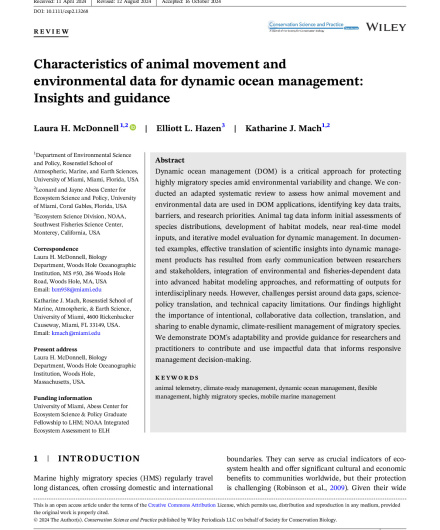
Characteristics of animal movement and environmental data for dynamic ocean management: Insights and guidance

Gestión de áreas marinas
Gobernanza regional
Año de la publicación:
2024
Autor:
Laura H. McDonnell
Elliott L. Hazen
Katharine J. Mach
Lugar de incidencia:
Global
Región oceánica:
Cosmopolita
Dynamic ocean management (DOM) is a critical approach for protecting highly migratory species amid environmental variability and change. We conducted an adapted systematic review to assess how animal movement and environmental data are used in DOM applications, identifying key data traits, barriers, and research priorities. Animal tag data inform initial assessments of species distributions, development of habitat models, near real-time model inputs, and iterative model evaluation for dynamic management. In documented examples, effective translation of scientific insights into dynamic management products has resulted from early communication between researchers and stakeholders, integration of environmental and fisheries-dependent data into advanced habitat modeling approaches, and reformatting of outputs for interdisciplinary needs. However, challenges persist around data gaps, science-policy translation, and technical capacity limitations. Our findings highlight the importance of intentional, collaborative data collection, translation, and sharing to enable dynamic, climate-resilient management of migratory species. We demonstrate DOM's adaptability and provide guidance for researchers and practitioners to contribute and use impactful data that informs responsive management...
Etiquetas:
This is an open access article under the terms of the Creative Commons Attribution License, which permits use, distribution and reproduction in any medium, providedthe original work is properly cited.
La estructura de clasificación de la lista de especies Blue Five para la biblioteca digital ha sido
elaborada siguiendo criterios tanto científicos como de accesibilidad para facilitar la búsqueda de
información. En primer lugar, se organizaron las especies basándose en la taxonomía aceptada por la
comunidad científica para garantizar precisión y coherencia. Simultáneamente, se han implementado
categorías y subcategorías, considerando características morfológicas, su distribución y el uso de los
nombres comunes, con el fin de optimizar la navegación y búsqueda de datos por parte de los usuarios.
Esta metodología equilibrada asegura que la lista no solo sea científicamente rigurosa, sino también
fácil de consultar para quienes necesiten acceder a información específica de manera eficiente.
ISBN/ISSN/DOI:
https://doi.org/10.1111/csp2.13268
Editor:
Conservation Science and Practice/Wiley
Idioma:
Inglés
Fuente:
Wiley
Documentos relacionados:
Gestión de áreas marinas
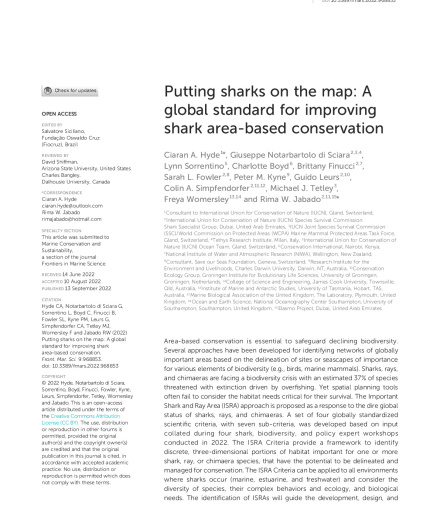
Putting sharks on the map: A global standard for improving...
Area-based conservation is essential to safeguard declining biodiversity. Several approaches have been developed for identifying networks of globally important areas...
Gestión de áreas marinas
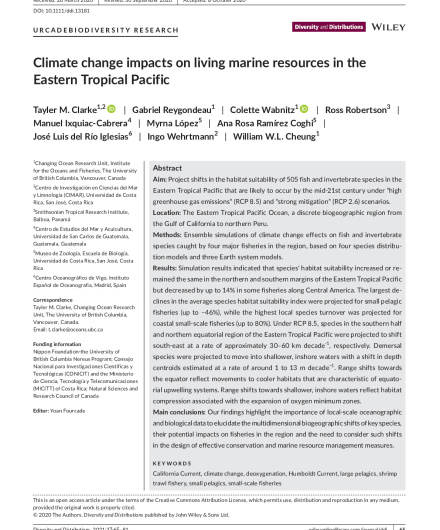
Climate change impacts on living marine resources in the Eastern...
Simulation results indicated that species' habitat suitability increased or remained the same in the northern and southern margins of the...
Gestión de áreas marinas
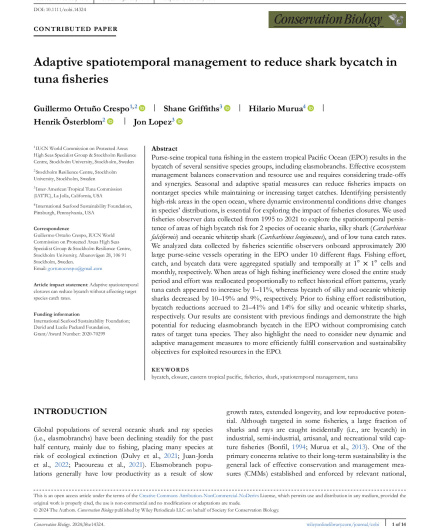
Adaptive spatiotemporal management to reduce shark bycatch in tuna fisheries
La pesca con cerco del atún tropical en el Pacífico Tropical Oriental (PTO) resulta en la captura incidental de varios...