
Al descargar el documento usted acepta los términos establecidos en el copyright del documento y la política de uso de la plataforma.
Biblioteca
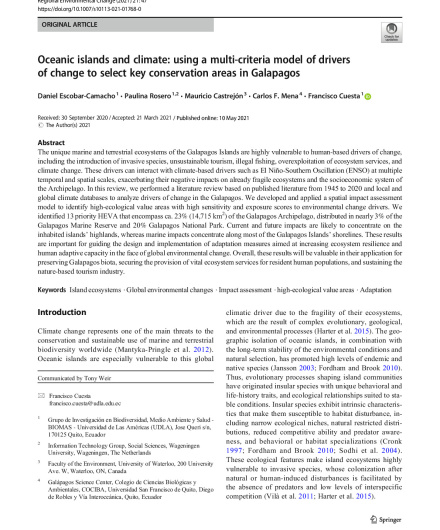
Oceanic islands and climate: using a multi-criteria model of drivers of change to select key conservation areas in Galapagos

Gestión de áreas marinas
Áreas Marinas Protegidas (AMP)
Año de la publicación:
2021
Autor:
Daniel Escobar Camacho
Paulina Rosero
Mauricio Castrejón
Carlos F. Mena
Francisco Cuesta
Lugar de incidencia:
Ecuador
Región oceánica:
Pacífico - Sudeste
The unique marine and terrestrial ecosystems of the Galapagos Islands are highly vulnerable to human-based drivers of change, including the introduction of invasive species, unsustainable tourism, illegal fishing, overexploitation of ecosystem services, and climate change. These drivers can interact with climate-based drivers such as El Niño-Southern Oscillation (ENSO) at multiple temporal and spatial scales, exacerbating their negative impacts on already fragile ecosystems and the socioeconomic system of the Archipelago. In this review, we performed a literature review based on published literature from 1945 to 2020 and local and global climate databases to analyze drivers of change in the Galapagos. We developed and applied a spatial impact assessment model to identify high-ecological value areas with high sensitivity and exposure scores to environmental change drivers. We identified 13 priority HEVA that encompass ca. 23% (14,715 km2) of the Galapagos Archipelago, distributed in nearly 3% of the Galapagos Marine Reserve and 20% Galapagos National Park. Current and future impacts are likely to concentrate on the inhabited islands’ highlands, whereas marine impacts concentrate along most of the Galapagos Islands’ shorelines. These results are important for guiding the design and...
Etiquetas:
This article is licensed under a Creative Commons Attribution 4.0 International License, which permits use, sharing, adaptation, distribution and reproduction in any medium or format, as long as you give appropriate credit to the original author(s) and the source, providea link to the Creative Commons licence, and indicate if changes were made.
La estructura de clasificación de la lista de especies Blue Five para la biblioteca digital ha sido
elaborada siguiendo criterios tanto científicos como de accesibilidad para facilitar la búsqueda de
información. En primer lugar, se organizaron las especies basándose en la taxonomía aceptada por la
comunidad científica para garantizar precisión y coherencia. Simultáneamente, se han implementado
categorías y subcategorías, considerando características morfológicas, su distribución y el uso de los
nombres comunes, con el fin de optimizar la navegación y búsqueda de datos por parte de los usuarios.
Esta metodología equilibrada asegura que la lista no solo sea científicamente rigurosa, sino también
fácil de consultar para quienes necesiten acceder a información específica de manera eficiente.
ISBN/ISSN/DOI:
https://doi.org/10.1007/s10113-021-01768-0
Editor:
Regional Environmental Change
Idioma:
Inglés
Fuente:
Springer
Especies mencionadas:
- Categoría Blue Five: Tortugas marinas
Documentos relacionados:
Gestión de áreas marinas
Putting sharks on the map: A global standard for improving...
Area-based conservation is essential to safeguard declining biodiversity. Several approaches have been developed for identifying networks of globally important areas...
Gestión de áreas marinas
Climate change impacts on living marine resources in the Eastern...
Simulation results indicated that species' habitat suitability increased or remained the same in the northern and southern margins of the...
Gestión de áreas marinas
Adaptive spatiotemporal management to reduce shark bycatch in tuna fisheries
La pesca con cerco del atún tropical en el Pacífico Tropical Oriental (PTO) resulta en la captura incidental de varios...