
Al descargar el documento usted acepta los términos establecidos en el copyright del documento y la política de uso de la plataforma.
Biblioteca
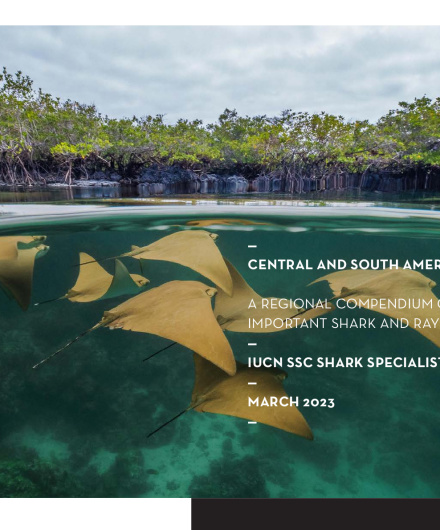
Central and South American Pacific: A regional compendium of Important Shark and Ray Areas

Participación Internacional
Coordinación técnica
Año de la publicación:
2023
Autor:
RW Jabado
E García-Rodríguez
PM Kyne
R Charles
A Gonzalez Pestana
MA Priest
A Battle-Morera
G Notarbartolo di Sciara
Lugar de incidencia:
Regional
Región oceánica:
Pacífico - Sudeste
The first Important Shark and Ray Areas (ISRA) regional expert workshop was held in hybrid mode (in person and online) in Bogotá, Colombia from 3–7 October 2022. The goal was to identify and delineate three dimensional and discrete portions of habitat that are critical to the survival of sharks, rays, and chimaeras, and that have the potential to be managed for conservation. The region covered was the Central and South American Pacific, from the Gulf of California in Mexico to southern Chile. This scientific collaboration amongst regional and global experts resulted in the identification of 65 Important Shark and Ray Areas, 5 candidate ISRAs, and 11 Areas of Interest. Identified ISRAs range in size from small underwater areas of 1.59 km2 at depths of 1,650–1,700 m (Northern Galápagos Hydrothermal Vents ISRA) to large areas of 3,191,603 km2 (Eastern Tropical Pacific Marine Corridor ISRA) from surface waters to a depth of 1,928 m. This compendium provides an overview of all areas delineated.
Etiquetas:
This publication may be reproduced for educational or non-profit purposes without special permission from the copyright holders, provided acknowledgment of the source is made.
La estructura de clasificación de la lista de especies Blue Five para la biblioteca digital ha sido
elaborada siguiendo criterios tanto científicos como de accesibilidad para facilitar la búsqueda de
información. En primer lugar, se organizaron las especies basándose en la taxonomía aceptada por la
comunidad científica para garantizar precisión y coherencia. Simultáneamente, se han implementado
categorías y subcategorías, considerando características morfológicas, su distribución y el uso de los
nombres comunes, con el fin de optimizar la navegación y búsqueda de datos por parte de los usuarios.
Esta metodología equilibrada asegura que la lista no solo sea científicamente rigurosa, sino también
fácil de consultar para quienes necesiten acceder a información específica de manera eficiente.
ISBN/ISSN/DOI:
https://doi.org/10.59216/ssg.isra.2023.r12
Editor:
International Union for Conservation of Nature (IUCN) Species Survival Commission (SSC) Shark Specialist Group
Idioma:
Inglés
Fuente:
Shark Specialist Group
Especies mencionadas:
- Categoría Blue Five: Tiburones Mantarrayas
- Familia: Tiburones cazones Tiburones martillo Tiburones ballena Tiburones tigre
- Especies: Tiburón jaquetón sedoso (Carcharhinus falciformis) Tiburón de Galápagos (Carcharhinus galapagensis) Tintorera/Tiburón coralero ñato (Triaenodon obesus) Tiburón martillo común (Sphyrna lewini) Tiburón ballena (Rhincodon typus) Solrayo (Odontaspis ferox)
Documentos relacionados:
Participación Internacional
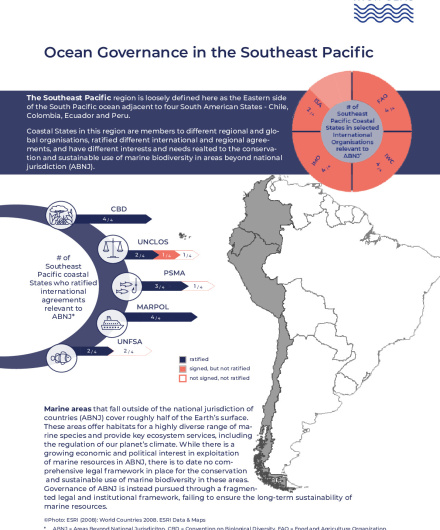
Ocean governance in the Southeast Pacific
The Southeast Pacific region is loosely defined here as the Eastern side of the South Pacific ocean adjacent to four...
Participación Internacional
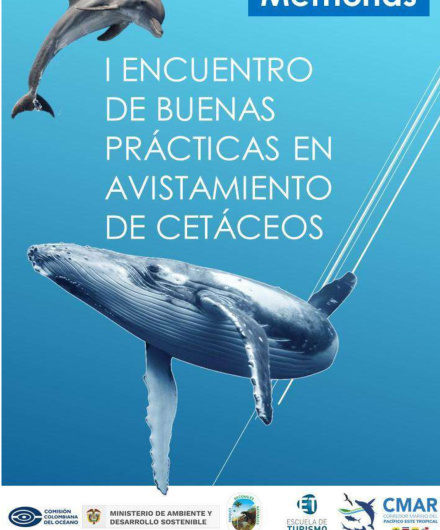
I Encuentro virtual de buenas prácticas para el avistamiento de...
Desde la mesa de trabajo de turismo y con apoyo de la mesa de biodiversidad del Comité Técnico Nacional del...
Participación Internacional
The outlook for oceans, seas and marine resources in Latin...
In preparation for the launch of the United Nations Decade of Oceans Science for Sustainable Development 2021-2030, ECLAC seeks to...