
Al descargar el documento usted acepta los términos establecidos en el copyright del documento y la política de uso de la plataforma.
Biblioteca
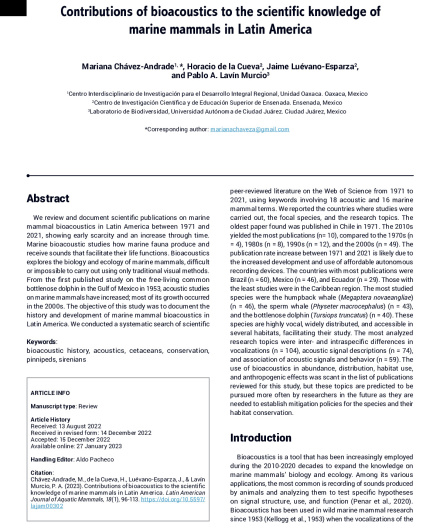
Contributions of bioacoustics to the scientific knowledge of marine mammals in Latin America

Monitoreo de especies
Metodologías de monitoreo
Año de la publicación:
2023
Autor:
Mariana Chávez Andrade
Horacio De la Cueva
Jaime Luévano Esparza
Pablo A. Lavín Murcio
Lugar de incidencia:
Regional
Región oceánica:
Cosmopolita
We review and document scientific publications on marine mammal bioacoustics in Latin America between 1971 and 2021, showing early scarcity and an increase through time.
Marine bioacoustic studies how marine fauna produce and receive sounds that facilitate their life functions. Bioacoustics explores the biology and ecology of marine mammals, difficult or impossible to carry out using only traditional visual methods.
From the first published study on the free-living common bottlenose dolphin in the Gulf of Mexico in 1953, acoustic studies on marine mammals have increased; most of its growth occurred in the 2000s. The objective of this study was to document the history and development of marine mammal bioacoustics in Latin America.
Etiquetas:
La estructura de clasificación de la lista de especies Blue Five para la biblioteca digital ha sido
elaborada siguiendo criterios tanto científicos como de accesibilidad para facilitar la búsqueda de
información. En primer lugar, se organizaron las especies basándose en la taxonomía aceptada por la
comunidad científica para garantizar precisión y coherencia. Simultáneamente, se han implementado
categorías y subcategorías, considerando características morfológicas, su distribución y el uso de los
nombres comunes, con el fin de optimizar la navegación y búsqueda de datos por parte de los usuarios.
Esta metodología equilibrada asegura que la lista no solo sea científicamente rigurosa, sino también
fácil de consultar para quienes necesiten acceder a información específica de manera eficiente.
ISBN/ISSN/DOI:
https://doi.org/10.5597/lajam00302
Editor:
Latin American Journal of Aquatic Mammals
Idioma:
Inglés
Fuente:
Latin American Journal of Aquatic Mammals
Especies mencionadas:
- Categoría Blue Five: Ballenas Delfines
- Familia: Rocuales Cachalotes Zifios Delfines
- Especies: Ballena azul (Balaenoptera musculus) Ballena jorobada (Megaptera novaeangliae) Cachalote (Physeter macrocephalus) Zifio de Cuvier (Ziphius cavirostris) Delfín común (Delphinus sp.) Delfín moteado pantropical (Stenella attenuata) Delfín girador (Stenella longirostris) Orca pigmea (Feresa attenuata) Ballena piloto de aleta corta (Globicephala macrorhynchus)
Documentos relacionados:
Monitoreo de especies
Global manta and devil ray population declines: Closing policy and...
Significant progress has been made in advancing priority actions to conserve manta and devil rays, yet implementation and enforcement of...
Monitoreo de especies
Demographic analysis of shortfin mako shark (Isurus oxyrinchus) in the...
Statistical of baseline and species-specific data are largely unavailable for several elasmobranchs (e.g., sharks, skates, and rays). Populations of many...
Monitoreo de especies
A systematic review protocol for quantifying bycatch of critically endangered...
The Pacific Ocean supports two leatherback sea turtle populations, each of which is Critically Endangered primarily as a result of...