
Al descargar el documento usted acepta los términos establecidos en el copyright del documento y la política de uso de la plataforma.
Biblioteca
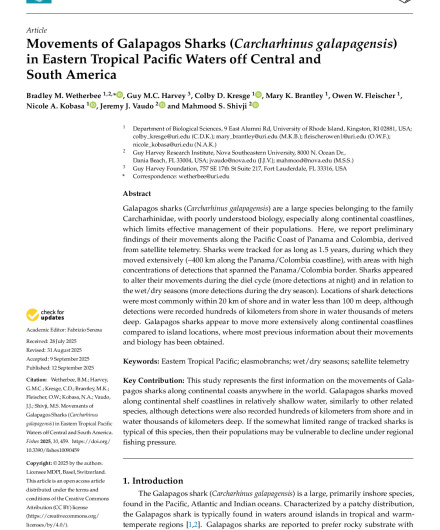
Movements of galapagos sharks (Carcharhinus galapagensis) in Eastern Tropical Pacific waters off Central and South America

Monitoreo de especies
Metodologías de monitoreo
Año de la publicación:
2025
Autor:
Bradley M. Wetherbee
Guy M.C. Harvey
Colby D. Kresge
Mary K. Brantley
Owen W. Fleischer
Nicole A. Kobasa
Jeremy J. Vaudo
Mahmood S. Shivji
Lugar de incidencia:
Colombia
Panamá
Región oceánica:
Pacífico - Sudeste
Galapagos sharks (Carcharhinus galapagensis) are a large species belonging to the family Carcharhinidae, with poorly understood biology, especially along continental coastlines, which limits effective management of their populations. Here, we report preliminary findings of their movements along the Pacific Coast of Panama and Colombia, derived from satellite telemetry. Sharks were tracked for as long as 1.5 years, during which they moved extensively (~400 km along the Panama/Colombia coastline), with areas with high
concentrations of detections that spanned the Panama/Colombia border. Sharks appeared to alter their movements during the diel cycle (more detections at night) and in relation to the wet/dry seasons (more detections during the dry season). Locations of shark detections were most commonly within 20 km of shore and in water less than 100 m deep, although detections were recorded hundreds of kilometers from shore in water thousands of meters deep. Galapagos sharks appear to move more extensively along continental coastlines compared to island locations, where most previous information about their movements and biology has been obtained.
Etiquetas:
© 2025 by the authors. Licensee MDPI, Basel, Switzerland.
This article is an open access article distributed under the terms and conditions of the Creative Commons
Attribution (CC BY) license (https://creativecommons.org/ licenses/by/4.0/).
La estructura de clasificación de la lista de especies Blue Five para la biblioteca digital ha sido
elaborada siguiendo criterios tanto científicos como de accesibilidad para facilitar la búsqueda de
información. En primer lugar, se organizaron las especies basándose en la taxonomía aceptada por la
comunidad científica para garantizar precisión y coherencia. Simultáneamente, se han implementado
categorías y subcategorías, considerando características morfológicas, su distribución y el uso de los
nombres comunes, con el fin de optimizar la navegación y búsqueda de datos por parte de los usuarios.
Esta metodología equilibrada asegura que la lista no solo sea científicamente rigurosa, sino también
fácil de consultar para quienes necesiten acceder a información específica de manera eficiente.
ISBN/ISSN/DOI:
https://doi.org/ 10.3390/fishes10090459
Editor:
MDPI
Idioma:
Inglés
Fuente:
MDPI
Especies mencionadas:
- Categoría Blue Five: Tiburones
- Familia: Tiburones cazones
- Especies: Tiburón de Galápagos (Carcharhinus galapagensis) Tiburón arenero (Carcharhinus obscurus)
Documentos relacionados:
Monitoreo de especies
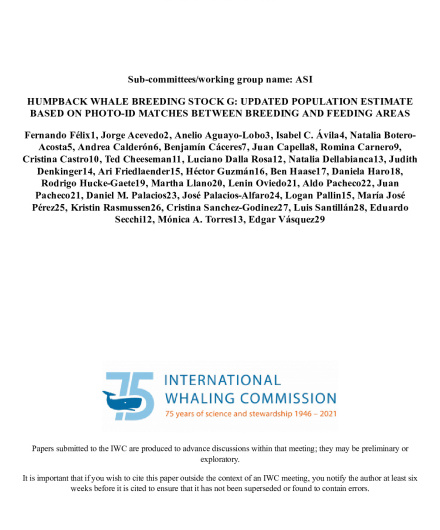
Humpback whale breeding stock G: updated population estimate based on...
We report a new mark-recapture-based population estimate for the humpback whale Breeding Stock G (BSG), defined by breeding grounds on...
Monitoreo de especies
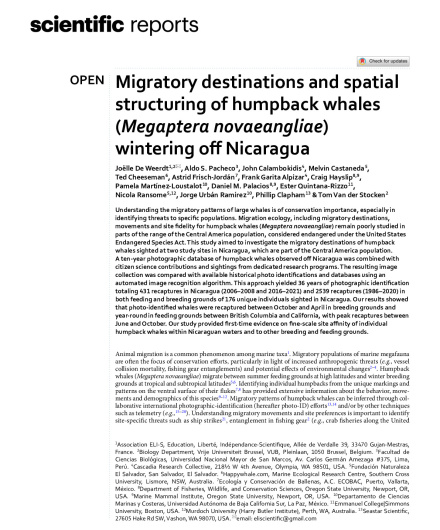
Migratory destinations and spatial structuring of humpback whales (Megaptera novaeangliae)...
Understanding the migratory patterns of large whales is of conservation importance, especially in identifying threats to specific populations. Migration ecology...
Monitoreo de especies
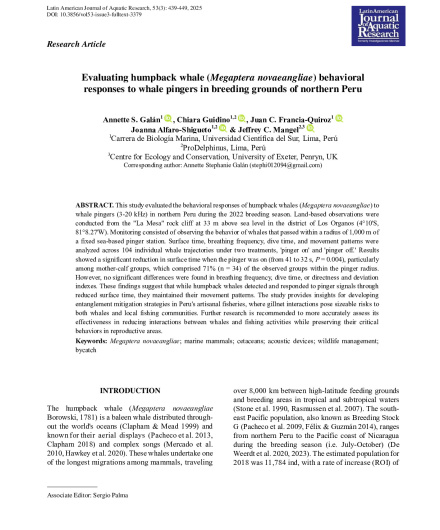
Evaluating humpback whale (Megaptera novaeangliae) behavioral responses to whale pingers...
This study evaluated the behavioral responses of humpback whales (Megaptera novaeangliae) to whale pingers (3-20 kHz) in northern...