
Al descargar el documento usted acepta los términos establecidos en el copyright del documento y la política de uso de la plataforma.
Biblioteca
Migratory destinations and spatial structuring of humpback whales (Megaptera novaeangliae) winter ing off Nicaragua.

Monitoreo de especies
Metodologías de monitoreo
Año de la publicación:
2023
Autor:
Joëlle De Weerdt
Aldo S. Pacheco
John Calambokidis
Melvin Castaneda
Ted Cheeseman
Astrid Frisch Jordán
Frank Garita Alpízar
Craig Hayslip
Pamela Martínez Loustalot
Daniel M. Palacios
Ester Quintana Rizzo
Nicola Ransome
Jorge Urbán Ramírez
Phillip Clapham
Tom Van der Stocken
Lugar de incidencia:
Nicaragua
Panamá
Región oceánica:
Pacífico - Centro Oriental
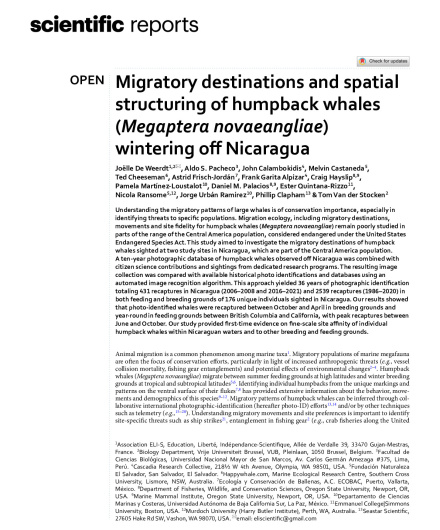
Understanding the migratory patterns of large whales is of conservation importance, especially in identifying threats to specific populations. Migration ecology, including migratory destinations, movements and site fidelity for humpback whales (Megaptera novaeangliae) remain poorly studied in parts of the range of the Central America population, considered endangered under the United States Endangered Species Act. This study aimed to investigate the migratory destinations of humpback whales sighted at two study sites in Nicaragua, which are part of the Central America population.
A ten-year photographic database of humpback whales observed off Nicaragua was combined with citizen science contributions and sightings from dedicated research programs. The resulting image collection was compared with available historical photo identifications and databases using an automated image recognition algorithm. This approach yielded 36 years of photographic identification totaling 431 recaptures in Nicaragua (2006–2008 and 2016–2021) and 2539 recaptures (1986–2020) in both feeding and breeding grounds of 176 unique individuals sighted in Nicaragua. Our results showed that photo-identified whales were recaptured between October and April in breeding grounds and year-round in feeding grounds...
Etiquetas:
La estructura de clasificación de la lista de especies Blue Five para la biblioteca digital ha sido
elaborada siguiendo criterios tanto científicos como de accesibilidad para facilitar la búsqueda de
información. En primer lugar, se organizaron las especies basándose en la taxonomía aceptada por la
comunidad científica para garantizar precisión y coherencia. Simultáneamente, se han implementado
categorías y subcategorías, considerando características morfológicas, su distribución y el uso de los
nombres comunes, con el fin de optimizar la navegación y búsqueda de datos por parte de los usuarios.
Esta metodología equilibrada asegura que la lista no solo sea científicamente rigurosa, sino también
fácil de consultar para quienes necesiten acceder a información específica de manera eficiente.
ISBN/ISSN/DOI:
https://doi.org/10.1038/s41598-023-41923-7
Editor:
Scientific Reports
Idioma:
Inglés
Fuente:
Nature portfolio
Especies mencionadas:
- Categoría Blue Five: Ballenas
- Familia: Rocuales
- Especies: Ballena jorobada (Megaptera novaeangliae)
Documentos relacionados:
Monitoreo de especies
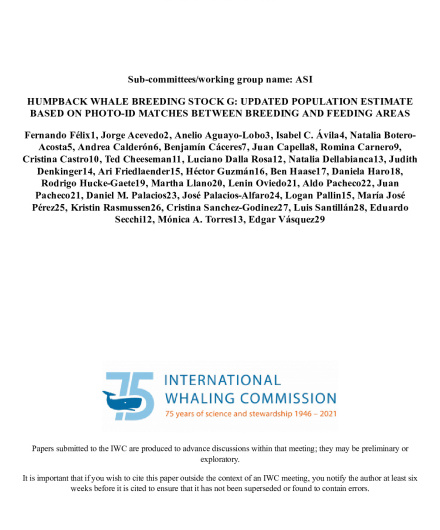
Humpback whale breeding stock G: updated population estimate based on...
We report a new mark-recapture-based population estimate for the humpback whale Breeding Stock G (BSG), defined by breeding grounds on...
Monitoreo de especies
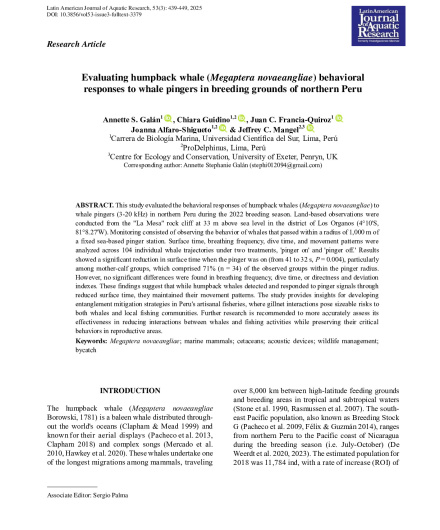
Evaluating humpback whale (Megaptera novaeangliae) behavioral responses to whale pingers...
This study evaluated the behavioral responses of humpback whales (Megaptera novaeangliae) to whale pingers (3-20 kHz) in northern...
Monitoreo de especies
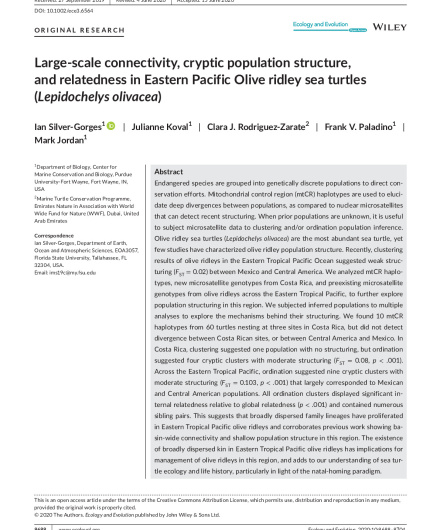
Large‐scale connectivity, cryptic population structure, and relatedness in Eastern Pacific...
Endangered species are grouped into genetically discrete populations to direct conservation efforts. Mitochondrial control region (mtCR) haplotypes are used to...