
Al descargar el documento usted acepta los términos establecidos en el copyright del documento y la política de uso de la plataforma.
Biblioteca
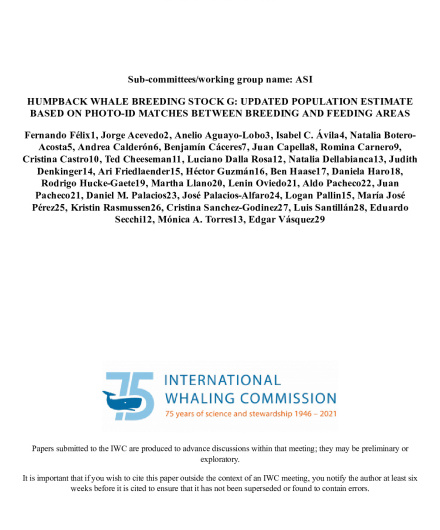
Humpback whale breeding stock G: updated population estimate based on photo-id matches between breeding and feeding areas

Monitoreo de especies
Metodologías de monitoreo
Año de la publicación:
2021
Autor:
Fernando Félix
Jorge Acevedo
Anelio Aguayo Lobo
Isabel C. Ávila
Natalia Botero Acosta
Andrea Calderón
Benjamín Cáceres
Juan Capella
Romina Carnero
Cristina Castro
Ted Cheeseman
Luciano Dalla Rosa
Natalia Dellabianca
Judith Denkinger
Ari Friedlaender [et.al]
Lugar de incidencia:
Regional
Región oceánica:
Pacífico - Sudeste
We report a new mark-recapture-based population estimate for the humpback whale Breeding Stock G (BSG), defined by breeding grounds on the northwestern coast of South America and southwestern Central America and feeding grounds around the Antarctic Peninsula and southern Chile. Photographic fluke catalogs from 23 research groups working in both breeding and feeding areas were compiled in the largest photo-ID matching effort ever made for this stock. A total of 6,354 unique individuals including 1,698 (26.7%) from feeding areas and 4,656 (73.3%) from breeding areas covering the period 1991-2018 were used for this purpose. The dataset was fitted to closed population models to estimate population size and Jolly-Seber models to estimate apparent survival, both implemented in the software Mark. Mixture models with two different data types, full likelihood and conditional likelihood, produced similar results of 11,784 and 11,786 (SE = 266 for both estimates) whales, respectively. In both cases, a model with two mixtures {Mth2} provided the best fit. Two Cormack-Jolly-Seber with Pledger mixtures models produced apparent survival estimates for the two mixtures (0.924 and 0.959, SE = 0.003 and 0.008; respectively). The new population estimate is 181% higher than a previously obtained in...
Etiquetas:
La estructura de clasificación de la lista de especies Blue Five para la biblioteca digital ha sido
elaborada siguiendo criterios tanto científicos como de accesibilidad para facilitar la búsqueda de
información. En primer lugar, se organizaron las especies basándose en la taxonomía aceptada por la
comunidad científica para garantizar precisión y coherencia. Simultáneamente, se han implementado
categorías y subcategorías, considerando características morfológicas, su distribución y el uso de los
nombres comunes, con el fin de optimizar la navegación y búsqueda de datos por parte de los usuarios.
Esta metodología equilibrada asegura que la lista no solo sea científicamente rigurosa, sino también
fácil de consultar para quienes necesiten acceder a información específica de manera eficiente.
Editor:
International Whaling Commission
Idioma:
Inglés
Fuente:
International Whaling Commission
Especies mencionadas:
- Categoría Blue Five: Ballenas Delfines
- Familia: Rocuales Delfines
- Especies: Ballena jorobada (Megaptera novaeangliae) Orca (Orcinus orca)
Documentos relacionados:
Monitoreo de especies
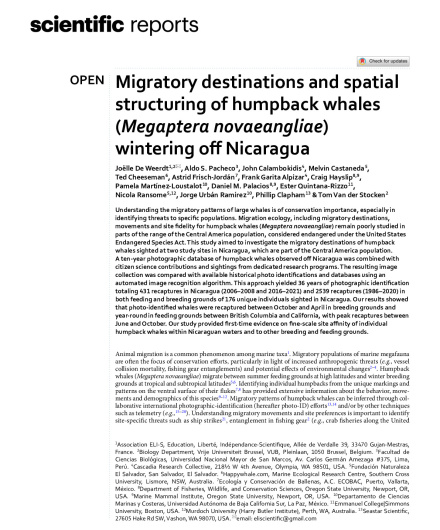
Migratory destinations and spatial structuring of humpback whales (Megaptera novaeangliae)...
Understanding the migratory patterns of large whales is of conservation importance, especially in identifying threats to specific populations. Migration ecology...
Monitoreo de especies
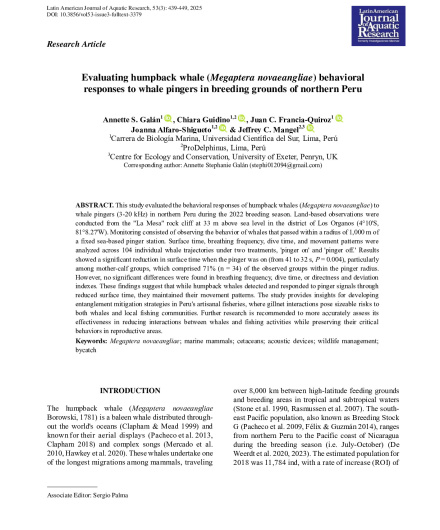
Evaluating humpback whale (Megaptera novaeangliae) behavioral responses to whale pingers...
This study evaluated the behavioral responses of humpback whales (Megaptera novaeangliae) to whale pingers (3-20 kHz) in northern...
Monitoreo de especies
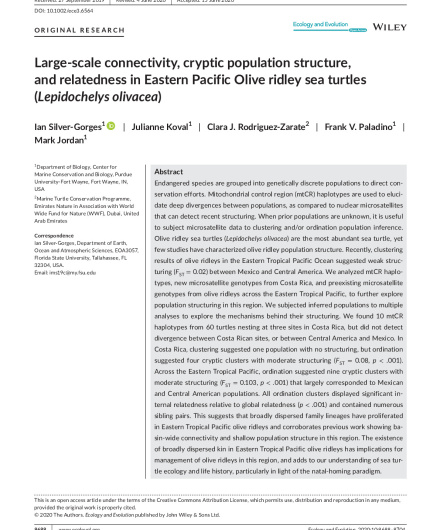
Large‐scale connectivity, cryptic population structure, and relatedness in Eastern Pacific...
Endangered species are grouped into genetically discrete populations to direct conservation efforts. Mitochondrial control region (mtCR) haplotypes are used to...