
Al descargar el documento usted acepta los términos establecidos en el copyright del documento y la política de uso de la plataforma.
Biblioteca
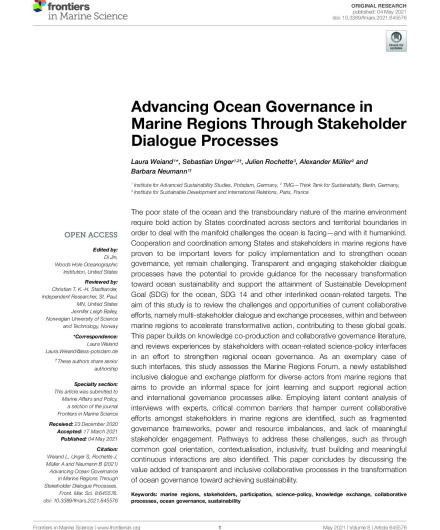
Advancing Ocean Governance in Marine Regions Through Stakeholder Dialogue Processes

Articulación multisectorial
Comunidad científica/academia
Año de la publicación:
2021
Autor:
Laura Weiand
Sebastian Unger
Julien Rochette
Alexander Müller
Barbara Neumann
Lugar de incidencia:
Global
Región oceánica:
Cosmopolita
The poor state of the ocean and the transboundary nature of the marine environment require bold action by States coordinated across sectors and territorial boundaries in order to deal with the manifold challenges the ocean is facing—and with it humankind. Cooperation and coordination among States and stakeholders in marine regions have proven to be important levers for policy implementation and to strengthen ocean governance, yet remain challenging. Transparent and engaging stakeholder dialogue processes have the potential to provide guidance for the necessary transformation toward ocean sustainability and support the attainment of Sustainable Development Goal (SDG) for the ocean, SDG 14 and other interlinked ocean-related targets. The aim of this study is to review the challenges and opportunities of current collaborative efforts, namely multi-stakeholder dialogue and exchange processes, within and between marine regions to accelerate transformative action, contributing to these global goals.
This paper builds on knowledge co-production and collaborative governance literature, and reviews experiences by stakeholders with ocean-related science-policy interfaces in an effort to strengthen regional ocean governance. As an exemplary case of such interfaces, this study assesses the...
Etiquetas:
© 2021 Weiand, Unger, Rochette, Müller and Neumann. This is an open-access article distributed under the terms of the Creative Commons Attribution License (CC BY). The use, distribution or reproduction in other forums is permitted, provided the original author(s) and the copyright owner(s) are credited and that the original publication in this journal is cited, in accordance with accepted academic practice. No use, distribution or reproduction is permitted which does not comply with these terms.
La estructura de clasificación de la lista de especies Blue Five para la biblioteca digital ha sido
elaborada siguiendo criterios tanto científicos como de accesibilidad para facilitar la búsqueda de
información. En primer lugar, se organizaron las especies basándose en la taxonomía aceptada por la
comunidad científica para garantizar precisión y coherencia. Simultáneamente, se han implementado
categorías y subcategorías, considerando características morfológicas, su distribución y el uso de los
nombres comunes, con el fin de optimizar la navegación y búsqueda de datos por parte de los usuarios.
Esta metodología equilibrada asegura que la lista no solo sea científicamente rigurosa, sino también
fácil de consultar para quienes necesiten acceder a información específica de manera eficiente.
ISBN/ISSN/DOI:
https://doi.org/10.3389/fmars.2021.645576
Editor:
Frontiers in Marine Science
Idioma:
Inglés
Fuente:
Frontiers in Marine Science
Documentos relacionados:
Articulación multisectorial
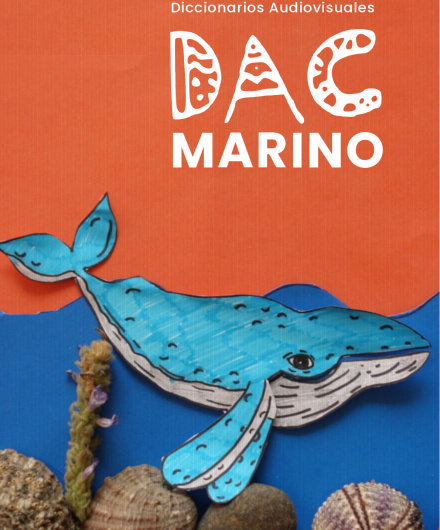
Diccionarios Audiovisuales Comunitarios Marinos
El primer Diccionario Audiovisual Comunitario sobre la riqueza marina de la costa peruana en el que los niños, niñas y...
Articulación multisectorial
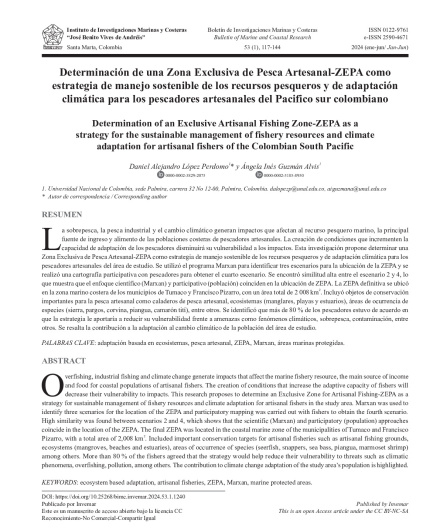
Determinación de una Zona Exclusiva de Pesca Artesanal-ZEPA como estrategia...
La sobrepesca, la pesca industrial y el cambio climático generan impactos que afectan al recurso pesquero marino, la principal fuente...
Articulación multisectorial
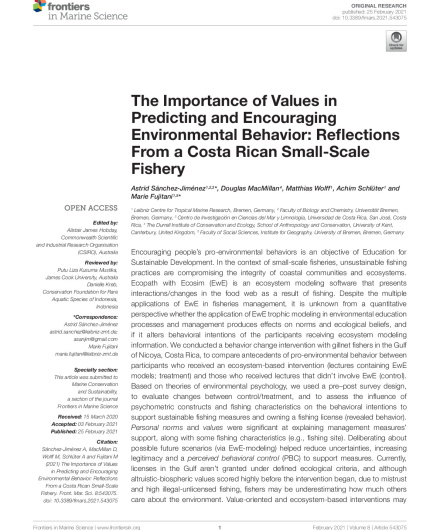
The Importance of values in predicting and encouraging environmental behavior...
Encouraging people’s pro-environmental behaviors is an objective of Education for Sustainable Development. In the context of small-scale fisheries, unsustainable fishing...