
Al descargar el documento usted acepta los términos establecidos en el copyright del documento y la política de uso de la plataforma.
Biblioteca
First record of the long-beaked common dolphin in Ecuador

Monitoreo de especies
Metodologías de monitoreo
Año de la publicación:
2025
Autor:
Fernando Félix,
Koen Van Waerebeek,
Roddy Macías,
May Platt,
Cristina Castro
Lugar de incidencia:
Chile
Ecuador
Perú
Región oceánica:
Pacífico - Sudeste
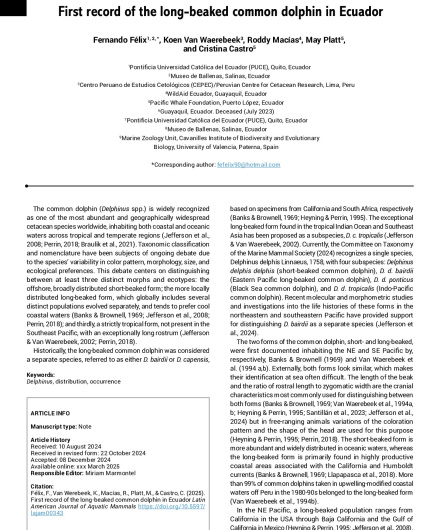
The common dolphin (Delphinus spp.) is widely recognized as one of the most abundant and geographically widespread cetacean species worldwide, inhabiting both coastal and oceanic waters across tropical and temperate regions (Jefferson et al.,
2008; Perrin, 2018; Braulik et al., 2021). Taxonomic classification and nomenclature have been subjects of ongoing debate due
to the species’ variability in color pattern, morphology, size, and ecological preferences. This debate centers on distinguishing
between at least three distinct morphs and ecotypes: the offshore, broadly distributed short-beaked form; the more locally
distributed long-beaked form, which globally includes several distinct populations evolved separately, and tends to prefer cool
coastal waters (Banks & Brownell, 1969; Jefferson et al., 2008; Perrin, 2018); and thirdly, a strictly tropical form, not present in the
Southeast Pacific, with an exceptionally long rostrum (Jefferson & Van Waerebeek, 2002; Perrin, 2018).
Etiquetas:
La estructura de clasificación de la lista de especies Blue Five para la biblioteca digital ha sido
elaborada siguiendo criterios tanto científicos como de accesibilidad para facilitar la búsqueda de
información. En primer lugar, se organizaron las especies basándose en la taxonomía aceptada por la
comunidad científica para garantizar precisión y coherencia. Simultáneamente, se han implementado
categorías y subcategorías, considerando características morfológicas, su distribución y el uso de los
nombres comunes, con el fin de optimizar la navegación y búsqueda de datos por parte de los usuarios.
Esta metodología equilibrada asegura que la lista no solo sea científicamente rigurosa, sino también
fácil de consultar para quienes necesiten acceder a información específica de manera eficiente.
ISBN/ISSN/DOI:
https://doi.org/10.5597/lajam00343
Editor:
Latin American Journal of Aquatic Mammals / Early View
Idioma:
Inglés
Fuente:
Latin American Journal of Aquatic Mammals
Especies mencionadas:
- Categoría Blue Five: Delfines
- Familia: Delfines
- Especies: Delfín común (Delphinus sp.)
Documentos relacionados:
Monitoreo de especies
Global manta and devil ray population declines: Closing policy and...
Significant progress has been made in advancing priority actions to conserve manta and devil rays, yet implementation and enforcement of...
Monitoreo de especies
Demographic analysis of shortfin mako shark (Isurus oxyrinchus) in the...
Statistical of baseline and species-specific data are largely unavailable for several elasmobranchs (e.g., sharks, skates, and rays). Populations of many...
Monitoreo de especies
A systematic review protocol for quantifying bycatch of critically endangered...
The Pacific Ocean supports two leatherback sea turtle populations, each of which is Critically Endangered primarily as a result of...