
Al descargar el documento usted acepta los términos establecidos en el copyright del documento y la política de uso de la plataforma.
Biblioteca
Future changes in environmental stressors for the seamount chains of the Southeast Pacific

Gestión de áreas marinas
Servicios ecosistémicos
Año de la publicación:
2025
Autor:
M. L. Hammond
M. Ramos
M. A. Gallardo
D. Zhai
E. A. Flores
C. F. Gaymer
J. Sellanes
G. Luna Jorquera
Lugar de incidencia:
Regional
Región oceánica:
Pacífico - Sudeste
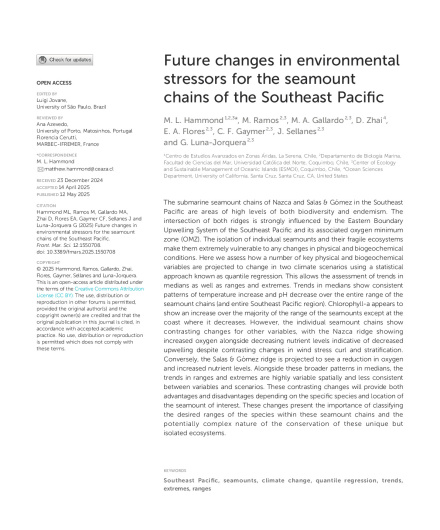
The submarine seamount chains of Nazca and Salas & Gómez in the Southeast Pacific are areas of high levels of both biodiversity and endemism. The intersection of both ridges is strongly influenced by the Eastern Boundary Upwelling System of the Southeast Pacific and its associated oxygen minimum zone (OMZ). The isolation of individual seamounts and their fragile ecosystems make them extremely vulnerable to any changes in physical and biogeochemical conditions. Here we assess how a number of key physical and biogeochemical variables are projected to change in two climate scenarios using a statistical approach known as quantile regression. This allows the assessment of trends in medians as well as ranges and extremes. Trends in medians show consistent patterns of temperature increase and pH decrease over the entire range of the seamount chains (and entire Southeast Pacific region). Chlorophyll-a appears to show an increase over the majority of the range of the seamounts except at the coast where it decreases. However, the individual seamount chains show contrasting changes for other variables, with the Nazca ridge showing increased oxygen alongside decreasing nutrient levels indicative of decreased upwelling despite contrasting changes in wind stress curl and stratification....
Etiquetas:
© 2025 Hammond, Ramos, Gallardo, Zhai, Flores, Gaymer, Sellanes and Luna-Jorquera. This is an open-access article distributed under the terms of the Creative Commons Attribution License (CC BY). The use, distribution or reproduction in other forums is permitted, provided the original author(s) and the copyright owner(s) are credited and that the original publication in this journal is cited, in accordance with accepted academic practice. No use, distribution or reproduction is permitted which does not comply with these terms.
La estructura de clasificación de la lista de especies Blue Five para la biblioteca digital ha sido
elaborada siguiendo criterios tanto científicos como de accesibilidad para facilitar la búsqueda de
información. En primer lugar, se organizaron las especies basándose en la taxonomía aceptada por la
comunidad científica para garantizar precisión y coherencia. Simultáneamente, se han implementado
categorías y subcategorías, considerando características morfológicas, su distribución y el uso de los
nombres comunes, con el fin de optimizar la navegación y búsqueda de datos por parte de los usuarios.
Esta metodología equilibrada asegura que la lista no solo sea científicamente rigurosa, sino también
fácil de consultar para quienes necesiten acceder a información específica de manera eficiente.
ISBN/ISSN/DOI:
DOI 10.3389/fmars.2025.1550708
Editor:
Frontiers in Marine Science
Idioma:
Inglés
Fuente:
Frontiers Original Research
Documentos relacionados:
Gestión de áreas marinas
Putting sharks on the map: A global standard for improving...
Area-based conservation is essential to safeguard declining biodiversity. Several approaches have been developed for identifying networks of globally important areas...
Gestión de áreas marinas
Climate change impacts on living marine resources in the Eastern...
Simulation results indicated that species' habitat suitability increased or remained the same in the northern and southern margins of the...
Gestión de áreas marinas
Adaptive spatiotemporal management to reduce shark bycatch in tuna fisheries
La pesca con cerco del atún tropical en el Pacífico Tropical Oriental (PTO) resulta en la captura incidental de varios...