
Al descargar el documento usted acepta los términos establecidos en el copyright del documento y la política de uso de la plataforma.
Biblioteca
Insights into blue whale (Balaenoptera musculus L.) population movements in the Galapagos Archipelago and Southeast Pacific

Monitoreo de especies
Metodologías de monitoreo
Año de la publicación:
2024
Autor:
Hector M. Guzman
Rocío M. Estévez
Stefanie Kaiser
Lugar de incidencia:
Ecuador
Perú
Región oceánica:
Pacífico - Sudeste
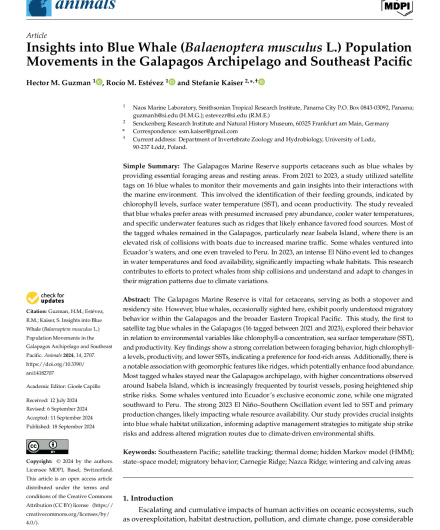
The Galapagos Marine Reserve supports cetaceans such as blue whales by providing essential foraging areas and resting areas. From 2021 to 2023, a study utilized satellite tags on 16 blue whales to monitor their movements and gain insights into their interactions with the marine environment. This involved the identification of their feeding grounds, indicated by chlorophyll levels, surface water temperature (SST), and ocean productivity. The study revealed that blue whales prefer areas with presumed increased prey abundance, cooler water temperatures,and specific underwater features such as ridges that likely enhance favored food sources. Most of the tagged whales remained in the Galapagos, particularly near Isabela Island, where there is an elevated risk of collisions with boats due to increased marine traffic. Some whales ventured into Ecuador’s waters, and one even traveled to Peru. In 2023, an intense El Niño event led to changes in water temperatures and food availability, significantly impacting whale habitats. This research contributes to efforts to protect whales from ship collisions and understand and adapt to changes in their migration patterns due to climate variations.
Etiquetas:
Copyright: © 2024 by the authors. Licensee MDPI, Basel, Switzerland.
This article is an open access article distributed under the terms and conditions of the Creative Commons Attribution (CC BY) license (https:// creativecommons.org/licenses/by/4.0/).
La estructura de clasificación de la lista de especies Blue Five para la biblioteca digital ha sido
elaborada siguiendo criterios tanto científicos como de accesibilidad para facilitar la búsqueda de
información. En primer lugar, se organizaron las especies basándose en la taxonomía aceptada por la
comunidad científica para garantizar precisión y coherencia. Simultáneamente, se han implementado
categorías y subcategorías, considerando características morfológicas, su distribución y el uso de los
nombres comunes, con el fin de optimizar la navegación y búsqueda de datos por parte de los usuarios.
Esta metodología equilibrada asegura que la lista no solo sea científicamente rigurosa, sino también
fácil de consultar para quienes necesiten acceder a información específica de manera eficiente.
ISBN/ISSN/DOI:
https://doi.org/10.3390/ ani14182707
Editor:
Animals
Idioma:
Inglés
Fuente:
Animals
Especies mencionadas:
- Categoría Blue Five: Ballenas
- Familia: Rocuales
- Especies: Ballena azul (Balaenoptera musculus)
Documentos relacionados:
Monitoreo de especies
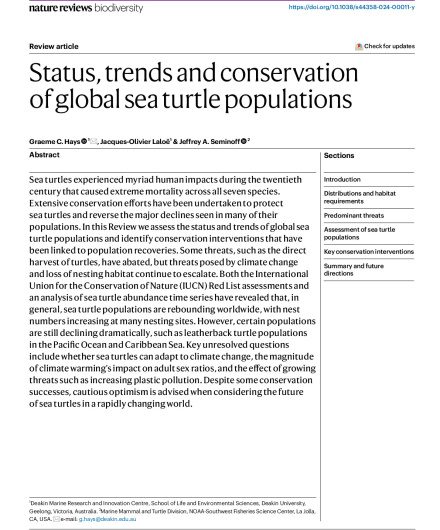
Status, trends and conservation of global sea turtle populations
Sea turtles experienced myriad human impacts during the twentieth century that caused extreme mortality across all seven species. Extensive conservation...
Monitoreo de especies
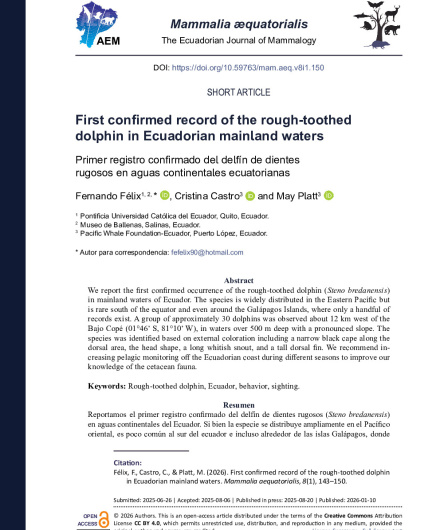
First confirmed record of the rough-toothed dolphin in ecuadorian mainland...
We report the first confirmed occurrence of the rough-toothed dolphin (Steno bredanensis) in mainland waters of Ecuador. The...
Monitoreo de especies
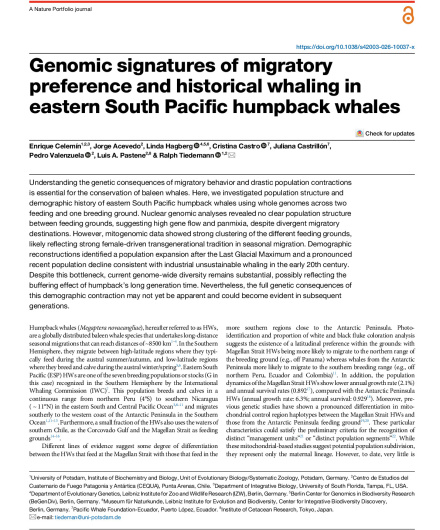
Genomic signatures of migratory preference and historical whaling in eastern...
Understanding the genetic consequences of migratory behavior and drastic population contractions is essential for the conservation of baleen whales. Here...