
Al descargar el documento usted acepta los términos establecidos en el copyright del documento y la política de uso de la plataforma.
Biblioteca
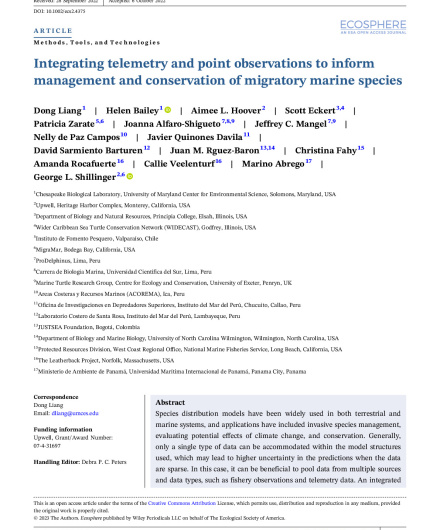
Integrating telemetry and point observations to inform management and conservation of migratory marine species

Monitoreo de especies
Metodologías de monitoreo
Año de la publicación:
2023
Autor:
Dong Liang
Helen Bailey
Aimee L. Hoover
Scott Eckert
Patricia Zarate
Joanna Alfaro Shigueto
Jeffrey C. Mangel
Nelly de Paz Campos
Javier Quinones Davila
David Sarmiento Barturen [Et al.]
Lugar de incidencia:
Regional
Región oceánica:
Pacífico - Sudeste
Species distribution models have been widely used in both terrestrial and marine systems, and applications have included invasive species management, evaluating potential effects of climate change, and conservation. Generally, only a single type of data can be accommodated within the model structures used, which may lead to higher uncertainty in the predictions when the data are sparse. In this case, it can be beneficial to pool data from multiple sources and data types, such as fishery observations and telemetry data. An integrated species distribution model (ISDM) utilizes data integration methods that address the challenges of harnessing multiple data types to estimate species distribution. In this study, an ISDM approach was developed to link turtle locations gathered as part of fishery observations with those derived from satellite telemetry in the East Pacific Ocean to enhance our understanding of a highly migratory and endangered marine species, the leatherback turtle (Dermochelys coriacea). These models were developed to support a dynamic management tool, South Pacific TurtleWatch, to identify high-risk areas of management concern and help inform bycatch reduction efforts for this critically endangered species. This data fusion approach could be applied to other...
Etiquetas:
This is an open access article under the terms of the Creative Commons Attribution License, which permits use, distribution and reproduction in any medium, providedthe original work is properly cited.
La estructura de clasificación de la lista de especies Blue Five para la biblioteca digital ha sido
elaborada siguiendo criterios tanto científicos como de accesibilidad para facilitar la búsqueda de
información. En primer lugar, se organizaron las especies basándose en la taxonomía aceptada por la
comunidad científica para garantizar precisión y coherencia. Simultáneamente, se han implementado
categorías y subcategorías, considerando características morfológicas, su distribución y el uso de los
nombres comunes, con el fin de optimizar la navegación y búsqueda de datos por parte de los usuarios.
Esta metodología equilibrada asegura que la lista no solo sea científicamente rigurosa, sino también
fácil de consultar para quienes necesiten acceder a información específica de manera eficiente.
ISBN/ISSN/DOI:
https://doi.org/10.1002/ecs2.4375
Editor:
Ecosphere/Wiley
Idioma:
Inglés
Fuente:
Wiley
Especies mencionadas:
- Categoría Blue Five: Tortugas marinas
- Familia: Dermoquélidos
- Especies: Tortuga laúd (Dermochelys coriacea)
Documentos relacionados:
Monitoreo de especies
Status, trends and conservation of global sea turtle populations
Sea turtles experienced myriad human impacts during the twentieth century that caused extreme mortality across all seven species. Extensive conservation...
Monitoreo de especies
First confirmed record of the rough-toothed dolphin in ecuadorian mainland...
We report the first confirmed occurrence of the rough-toothed dolphin (Steno bredanensis) in mainland waters of Ecuador. The...
Monitoreo de especies
Genomic signatures of migratory preference and historical whaling in eastern...
Understanding the genetic consequences of migratory behavior and drastic population contractions is essential for the conservation of baleen whales. Here...