
Al descargar el documento usted acepta los términos establecidos en el copyright del documento y la política de uso de la plataforma.
Biblioteca
Medio ambiente acuático *Sistema de Información Biogeográfica de los Océanos *Declaración de Galway

Monitoreo de especies
Metodologías de monitoreo
Año de la publicación:
2025
Autor:
Fernando Félix,
Cristina Castro,
Marie Françoise Van BressemLuna Barragán,
May Platt,
Koen Van Waerebeek
Lugar de incidencia:
Ecuador
Región oceánica:
Pacífico - Sudeste
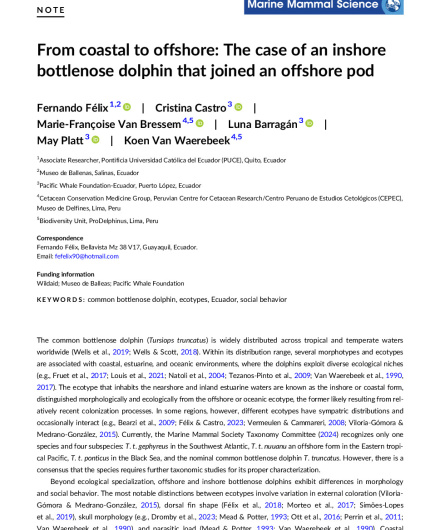
The common bottlenose dolphin (Tursiops truncatus) is widely distributed across tropical and temperate watersworldwide (Wells et al., 2019; Wells & Scott, 2018). Within its distribution range, several morphotypes and ecotypes are associated with coastal, estuarine, and oceanic environments, where the dolphins exploit diverse ecological niches (e.g., Fruet et al., 2017; Louis et al., 2021; Natoli et al., 2004; Tezanos-Pinto et al., 2009; Van Waerebeek et al., 1990, 2017). The ecotype that inhabits the nearshore and inland estuarine waters are known as the inshore or coastal form, distinguished morphologically and ecologically from the offshore or oceanic ecotype, the former likely resulting from relatively recent colonization processes.
Etiquetas:
© 2025 Society for Marine Mammalogy
La estructura de clasificación de la lista de especies Blue Five para la biblioteca digital ha sido
elaborada siguiendo criterios tanto científicos como de accesibilidad para facilitar la búsqueda de
información. En primer lugar, se organizaron las especies basándose en la taxonomía aceptada por la
comunidad científica para garantizar precisión y coherencia. Simultáneamente, se han implementado
categorías y subcategorías, considerando características morfológicas, su distribución y el uso de los
nombres comunes, con el fin de optimizar la navegación y búsqueda de datos por parte de los usuarios.
Esta metodología equilibrada asegura que la lista no solo sea científicamente rigurosa, sino también
fácil de consultar para quienes necesiten acceder a información específica de manera eficiente.
ISBN/ISSN/DOI:
DOI: 10.1111/mms.13223
Editor:
Society for Marine Mammalogy
Idioma:
Inglés
Fuente:
pacificwhale.org
Especies mencionadas:
- Categoría Blue Five: Delfines
- Familia: Delfines
- Especies: Delfín nariz de botella (Tursiops truncatus)
Documentos relacionados:
Monitoreo de especies
Global manta and devil ray population declines: Closing policy and...
Significant progress has been made in advancing priority actions to conserve manta and devil rays, yet implementation and enforcement of...
Monitoreo de especies
Demographic analysis of shortfin mako shark (Isurus oxyrinchus) in the...
Statistical of baseline and species-specific data are largely unavailable for several elasmobranchs (e.g., sharks, skates, and rays). Populations of many...
Monitoreo de especies
A systematic review protocol for quantifying bycatch of critically endangered...
The Pacific Ocean supports two leatherback sea turtle populations, each of which is Critically Endangered primarily as a result of...