
Al descargar el documento usted acepta los términos establecidos en el copyright del documento y la política de uso de la plataforma.
Biblioteca
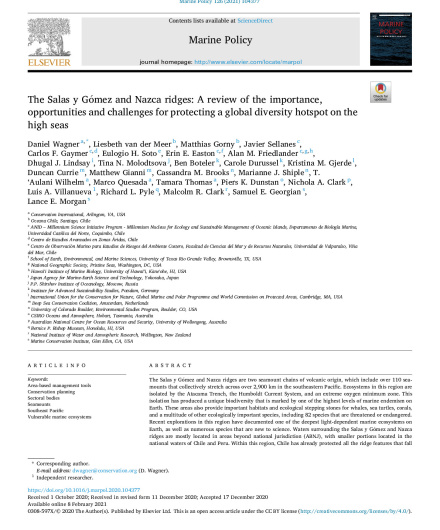
The Salas y Gómez and Nazca ridges: A review of the importance, opportunities and challenges for protecting a global diversity hotspot on the high seas

Gestión de áreas marinas
Áreas Marinas Protegidas (AMP)
Año de la publicación:
2021
Autor:
Daniel Wagner
Liesbeth van der Meer
Matías Gorny
Javier Sellanes
Carlos F. Gaymer
Eulogio H. Soto
Erin E. Easton
Alan M. Friedlander
Dhugal J. Lindsay
Tina N. Molodtsova
Ben Boteler
Carole Durussel
Kristina M. Gjerde [Et al.]
Lugar de incidencia:
Regional
Región oceánica:
Pacífico - Sudeste
The Salas y Gómez and Nazca ridges are two seamount chains of volcanic origin, which include over 110 seamounts that collectively stretch across over 2,900 km in the southeastern Pacific. Ecosystems in this region are isolated by the Atacama Trench, the Humboldt Current System, and an extreme oxygen minimum zone. This isolation has produced a unique biodiversity that is marked by one of the highest levels of marine endemism on Earth. These areas also provide important habitats and ecological stepping stones for whales, sea turtles, corals, and a multitude of other ecologically important species, including 82 species that are threatened or endangered. Recent explorations in this region have documented one of the deepest light-dependent marine ecosystems on Earth, as well as numerous species that are new to science. Waters surrounding the Salas y Gómez and Nazca ridges are mostly located in areas beyond national jurisdiction (ABNJ), with smaller portions located in the national waters of Chile and Peru. Within this region, Chile has already protected all the ridge features that fall within its jurisdiction, and Peru is evaluating a proposal that would protect the seafloor that falls within its national waters. However, all of the ABNJ in the region, which cover over 73% of the...
Etiquetas:
© 2020 The Author(s). Published by Elsevier Ltd. This is an open access article under the CC BY license (http://creativecommons.org/licenses/by/4.0/).
La estructura de clasificación de la lista de especies Blue Five para la biblioteca digital ha sido
elaborada siguiendo criterios tanto científicos como de accesibilidad para facilitar la búsqueda de
información. En primer lugar, se organizaron las especies basándose en la taxonomía aceptada por la
comunidad científica para garantizar precisión y coherencia. Simultáneamente, se han implementado
categorías y subcategorías, considerando características morfológicas, su distribución y el uso de los
nombres comunes, con el fin de optimizar la navegación y búsqueda de datos por parte de los usuarios.
Esta metodología equilibrada asegura que la lista no solo sea científicamente rigurosa, sino también
fácil de consultar para quienes necesiten acceder a información específica de manera eficiente.
ISBN/ISSN/DOI:
https://doi.org/10.1016/j.marpol.2020.104377
Editor:
Elsevier/Marine Policy
Idioma:
Inglés
Fuente:
ScienceDirect
Especies mencionadas:
- Categoría Blue Five: Ballenas Tiburones Mantarrayas Tortugas marinas
Documentos relacionados:
Gestión de áreas marinas
Putting sharks on the map: A global standard for improving...
Area-based conservation is essential to safeguard declining biodiversity. Several approaches have been developed for identifying networks of globally important areas...
Gestión de áreas marinas
Climate change impacts on living marine resources in the Eastern...
Simulation results indicated that species' habitat suitability increased or remained the same in the northern and southern margins of the...
Gestión de áreas marinas
Adaptive spatiotemporal management to reduce shark bycatch in tuna fisheries
La pesca con cerco del atún tropical en el Pacífico Tropical Oriental (PTO) resulta en la captura incidental de varios...