
Al descargar el documento usted acepta los términos establecidos en el copyright del documento y la política de uso de la plataforma.
Biblioteca
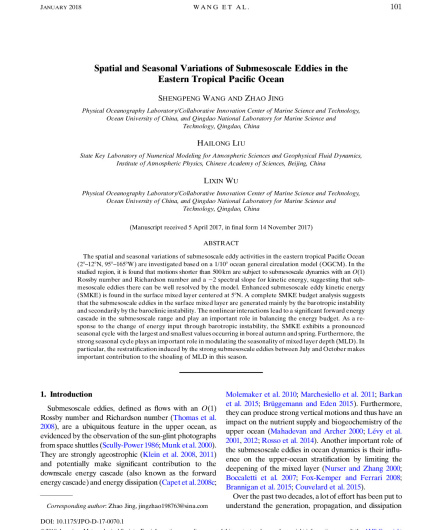
Spatial and seasonal variations of submesoscale eddies in the Eastern Tropical Pacific Ocean

Gestión de áreas marinas
Servicios ecosistémicos
Año de la publicación:
2018
Autor:
Wang Shengpeng
Zhao Jing
Hai Long Liu
Lixin Wu
Lugar de incidencia:
Regional
Región oceánica:
Pacífico - Sudeste
The spatial and seasonal variations of submesoscale eddy activities in the eastern tropical Pacific Ocean (28–128N, 958–1658W) are investigated based on a 1/108 ocean general circulation model (OGCM). In the studied region, it is found that motions shorter than 500 km are subject to submesoscale dynamics with an O(1) Rossby number and Richardson number and a 22 spectral slope for kinetic energy, suggesting that submesoscale eddies there can be well resolved by the model. Enhanced submesoscale eddy kinetic energy (SMKE) is found in the surface mixed layer centered at 58N. A complete SMKE budget analysis suggests that the submesoscale eddies in the surface mixed layer are generated mainly by the barotropic instability and secondarily by the baroclinic instability. The nonlinear interactions lead to a significant forward energy cascade in the submesoscale range and play an important role in balancing the energy budget. As a response to the change of energy input through barotropic instability, the SMKE exhibits a pronounced seasonal cycle with the largest and smallest values occurring in boreal autumn and spring. Furthermore, the strong seasonal cycle plays an important role inmodulating the seasonality ofmixed layer depth (MLD). In particular, the restratification induced by the...
Etiquetas:
© 2018 American Meteorological Society
La estructura de clasificación de la lista de especies Blue Five para la biblioteca digital ha sido
elaborada siguiendo criterios tanto científicos como de accesibilidad para facilitar la búsqueda de
información. En primer lugar, se organizaron las especies basándose en la taxonomía aceptada por la
comunidad científica para garantizar precisión y coherencia. Simultáneamente, se han implementado
categorías y subcategorías, considerando características morfológicas, su distribución y el uso de los
nombres comunes, con el fin de optimizar la navegación y búsqueda de datos por parte de los usuarios.
Esta metodología equilibrada asegura que la lista no solo sea científicamente rigurosa, sino también
fácil de consultar para quienes necesiten acceder a información específica de manera eficiente.
ISBN/ISSN/DOI:
DOI: https://doi.org/10.1175/JPO-D-17-0070.1
Editor:
American Meteorological Society
Idioma:
Inglés
Fuente:
Journal Physical Oceanography
Documentos relacionados:
Gestión de áreas marinas
Putting sharks on the map: A global standard for improving...
Area-based conservation is essential to safeguard declining biodiversity. Several approaches have been developed for identifying networks of globally important areas...
Gestión de áreas marinas
Climate change impacts on living marine resources in the Eastern...
Simulation results indicated that species' habitat suitability increased or remained the same in the northern and southern margins of the...
Gestión de áreas marinas
Adaptive spatiotemporal management to reduce shark bycatch in tuna fisheries
La pesca con cerco del atún tropical en el Pacífico Tropical Oriental (PTO) resulta en la captura incidental de varios...