
Al descargar el documento usted acepta los términos establecidos en el copyright del documento y la política de uso de la plataforma.
Biblioteca
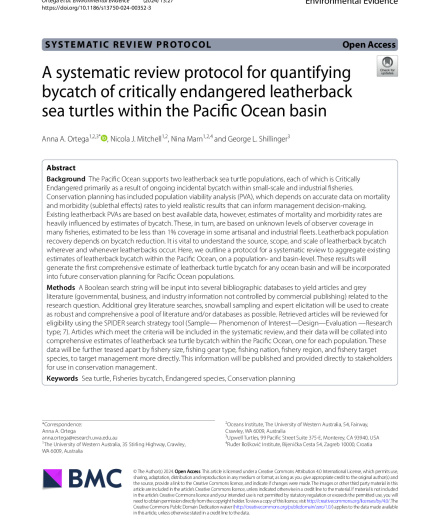
A systematic review protocol for quantifying bycatch of critically endangered leatherback sea turtles within the Pacific Ocean basin

Monitoreo de especies
Metodologías de monitoreo
Año de la publicación:
2024
Autor:
Anna A. Ortega
Nicola J. Mitchell
Nina Marn
George L. Shillinger
Lugar de incidencia:
Global
Región oceánica:
Cosmopolita
The Pacific Ocean supports two leatherback sea turtle populations, each of which is Critically Endangered primarily as a result of ongoing incidental bycatch within small-scale and industrial fisheries. Conservation planning has included population viability analysis (PVA), which depends on accurate data on mortality and morbidity (sublethal effects) rates to yield realistic results that can inform management decision-making. Existing leatherback PVAs are based on best available data, however, estimates of mortality and morbidity rates are heavily influenced by estimates of bycatch. These, in turn, are based on unknown levels of observer coverage in many fisheries, estimated to be less than 1% coverage in some artisanal and industrial fleets. Leatherback population recovery depends on bycatch reduction. It is vital to understand the source, scope, and scale of leatherback bycatch wherever and whenever leatherbacks occur. Here, we outline a protocol for a systematic review to aggregate existing estimates of leatherback bycatch within the Pacific Ocean, on a population- and basin-level. These results will generate the first comprehensive estimate of leatherback turtle bycatch for any ocean basin and will be incorporated into future conservation planning for Pacific Ocean...
Etiquetas:
© The Author(s) 2024. Open Access This article is licensed under a Creative Commons Attribution 4.0 International License, which permits use, sharing, adaptation, distribution and reproduction in any medium or format, as long as you give appropriate credit to the original author(s) and the source, provide a link to the Creative Commons licence, and indicate if changes were made. The images or other third party material in this article are included in the article’s Creative Commons licence, unless indicated otherwise in a credit line to the material. If material is not included in the article’s Creative Commons licence and your intended use is not permitted by statutory regulation or exceeds the permitted use, you will need to obtain permission directly from the copyright holder. To view a copy of this licence, visit http:// creativ ecommon s.or g/licenses/by/4.0/. The Creative Commons Public Domain Dedication waiver (http: //creativecommo ns. org/publicdo main / zero/1.0/) applies to the data made available in this article, unless otherwise stated in a credit line to the data.
La estructura de clasificación de la lista de especies Blue Five para la biblioteca digital ha sido
elaborada siguiendo criterios tanto científicos como de accesibilidad para facilitar la búsqueda de
información. En primer lugar, se organizaron las especies basándose en la taxonomía aceptada por la
comunidad científica para garantizar precisión y coherencia. Simultáneamente, se han implementado
categorías y subcategorías, considerando características morfológicas, su distribución y el uso de los
nombres comunes, con el fin de optimizar la navegación y búsqueda de datos por parte de los usuarios.
Esta metodología equilibrada asegura que la lista no solo sea científicamente rigurosa, sino también
fácil de consultar para quienes necesiten acceder a información específica de manera eficiente.
ISBN/ISSN/DOI:
https://doi.org/10.1186/s13750-024-00352-3
Editor:
Environmental Evidence
Idioma:
Inglés
Fuente:
Springer
Especies mencionadas:
- Categoría Blue Five: Tortugas marinas
- Familia: Dermoquélidos
- Especies: Tortuga laúd (Dermochelys coriacea)
Documentos relacionados:
Monitoreo de especies
Global manta and devil ray population declines: Closing policy and...
Significant progress has been made in advancing priority actions to conserve manta and devil rays, yet implementation and enforcement of...
Monitoreo de especies
Demographic analysis of shortfin mako shark (Isurus oxyrinchus) in the...
Statistical of baseline and species-specific data are largely unavailable for several elasmobranchs (e.g., sharks, skates, and rays). Populations of many...
Monitoreo de especies
The biology and ecology of the Pacific sharpnose shark Rhizoprionodon...
Amidst global declines in elasmobranch populations resulting predominantly from overfishing, the need to gather data regarding shark ecology is greater...