
Al descargar el documento usted acepta los términos establecidos en el copyright del documento y la política de uso de la plataforma.
Biblioteca
Toward understanding the communication in sperm whales


Monitoreo de especies
Metodologías de monitoreo
Año de la publicación:
2022
Autor:
Jacob Andreas
Gasper Begus
Michael M. Bronstein
Roee Diamant
Denley Delaney
Shane Gero
Shafi Goldwasser
David F. Gruber
Sarah de Haas
Peter Malkin
Nikolay Pavlov
Roger Payne
Giovanni Petri
Daniela Rus
Pratyusha Sharma
Dan Tchernov
Pernille Tønnesen
Antonio Torralba
Daniel Vogt
Robert J. Wood
Lugar de incidencia:
Global
Región oceánica:
Cosmopolita
Machine learning has been advancing dramatically over the past decade. Most strides are human-based applications due to the availability of large-scale datasets; however, opportunities are ripe to apply this technology to more deeply understand non-human communication. We detail a scientific roadmap for advancing the understanding of communication of whales that can be built further upon as a template to decipher other forms of animal and non-human communication. Sperm whales, with their highly developed neuroanatomical features, cognitive abilities, social structures, and discrete click-based encoding make for an excellent model for advanced tools that can be applied to other animals in the future. We outline the key elements required for the collection and processing of massive datasets, detecting basic communication units and language-like higher-level structures, and validating models through interactive playback experiments. The technological capabilities developed by such an undertaking hold potential for cross-applications in broader communities investigating non-human communication and behavioral research.
Etiquetas:
ª 2022 The Authors. This is an open access article under the CC BY-NC-ND license (http://creativecommons.org/licenses/by-nc-nd/4.0/)
La estructura de clasificación de la lista de especies Blue Five para la biblioteca digital ha sido
elaborada siguiendo criterios tanto científicos como de accesibilidad para facilitar la búsqueda de
información. En primer lugar, se organizaron las especies basándose en la taxonomía aceptada por la
comunidad científica para garantizar precisión y coherencia. Simultáneamente, se han implementado
categorías y subcategorías, considerando características morfológicas, su distribución y el uso de los
nombres comunes, con el fin de optimizar la navegación y búsqueda de datos por parte de los usuarios.
Esta metodología equilibrada asegura que la lista no solo sea científicamente rigurosa, sino también
fácil de consultar para quienes necesiten acceder a información específica de manera eficiente.
ISBN/ISSN/DOI:
https://doi.org/10.1016/j.isci.2022.104393
Editor:
iScience
Idioma:
Inglés
Fuente:
ScienceDirect
Especies mencionadas:
- Categoría Blue Five: Ballenas
- Familia: Cachalotes
Documentos relacionados:
Monitoreo de especies
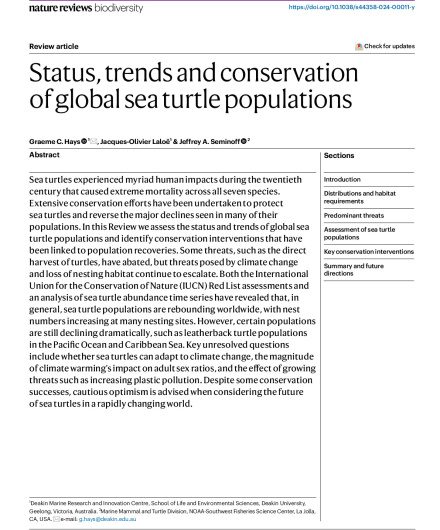
Status, trends and conservation of global sea turtle populations
Sea turtles experienced myriad human impacts during the twentieth century that caused extreme mortality across all seven species. Extensive conservation...
Monitoreo de especies
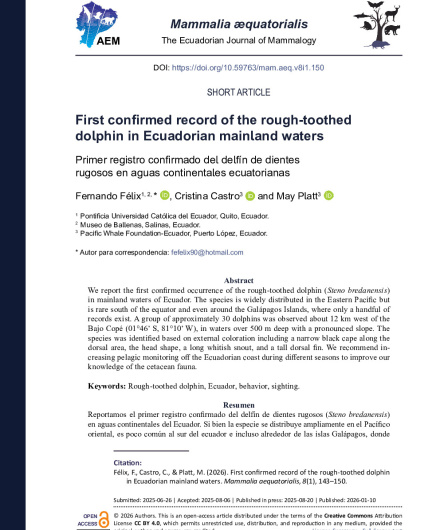
First confirmed record of the rough-toothed dolphin in ecuadorian mainland...
We report the first confirmed occurrence of the rough-toothed dolphin (Steno bredanensis) in mainland waters of Ecuador. The...
Monitoreo de especies
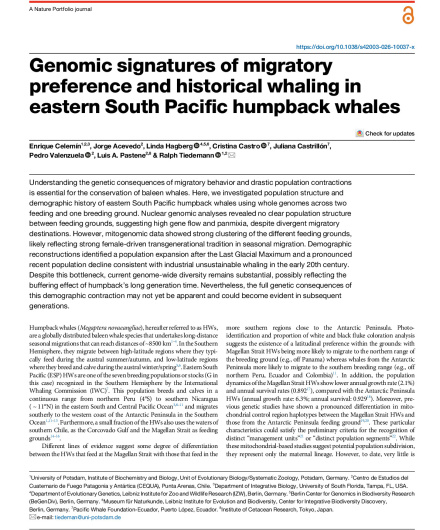
Genomic signatures of migratory preference and historical whaling in eastern...
Understanding the genetic consequences of migratory behavior and drastic population contractions is essential for the conservation of baleen whales. Here...