
Al descargar el documento usted acepta los términos establecidos en el copyright del documento y la política de uso de la plataforma.
Biblioteca
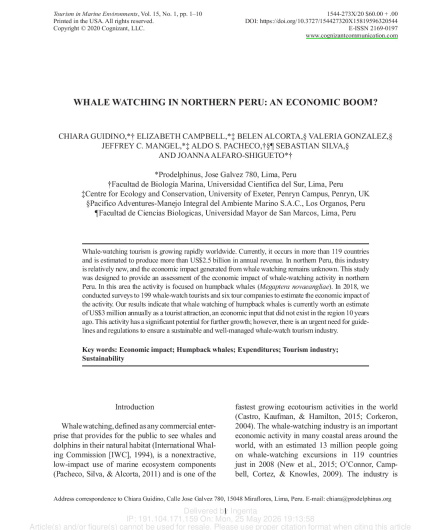
Whale watching in northern Peru: An economic boom?

Iniciativas sostenibles
Sectores productivos
Año de la publicación:
2026
Autor:
Chiara Guidino
Elizabeth Campbell
Belen Alcorta
Valeria Gonzalez
Jeffrey C. Mangel
Aldo S. Pacheco
Sebastian Silva
Joanna Alfaro Shigueto
Lugar de incidencia:
Perú
Región oceánica:
Pacífico - Sudeste
Whale-watching tourism is growing rapidly worldwide. Currently, it occurs in more than 119 countries and is estimated to produce more than US$2.5 billion in annual revenue. In northern Peru, this industry is relatively new, and the economic impact generated from whale watching remains unknown. This study was designed to provide an assessment of the economic impact of whale-watching activity in northern Peru. In this area the activity is focused on humpback whales (Megaptera novaeangliae). In 2018, we conducted surveys to 199 whale-watch tourists and six tour companies to estimate the economic impact of the activity. Our results indicate that whale watching of humpback whales is currently worth an estimate of US$3 million annually as a tourist attraction, an economic input that did not exist in the region 10 years ago. This activity has a significant potential for further growth; however, there is an urgent need for guidelines and regulations to ensure a sustainable and well-managed whale-watch tourism industry.
Etiquetas:
Copyright © 2020 Cognizant, LLC
La estructura de clasificación de la lista de especies Blue Five para la biblioteca digital ha sido
elaborada siguiendo criterios tanto científicos como de accesibilidad para facilitar la búsqueda de
información. En primer lugar, se organizaron las especies basándose en la taxonomía aceptada por la
comunidad científica para garantizar precisión y coherencia. Simultáneamente, se han implementado
categorías y subcategorías, considerando características morfológicas, su distribución y el uso de los
nombres comunes, con el fin de optimizar la navegación y búsqueda de datos por parte de los usuarios.
Esta metodología equilibrada asegura que la lista no solo sea científicamente rigurosa, sino también
fácil de consultar para quienes necesiten acceder a información específica de manera eficiente.
ISBN/ISSN/DOI:
DOI: https://doi.org/10.3727/154427320X15819596320544
Editor:
Tourism in Marine Environments
Idioma:
Inglés
Fuente:
https://cognizantcommunication.com/
Especies mencionadas:
- Categoría Blue Five: Ballenas
- Familia: Rocuales
- Especies: Ballena jorobada (Megaptera novaeangliae)
Documentos relacionados:
Iniciativas sostenibles
How marine plastic debris shapes tourist behavior: Willingness to return...
Marine plastic pollution poses a growing threat to tourism-dependent economies, particularly in regions reliant on pristine beach environments such as...
Iniciativas sostenibles
Whale-watching tourism as a driving force for socioeconomic development in...
We aim to analyze the socioeconomic impact of the whale-watching industry in one of the poorest areas in Ecuador. Puerto...
Iniciativas sostenibles
Tourist knowledge, pro-conservation intentions, and tourist concern for the impacts...
Whale watching has become an important economic activity for many coastal areas where whales aggregate at certain times of year...