
Al descargar el documento usted acepta los términos establecidos en el copyright del documento y la política de uso de la plataforma.
Biblioteca
Marine mammals used as bait for improvised fish aggregating devices in marine waters of Ecuador, eastern tropical Pacific


Monitoreo de especies
Metodologías de monitoreo
Año de la publicación:
2020
Autor:
Cristina Castro
Koen Van Waerebeek
Diana Cárdenas
Juan José Alava
Lugar de incidencia:
Ecuador
Región oceánica:
Pacífico - Sudeste
Fish aggregating devices (FADs) are floating objects typically used to attract and capture pelagic fish in industrial tuna fisheries. This study documents 9 cases, involving 31 marine mammals, of incidentally captured, killed or otherwise retrieved cetaceans and pinnipeds which were used, or presumably used, as bait for improvised fish aggregation devices (IFAD) by artisanal fishers in coastal Ecuador. At least 3 species of small cetaceans were affected, including pantropical spotted dolphin Stenella attenuata, short-finned pilot whale Globicephala macrorhynchus, pygmy killer whale Feresa attenuata and an unidentified small delphinid, as well as South American sea lions Otaria byronia which were reportedly killed on purpose for this fishing practice. A sperm whale Physeter macrocephalus and a humpback whale Megaptera novaeangliae were presumably found floating at sea and opportunistically exploited as FADs. The South American sea lion represented 80.6% of marine mammals used as bait associated with FADs (25 sea lions out of 31 marine mammals), while the remaining 5 (possibly 6) cetacean species represented 19.4%. This is the first report of baited FADs in Ecuador, the extent of which is still unknown. This fishing technique has not been documented in other nations along the west...
Etiquetas:
© The authors 2020. Open Access under Creative Commons by Attribution Licence. Use, distribution and reproduction are unrestricted. Authors and original publication must be credited.
La estructura de clasificación de la lista de especies Blue Five para la biblioteca digital ha sido
elaborada siguiendo criterios tanto científicos como de accesibilidad para facilitar la búsqueda de
información. En primer lugar, se organizaron las especies basándose en la taxonomía aceptada por la
comunidad científica para garantizar precisión y coherencia. Simultáneamente, se han implementado
categorías y subcategorías, considerando características morfológicas, su distribución y el uso de los
nombres comunes, con el fin de optimizar la navegación y búsqueda de datos por parte de los usuarios.
Esta metodología equilibrada asegura que la lista no solo sea científicamente rigurosa, sino también
fácil de consultar para quienes necesiten acceder a información específica de manera eficiente.
ISBN/ISSN/DOI:
DOI: https://doi.org/10.3354/esr01015
Editor:
Inter-Research
Idioma:
Inglés
Fuente:
Inter-Research
Especies mencionadas:
- Categoría Blue Five: Ballenas Delfines
- Familia: Cachalotes Delfines
- Especies: Cachalote (Physeter macrocephalus) Delfín moteado pantropical (Stenella attenuata) Orca pigmea (Feresa attenuata) Ballena piloto de aleta corta (Globicephala macrorhynchus)
Documentos relacionados:

Monitoreo de especies
From coastal to offshore: The case of an inshore bottlenose...
"The common bottlenose dolphin (Tursiops truncatus) is widely distributed across tropical and temperate waters
worldwide (Wells et al...
Monitoreo de especies
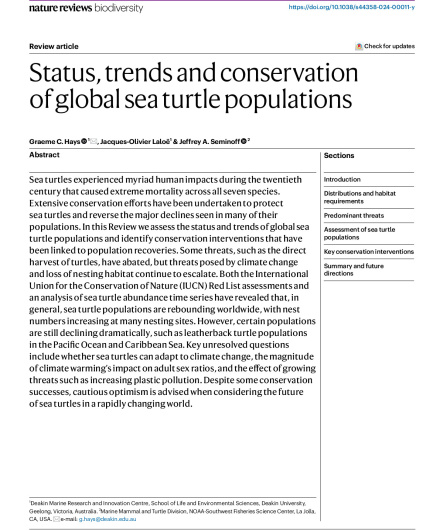
Status, trends and conservation of global sea turtle populations
Sea turtles experienced myriad human impacts during the twentieth century that caused extreme mortality across all seven species. Extensive conservation...

Monitoreo de especies
First confirmed record of the rough-toothed dolphin in ecuadorian mainland...
We report the first confirmed occurrence of the rough-toothed dolphin (Steno bredanensis) in mainland waters of Ecuador. The...