
Al descargar el documento usted acepta los términos establecidos en el copyright del documento y la política de uso de la plataforma.
Biblioteca
Using stable isotopes analysis to understand ontogenetic trophic variations of the scalloped hammerhead shark at the Galapagos Marine Reserve


Monitoreo de especies
Metodologías de monitoreo
Año de la publicación:
2022
Autor:
Florencia Cerutti-Pereyra
Pelayo Salinas-De-León
Camila Arnés-Urgellés
Jennifer Suarez-Moncada
Eduardo Espinoza
Leandro Vaca
Diego Páez-Rosas
Lugar de incidencia:
Ecuador
Región oceánica:
Pacífico - Sudeste
Changes in life-history requirements drive trophic variations, particularly in large marine predators. The life history of many shark species is still poorly known and understanding their dietary ontogeny is a challenging task, especially for highly migratory species. Stable isotope analysis has proven as a useful method for examining the foraging strategies of sharks and other marine predators. We assessed the foraging strategies and ontogenetic changes of scalloped hammerhead sharks, Sphyrna lewini, at Galapagos Marine Reserve (GMR), by analysing δ13C and δ15N signatures in different maturity stages. Our isotopic results suggest ontogenetic shifts in resource use between sub-adult and adult stages, but not between adult and juvenile stages. Carbon isotopic signatures found in the juvenile stage were enriched in contrast to sub-adults (~0.73‰) suggesting a combination of the maternal input and the use of coastal resources around the Galapagos Islands. Adult female sharks also showed enrichment in δ13C (~0.53‰) in comparison to sub-adult stages that suggest feeding in high primary productivity areas, such as the GMR. This study improves the understanding of the trophic ecology and ontogenetic changes of a highly migratory shark that moves across the protected and unprotected...
Etiquetas:
© 2022 Cerutti-Pereyra et al. This is an open access article distributed under the terms of the Creative Commons Attribution License, which permits unrestricted use, distribution, and reproduction in any medium, provided the original author and source are credited.
La estructura de clasificación de la lista de especies Blue Five para la biblioteca digital ha sido
elaborada siguiendo criterios tanto científicos como de accesibilidad para facilitar la búsqueda de
información. En primer lugar, se organizaron las especies basándose en la taxonomía aceptada por la
comunidad científica para garantizar precisión y coherencia. Simultáneamente, se han implementado
categorías y subcategorías, considerando características morfológicas, su distribución y el uso de los
nombres comunes, con el fin de optimizar la navegación y búsqueda de datos por parte de los usuarios.
Esta metodología equilibrada asegura que la lista no solo sea científicamente rigurosa, sino también
fácil de consultar para quienes necesiten acceder a información específica de manera eficiente.
ISBN/ISSN/DOI:
https://doi.org/10.1371/journal.pone.0268736
Editor:
PLoS ONE
Idioma:
Inglés
Fuente:
PLoS ONE
Especies mencionadas:
- Categoría Blue Five: Tiburones
- Familia: Tiburones martillo
- Especies: Tiburón martillo común (Sphyrna lewini)
Documentos relacionados:

Monitoreo de especies
From coastal to offshore: The case of an inshore bottlenose...
"The common bottlenose dolphin (Tursiops truncatus) is widely distributed across tropical and temperate waters
worldwide (Wells et al...
Monitoreo de especies
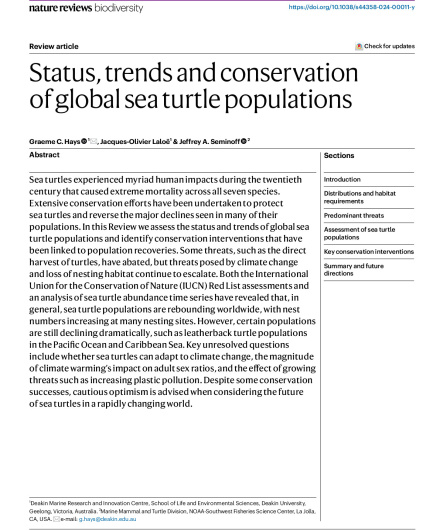
Status, trends and conservation of global sea turtle populations
Sea turtles experienced myriad human impacts during the twentieth century that caused extreme mortality across all seven species. Extensive conservation...

Monitoreo de especies
First confirmed record of the rough-toothed dolphin in ecuadorian mainland...
We report the first confirmed occurrence of the rough-toothed dolphin (Steno bredanensis) in mainland waters of Ecuador. The...