
Al descargar el documento usted acepta los términos establecidos en el copyright del documento y la política de uso de la plataforma.
Biblioteca
International fisheries threaten globally endangered sharks in the Eastern Tropical Pacific Ocean: the case of the Fu Yuan Yu Leng 999 reefer vessel seized within the Galápagos Marine Reserve

Gestión de áreas marinas
Vigilancia y control
Año de la publicación:
2021
Autor:
Elisa Bonaccorso
Nicté Ordóñez-Garza
Diana A. Pazmiño
Alex Hearn
Diego Páez-Rosas
Sebastián Cruz
Juan Pablo Muñoz-Pérez
Eduardo Espinoza
Jenifer Suárez
Lauren D. Muñoz-Rosado
Andrea Vizuete [Et al.]
Lugar de incidencia:
Ecuador
Región oceánica:
Pacífico - Sudeste
Shark fishing, driven by the fin trade, is the primary cause of global shark population declines. Here, we present a case study that exemplifies how industrial fisheries are likely depleting shark populations in the Eastern Tropical Pacific Ocean. In August 2017, the vessel Fu Yuan Yu Leng 999, of Chinese flag, was detained while crossing through the Galápagos Marine Reserve without authorization. This vessel contained 7639 sharks, representing one of the largest seizures recorded to date. Based on a sample of 929 individuals (12%), we found 12 shark species: 9 considered as Vulnerable or higher risk by the IUCN and 8 listed in CITES. Four species showed a higher proportion of immature than mature individuals, whereas size-distribution hints that at least some of the fishing ships associated with the operation may have been using purse-seine gear fishing equipment, which, for some species, goes against international conventions. Our data expose the magnitude of the threat that fishing industries and illegal trade represent to sharks in the Eastern Tropical Pacific Ocean.
Etiquetas:
This article is licensed under a Creative Commons Attribution 4.0 International License, which permits use, sharing, adaptation, distribution and reproduction in any medium or format, as long as you give appropriate credit to the original author(s) and the source, provide a link to the Creative Commons licence, and indicate if changes were made.
La estructura de clasificación de la lista de especies Blue Five para la biblioteca digital ha sido
elaborada siguiendo criterios tanto científicos como de accesibilidad para facilitar la búsqueda de
información. En primer lugar, se organizaron las especies basándose en la taxonomía aceptada por la
comunidad científica para garantizar precisión y coherencia. Simultáneamente, se han implementado
categorías y subcategorías, considerando características morfológicas, su distribución y el uso de los
nombres comunes, con el fin de optimizar la navegación y búsqueda de datos por parte de los usuarios.
Esta metodología equilibrada asegura que la lista no solo sea científicamente rigurosa, sino también
fácil de consultar para quienes necesiten acceder a información específica de manera eficiente.
ISBN/ISSN/DOI:
https://doi.org/10.1038/s41598-021-94126-3
Editor:
Scientific Reports
Idioma:
Inglés
Fuente:
Nature portfolio
Especies mencionadas:
- Categoría Blue Five: Tiburones
- Familia: Tiburones zorro Tiburones majarros Tiburones cazones Tiburones martillo Tiburones ballena
- Especies: Zorro ojón (Alopias superciliosus) Zorro pelágico (Alopias pelagicus) Tiburón mako (Isurus oxyrinchus) Tiburón jaquetón sedoso (Carcharhinus falciformis) Tiburón oceánico (Carcharhinus longimanus) Tiburón tigre (Galeocerdo cuvier) Tiburón azul (Prionace glauca) Tiburón martillo común (Sphyrna lewini) Tiburón martillo (Sphyrna zygaena) Tiburón ballena (Rhincodon typus)
Documentos relacionados:

Gestión de áreas marinas
Fishing effort dynamics around the Galápagos Marine Reserve as depicted...
The waters around the Galápagos Marine Reserve (GMR) are important fishing grounds for authorized artisanal vessels fishing within the reserve...
Gestión de áreas marinas
Opportunities and challenges for improving fisheries management through greater transparency...
When fisheries managers cannot see who is fishing or where fishing occurs, their scope for management interventions is limited. This...
Gestión de áreas marinas
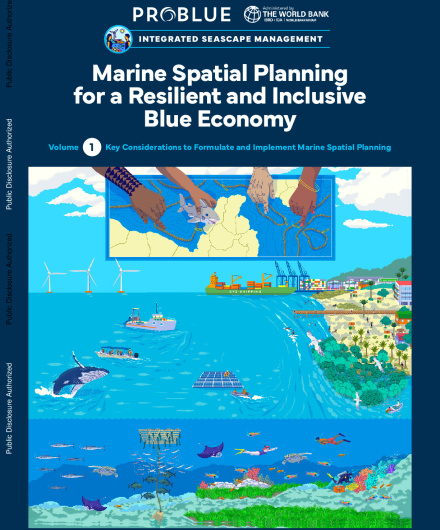
Marine spatial planning for a resilient and inclusive blue economy...
The World Bank defines the Blue Economy as the sustainable and integrated development of economic sectors in healthy oceans. It...