
Al descargar el documento usted acepta los términos establecidos en el copyright del documento y la política de uso de la plataforma.
Biblioteca
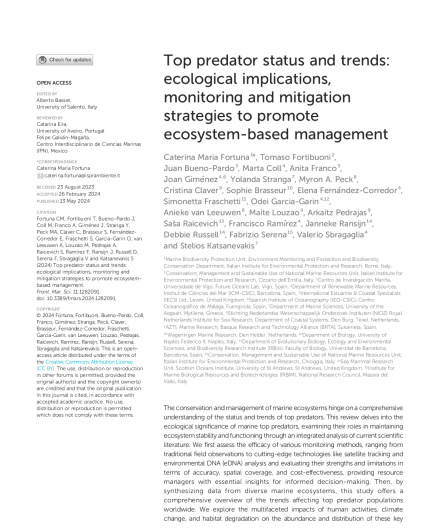
Top predator status and trends: Ecological implications, monitoring and mitigation strategies to promote ecosystem-based management

Monitoreo de especies
Metodologías de monitoreo
Año de la publicación:
2024
Autor:
Caterina Maria Fortuna
Tomaso Fortibuoni
Juan Bueno-Pardo
Marta Coll
Anita Franco
Joan Giménez
Yolanda Stranga
Myron A. Peck
Cristina Claver
Sophie Brasseur
Elena Fernández-Corredor
Simonetta Fraschetti
Odei Garcia-Garin
Anieke van Leeuwen
Maite Louzao
Arkaitz Pedrajas
Saša Raicevich
Francisco Ramírez
Janneke Ransijn
Debbie Russell
Fabrizio Serena
Valerio Sbragaglia
Stelios Katsanevakis
Lugar de incidencia:
Global
Región oceánica:
Cosmopolita
The conservation and management of marine ecosystems hinge on a comprehensive understanding of the status and trends of top predators. This review delves into the ecological significance of marine top predators, examining their roles in maintaining ecosystem stability and functioning through an integrated analysis of current scientific literature. We first assess the efficacy of various monitoring methods, ranging from traditional field observations to cutting-edge technologies like satellite tracking and environmental DNA (eDNA) analysis and evaluating their strengths and limitations in terms of accuracy, spatial coverage, and cost-effectiveness, providing resource managers with essential insights for informed decision-making. Then, by synthesizing data from diverse marine ecosystems, this study offers a comprehensive overview of the trends affecting top predator populations worldwide.
Etiquetas:
© 2024 Fortuna, Fortibuoni, Bueno-Pardo, Coll, Franco, Gime´ nez, Stranga, Peck, Claver, Brasseur, Ferna´ndez-Corredor, Fraschetti, Garcia-Garin, van Leeuwen, Louzao, Pedrajas, Raicevich, Ram´ırez, Ransijn, Russell, Serena, Sbragaglia and Katsanevakis. This is an openaccess article distributed under the terms of the Creative Commons Attribution License (CC BY). The use, distribution or reproduction in other forums is permitted, provided the original author(s) and the copyright owner(s) are credited and that the original publication in this journal is cited, in accordance with accepted academic practice. No use, distribution or reproduction is permitted which does not comply with these terms.
La estructura de clasificación de la lista de especies Blue Five para la biblioteca digital ha sido
elaborada siguiendo criterios tanto científicos como de accesibilidad para facilitar la búsqueda de
información. En primer lugar, se organizaron las especies basándose en la taxonomía aceptada por la
comunidad científica para garantizar precisión y coherencia. Simultáneamente, se han implementado
categorías y subcategorías, considerando características morfológicas, su distribución y el uso de los
nombres comunes, con el fin de optimizar la navegación y búsqueda de datos por parte de los usuarios.
Esta metodología equilibrada asegura que la lista no solo sea científicamente rigurosa, sino también
fácil de consultar para quienes necesiten acceder a información específica de manera eficiente.
ISBN/ISSN/DOI:
doi: 10.3389/fmars.2024.1282091
Editor:
Frontiers in Marine Science
Idioma:
Inglés
Fuente:
Frontiers in Marine Science
Especies mencionadas:
- Categoría Blue Five: Ballenas Delfines Tiburones Mantarrayas
- Familia: Tiburones majarros Tiburones cazones Tiburones peregrinos
- Especies: Tiburón blanco (Carcharodon carcharias) Tiburón azul (Prionace glauca) Tiburón peregrino (Cetorhinus maximus)
Documentos relacionados:
Monitoreo de especies
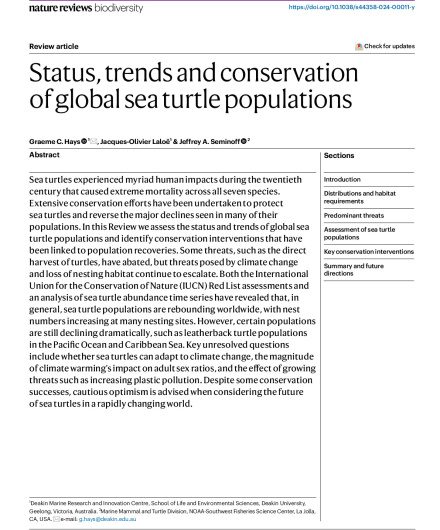
Status, trends and conservation of global sea turtle populations
Sea turtles experienced myriad human impacts during the twentieth century that caused extreme mortality across all seven species. Extensive conservation...
Monitoreo de especies
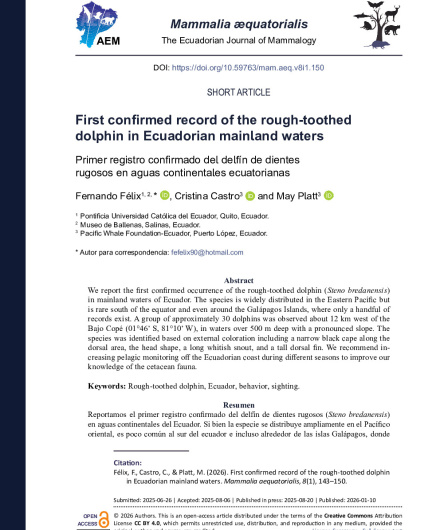
First confirmed record of the rough-toothed dolphin in ecuadorian mainland...
We report the first confirmed occurrence of the rough-toothed dolphin (Steno bredanensis) in mainland waters of Ecuador. The...
Monitoreo de especies
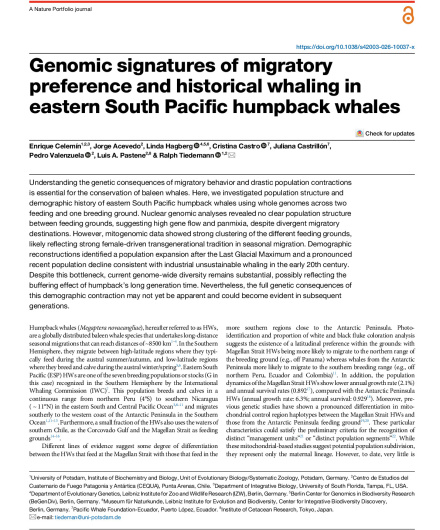
Genomic signatures of migratory preference and historical whaling in eastern...
Understanding the genetic consequences of migratory behavior and drastic population contractions is essential for the conservation of baleen whales. Here...