
Al descargar el documento usted acepta los términos establecidos en el copyright del documento y la política de uso de la plataforma.
Biblioteca
Biogeographic variation in the diet of juvenile blacktip sharks across the Galapagos Archipelago

Monitoreo de especies
Metodologías de monitoreo
Año de la publicación:
2026
Autor:
Savannah J. Ryburn
Eldridge Wisely
Eduardo Espinoza
Daniel Armijos
Haley E. Capone
Diana A. Pazmiño
Alex Hearn
John F. Bruno
Lugar de incidencia:
Regional
Región oceánica:
Pacífico - Sudeste
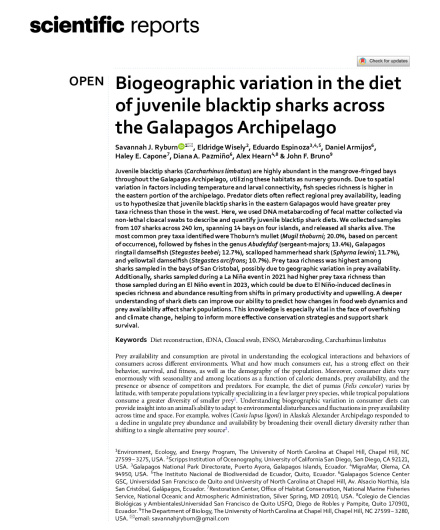
Juvenile blacktip sharks (Carcharhinus limbatus) are highly abundant in the mangrove-fringed bays throughout the Galapagos Archipelago, utilizing these habitats as nursery grounds. Due to spatial variation in factors including temperature and larval connectivity, fish species richness is higher in the eastern portion of the archipelago. Predator diets often reflect regional prey availability, leading us to hypothesize that juvenile blacktip sharks in the eastern Galapagos would have greater prey taxa richness than those in the west. Here, we used DNA metabarcoding of fecal matter collected via non-lethal cloacal swabs to describe and quantify juvenile blacktip shark diets. We collected samples from 107 sharks across 240 km, spanning 14 bays on four islands, and released all sharks alive. The most common prey taxa identified were Thoburn’s mullet (Mugil thoburni; 20.0%, based on percent of occurrence), followed by fishes in the genus Abudefduf (sergeant-majors; 13.4%), Galapagos ringtail damselfish (Stegastes beebei; 12.7%), scalloped hammerhead shark (Sphyrna lewini; 11.7%), and yellowtail damselfish (Stegastes arcifrons; 10.7%). Prey taxa richness was highest among sharks sampled in the bays of San Cristobal, possibly due to geographic variation in prey availability.
Additionally...
Etiquetas:
This article is licensed under a Creative Commons Attribution-NonCommercial-NoDerivatives 4.0 International License
La estructura de clasificación de la lista de especies Blue Five para la biblioteca digital ha sido
elaborada siguiendo criterios tanto científicos como de accesibilidad para facilitar la búsqueda de
información. En primer lugar, se organizaron las especies basándose en la taxonomía aceptada por la
comunidad científica para garantizar precisión y coherencia. Simultáneamente, se han implementado
categorías y subcategorías, considerando características morfológicas, su distribución y el uso de los
nombres comunes, con el fin de optimizar la navegación y búsqueda de datos por parte de los usuarios.
Esta metodología equilibrada asegura que la lista no solo sea científicamente rigurosa, sino también
fácil de consultar para quienes necesiten acceder a información específica de manera eficiente.
ISBN/ISSN/DOI:
https://doi.org/10.1038/s41598-026-37386-1
Editor:
Scientific Reports
Idioma:
Inglés
Fuente:
Nature portfolio
Especies mencionadas:
- Categoría Blue Five: Tiburones
- Familia: Tiburones cazones
- Especies: Tiburón macuira o punta negra (Carcharhinus limbatus)
Documentos relacionados:
Monitoreo de especies
A Review of the status of sharks, rays and chimaeras...
Chondrichthyan fishes (sharks, rays and chimaeras) are a group of high conservation concern globally. Species are impacted by varying threats...
Monitoreo de especies
Movements of galapagos sharks (Carcharhinus galapagensis) in Eastern Tropical Pacific...
Galapagos sharks (Carcharhinus galapagensis) are a large species belonging to the family Carcharhinidae, with poorly understood biology...
Monitoreo de especies
Microplastic pollution in seawater and marine organisms across the Tropical...
Detection of plastic debris degrading into micro particles across all oceanic environments and inside of marine organisms is no longer...