
Al descargar el documento usted acepta los términos establecidos en el copyright del documento y la política de uso de la plataforma.
Biblioteca
Current global population size, post-whaling trend and historical trajectory of sperm whales

Monitoreo de especies
Metodologías de monitoreo
Año de la publicación:
2022
Autor:
Hal Whitehead
Megan Shin
Lugar de incidencia:
Global
Región oceánica:
Cosmopolita
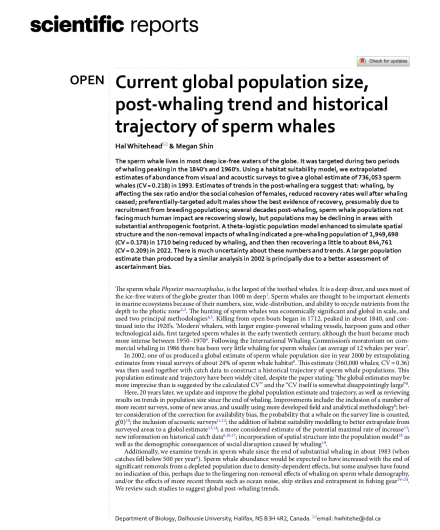
The sperm whale lives in most deep ice-free waters of the globe. It was targeted during two periods of whaling peaking in the 1840’s and 1960’s. Using a habitat suitability model, we extrapolated estimates of abundance from visual and acoustic surveys to give a global estimate of 736,053 sperm whales (CV = 0.218) in 1993. Estimates of trends in the post-whaling era suggest that: whaling, by affecting the sex ratio and/or the social cohesion of females, reduced recovery rates well after whaling ceased; preferentially-targeted adult males show the best evidence of recovery, presumably due to recruitment from breeding populations; several decades post-whaling, sperm whale populations not facing much human impact are recovering slowly, but populations may be declining in areas with substantial anthropogenic footprint. A theta-logistic population model enhanced to simulate spatial structure and the non-removal impacts of whaling indicated a pre-whaling population of 1,949,698 (CV = 0.178) in 1710 being reduced by whaling, and then then recovering a little to about 844,761 (CV = 0.209) in 2022. There is much uncertainty about these numbers and trends. A larger population estimate than produced by a similar analysis in 2002 is principally due to a better assessment of ascertainment bias...
Etiquetas:
This article is licensed under a Creative Commons Attribution 4.0 International License, which permits use, sharing, adaptation, distribution and reproduction in any medium or format, as long as you give appropriate credit to the original author(s) and the source, provide a link to the Creative Commons licence, and indicate if changes were made.
La estructura de clasificación de la lista de especies Blue Five para la biblioteca digital ha sido
elaborada siguiendo criterios tanto científicos como de accesibilidad para facilitar la búsqueda de
información. En primer lugar, se organizaron las especies basándose en la taxonomía aceptada por la
comunidad científica para garantizar precisión y coherencia. Simultáneamente, se han implementado
categorías y subcategorías, considerando características morfológicas, su distribución y el uso de los
nombres comunes, con el fin de optimizar la navegación y búsqueda de datos por parte de los usuarios.
Esta metodología equilibrada asegura que la lista no solo sea científicamente rigurosa, sino también
fácil de consultar para quienes necesiten acceder a información específica de manera eficiente.
ISBN/ISSN/DOI:
https://doi.org/10.1038/s41598-022-24107-7
Editor:
Scientific Reports
Idioma:
Inglés
Fuente:
Nature portfolio
Especies mencionadas:
- Categoría Blue Five: Ballenas
- Familia: Cachalotes
- Especies: Cachalote (Physeter macrocephalus)
Documentos relacionados:
Monitoreo de especies
Vulnerability of Eastern Tropical Pacific chondrichthyan fish to climate change
El cambio climático es una emergencia medioambiental que amenaza a especies y ecosistemas en todo el mundo. Los océanos han...
Monitoreo de especies
Imminent risk of extirpation for two bottlenose dolphin communities in...
A long-term study of a common bottlenose dolphin (Tursiops truncatus) population inhabiting the Gulf of Guayaquil, Ecuador (2°33′...
Monitoreo de especies
Cranial variation between coastal and offshore bottlenose dolphins, Tursiops truncatus...
Skull shape analysis provides useful information on wildlife ecology and potential local adaptations. Common bottlenose dolphins (Tursiops truncatus)...