
Al descargar el documento usted acepta los términos establecidos en el copyright del documento y la política de uso de la plataforma.
Biblioteca
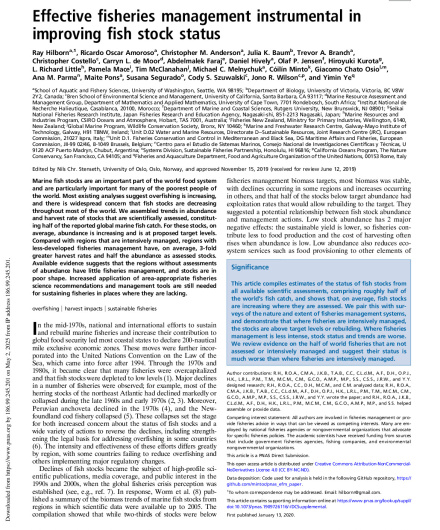
Effective fisheries management instrumental in improving fish stock status

Iniciativas sostenibles
Sectores productivos
Año de la publicación:
2020
Autor:
Ray Hilborn
Ricardo Oscar Amoroso
Christopher M. Anderson
Yimin Ye
Lugar de incidencia:
Global
Región oceánica:
Cosmopolita
Marine fish stocks are an important part of the world food system and are particularly important for many of the poorest people of the world. Most existing analyses suggest overfishing is increasing, and there is widespread concern that fish stocks are decreasing throughout most of the world. We assembled trends in abundance and harvest rate of stocks that are scientifically assessed, constituting half of the reported global marine fish catch. For these stocks, on average, abundance is increasing and is at proposed target levels. Compared with regions that are intensively managed, regions with less-developed fisheries management have, on average, 3-fold greater harvest rates and half the abundance as assessed stocks. Available evidence suggests that the regions without assessments of abundance have little fisheries management, and stocks are in poor shape. Increased application of area-appropriate fisheries science recommendations and management tools are still needed for sustaining fisheries in places where they are lacking.
Etiquetas:
This open access article is distributed under Creative Commons Attribution-NonCommercial-NoDerivatives License 4.0 (CC BY-NC-ND).
La estructura de clasificación de la lista de especies Blue Five para la biblioteca digital ha sido
elaborada siguiendo criterios tanto científicos como de accesibilidad para facilitar la búsqueda de
información. En primer lugar, se organizaron las especies basándose en la taxonomía aceptada por la
comunidad científica para garantizar precisión y coherencia. Simultáneamente, se han implementado
categorías y subcategorías, considerando características morfológicas, su distribución y el uso de los
nombres comunes, con el fin de optimizar la navegación y búsqueda de datos por parte de los usuarios.
Esta metodología equilibrada asegura que la lista no solo sea científicamente rigurosa, sino también
fácil de consultar para quienes necesiten acceder a información específica de manera eficiente.
ISBN/ISSN/DOI:
https://www.pnas.org/lookup/suppl/doi:10.1073/pnas.1909726116/-/DCSupplemental.
Editor:
The Proceedings of the National Academy of Sciences (PNAS)
Idioma:
Inglés
Fuente:
PNAS
Documentos relacionados:
Iniciativas sostenibles
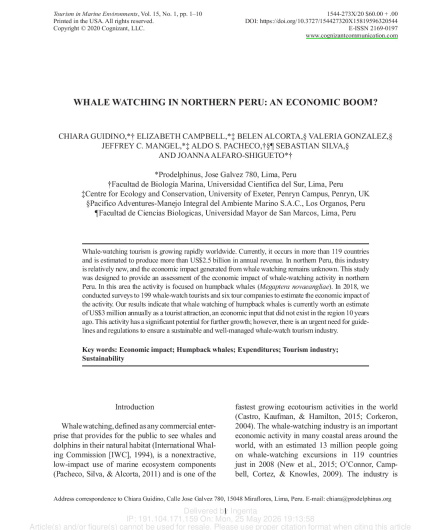
Whale watching in northern Peru: An economic boom?
Whale-watching tourism is growing rapidly worldwide. Currently, it occurs in more than 119 countries and is estimated to produce more...
Iniciativas sostenibles
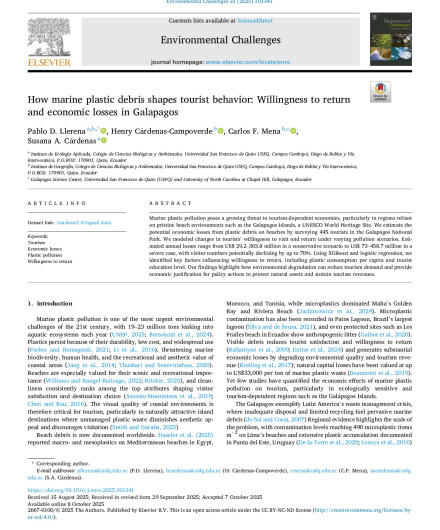
How marine plastic debris shapes tourist behavior: Willingness to return...
Marine plastic pollution poses a growing threat to tourism-dependent economies, particularly in regions reliant on pristine beach environments such as...
Iniciativas sostenibles
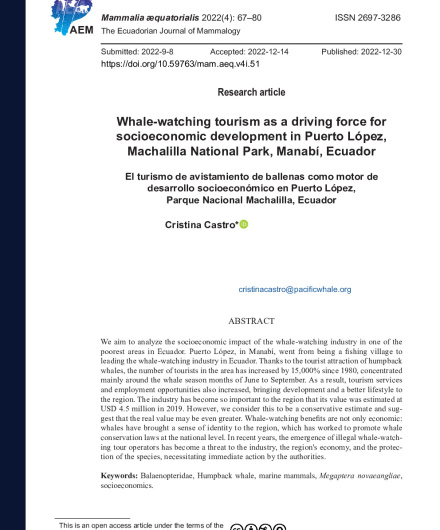
Whale-watching tourism as a driving force for socioeconomic development in...
We aim to analyze the socioeconomic impact of the whale-watching industry in one of the poorest areas in Ecuador. Puerto...