
Al descargar el documento usted acepta los términos establecidos en el copyright del documento y la política de uso de la plataforma.
Biblioteca
Efficacy of a novel shark bycatch mitigation device in a tuna longline fishery

Iniciativas sostenibles
Sectores productivos
Año de la publicación:
2022
Autor:
Philip D. Doherty
Robert Enever
Lucy C.M. Omeyer
Lydia Tivenan
Grant Course
Guy Pasco
David Thomas
Ben Sullivan
Ben Kibel
Pete Kibel
Brendan J. Godley
Lugar de incidencia:
Global
Región oceánica:
Cosmopolita
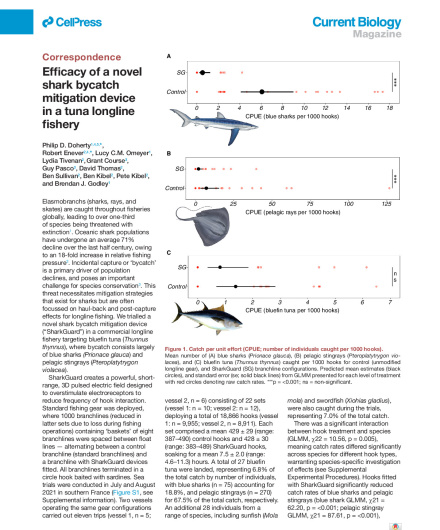
Elasmobranchs (sharks, rays, and skates) are caught throughout fisheries globally, leading to over one-third of species being threatened with extinction1. Oceanic shark populations have undergone an average 71% decline over the last half century, owing to an 18-fold increase in relative fishing pressure2. Incidental capture or ‘bycatch’ is a primary driver of population declines, and poses an important challenge for species conservation3. This threat necessitates mitigation strategies that exist for sharks but are often focussed on haul-back and post-capture effects for longline fishing. We trialled a novel shark bycatch mitigation device (“SharkGuard”) in a commercial longline fishery targeting bluefin tuna (Thunnus thynnus), where bycatch consists largely of blue sharks (Prionace glauca) and pelagic stingrays (Pteroplatytrygon violacea).
Etiquetas:
This is an open access article under the CC BY license (http://creativecommons.org/licenses/by/4.0/).
La estructura de clasificación de la lista de especies Blue Five para la biblioteca digital ha sido
elaborada siguiendo criterios tanto científicos como de accesibilidad para facilitar la búsqueda de
información. En primer lugar, se organizaron las especies basándose en la taxonomía aceptada por la
comunidad científica para garantizar precisión y coherencia. Simultáneamente, se han implementado
categorías y subcategorías, considerando características morfológicas, su distribución y el uso de los
nombres comunes, con el fin de optimizar la navegación y búsqueda de datos por parte de los usuarios.
Esta metodología equilibrada asegura que la lista no solo sea científicamente rigurosa, sino también
fácil de consultar para quienes necesiten acceder a información específica de manera eficiente.
ISBN/ISSN/DOI:
DOI: 10.1016/j.cub.2022.09.003
Editor:
Current Biology/Elsevier
Idioma:
Inglés
Fuente:
CellPress
Especies mencionadas:
- Categoría Blue Five: Tiburones Mantarrayas
- Familia: Tiburones cazones Rayas látigo
- Especies: Tiburón azul (Prionace glauca) Raya violácea (Pteroplatytrygon violacea)
Documentos relacionados:
Iniciativas sostenibles
Whale watching in northern Peru: An economic boom?
Whale-watching tourism is growing rapidly worldwide. Currently, it occurs in more than 119 countries and is estimated to produce more...
Iniciativas sostenibles
How marine plastic debris shapes tourist behavior: Willingness to return...
Marine plastic pollution poses a growing threat to tourism-dependent economies, particularly in regions reliant on pristine beach environments such as...
Iniciativas sostenibles
Whale-watching tourism as a driving force for socioeconomic development in...
We aim to analyze the socioeconomic impact of the whale-watching industry in one of the poorest areas in Ecuador. Puerto...