
Al descargar el documento usted acepta los términos establecidos en el copyright del documento y la política de uso de la plataforma.
Biblioteca
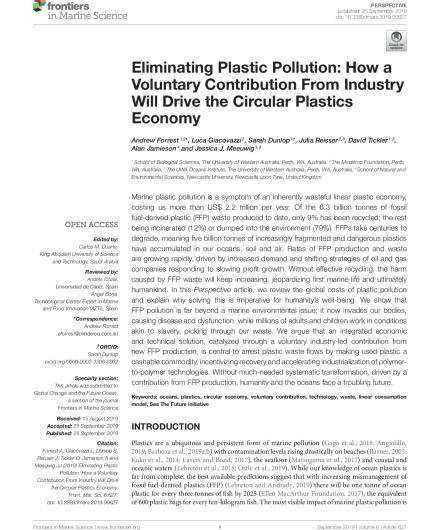
Eliminating plastic pollution: How a voluntary contribution from industry will drive the circular plastics economy

Iniciativas sostenibles
Actividades público-privadas
Año de la publicación:
2019
Autor:
Andrew Forrest
Luca Giacovazzi
Sarah Dunlop
Julia Reisser
David Tickler
Alan Jamieson
Jessica J. Meeuwig
Lugar de incidencia:
Global
Región oceánica:
Cosmopolita
Marine plastic pollution is a symptom of an inherently wasteful linear plastic economy, costing us more than US$ 2.2 trillion per year. Of the 6.3 billion tonnes of fossil fuel-derived plastic (FFP) waste produced to date, only 9% has been recycled; the rest being incinerated (12%) or dumped into the environment (79%). FFPs take centuries to degrade, meaning five billion tonnes of increasingly fragmented and dangerous plastics have accumulated in our oceans, soil and air. Rates of FFP production and waste are growing rapidly, driven by increased demand and shifting strategies of oil and gas companies responding to slowing profit growth. Without effective recycling, the harm caused by FFP waste will keep increasing, jeopardizing first marine life and ultimately humankind. In this Perspective article, we review the global costs of plastic pollution and explain why solving this is imperative for humanity’s well-being. We show that FFP pollution is far beyond a marine environmental issue: it now invades our bodies, causing disease and dysfunction, while millions of adults and children work in conditions akin to slavery, picking through our waste. We argue that an integrated economic and technical solution, catalyzed through a voluntary industry-led contribution from new FFP...
Etiquetas:
© 2019 Forrest, Giacovazzi, Dunlop, Reisser, Tickler, Jamieson y Meeuwig. Este artículo es de acceso abierto y se distribuye bajo los términos de la Licencia Creative Commons Atribución (CC BY) . Se permite su uso, distribución y reproducción en otros foros, siempre que se cite al autor original y al titular de los derechos de autor, y se cite la publicación original en esta revista, de acuerdo con la práctica académica aceptada. No se permite ningún uso, distribución ni reproducción que no cumpla con estos términos.
La estructura de clasificación de la lista de especies Blue Five para la biblioteca digital ha sido
elaborada siguiendo criterios tanto científicos como de accesibilidad para facilitar la búsqueda de
información. En primer lugar, se organizaron las especies basándose en la taxonomía aceptada por la
comunidad científica para garantizar precisión y coherencia. Simultáneamente, se han implementado
categorías y subcategorías, considerando características morfológicas, su distribución y el uso de los
nombres comunes, con el fin de optimizar la navegación y búsqueda de datos por parte de los usuarios.
Esta metodología equilibrada asegura que la lista no solo sea científicamente rigurosa, sino también
fácil de consultar para quienes necesiten acceder a información específica de manera eficiente.
ISBN/ISSN/DOI:
doi: 10.3389/fmars.2019.00627
Editor:
Frontiers in Marine Science
Idioma:
Inglés
Fuente:
PERSPECTIVE article
Especies mencionadas:
- Categoría Blue Five: Tiburones Tortugas marinas
Documentos relacionados:
Iniciativas sostenibles
Whale watching in northern Peru: An economic boom?
Whale-watching tourism is growing rapidly worldwide. Currently, it occurs in more than 119 countries and is estimated to produce more...
Iniciativas sostenibles
How marine plastic debris shapes tourist behavior: Willingness to return...
Marine plastic pollution poses a growing threat to tourism-dependent economies, particularly in regions reliant on pristine beach environments such as...
Iniciativas sostenibles
Whale-watching tourism as a driving force for socioeconomic development in...
We aim to analyze the socioeconomic impact of the whale-watching industry in one of the poorest areas in Ecuador. Puerto...