
Al descargar el documento usted acepta los términos establecidos en el copyright del documento y la política de uso de la plataforma.
Biblioteca
Marine ecosystem services and integrated management: “There's a crack, a crack in everything, that's how the light gets in”!

Gestión de áreas marinas
Servicios ecosistémicos
Año de la publicación:
2023
Autor:
Michael Elliott
Lugar de incidencia:
Global
Región oceánica:
Cosmopolita
There have been many recent developments and discussions regarding marine science for policy, governance and management in the pages of Marine Pollution Bulletin and elsewhere and especially the movement towards systems analysis to cope with the complexity of marine natural and human systems (for example, Elliott et al., 2017, 2020a, 2020b; Cormier et al., 2022, and references therein). It is emphasised that the marine system has to be viewed through both ecocentric and anthropocentric lenses but both aspects are needed to consider the whole ecosystem. Because of this, it is now especially appropriate to reappraise an integrative model linking the natural and social sciences, governance and management. If such a model can be agreed then it would enable a recipe for assessing and managing human activities in the sea. Such a model would need to merge the natural and social sciences, not least to include concepts regarding the ecosystem services and societal goods and benefits provided by our oceans. Despite this, and perhaps as expected, there continues to be discussion and even argument relating to the meaning, interpretation and use of the relevant terms, especially regarding the concepts relating to ecosystem services.
This article attempts to clarify the ecosystem services...
Etiquetas:
© 2023 Published by Elsevier Ltd.
La estructura de clasificación de la lista de especies Blue Five para la biblioteca digital ha sido
elaborada siguiendo criterios tanto científicos como de accesibilidad para facilitar la búsqueda de
información. En primer lugar, se organizaron las especies basándose en la taxonomía aceptada por la
comunidad científica para garantizar precisión y coherencia. Simultáneamente, se han implementado
categorías y subcategorías, considerando características morfológicas, su distribución y el uso de los
nombres comunes, con el fin de optimizar la navegación y búsqueda de datos por parte de los usuarios.
Esta metodología equilibrada asegura que la lista no solo sea científicamente rigurosa, sino también
fácil de consultar para quienes necesiten acceder a información específica de manera eficiente.
ISBN/ISSN/DOI:
https://doi.org/10.1016/j.marpolbul.2023.115177
Editor:
Elsevier/Marine Pollution Bulletin
Idioma:
Inglés
Fuente:
ScienceDirect
Documentos relacionados:
Gestión de áreas marinas
Opportunities and challenges for improving fisheries management through greater transparency...
When fisheries managers cannot see who is fishing or where fishing occurs, their scope for management interventions is limited. This...
Gestión de áreas marinas
Marine spatial planning for a resilient and inclusive blue economy...
The World Bank defines the Blue Economy as the sustainable and integrated development of economic sectors in healthy oceans. It...
Gestión de áreas marinas
Informe del consejo asesor científico sobre minería de fondos marinos
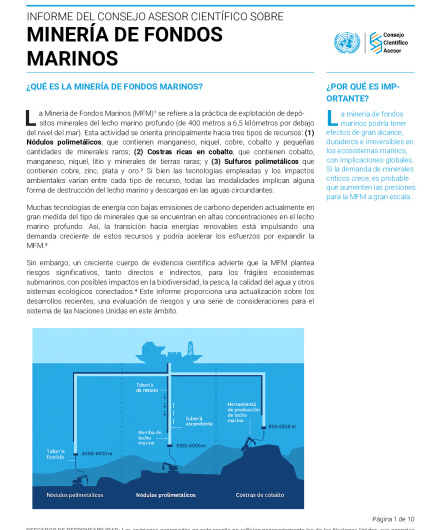
Un creciente cuerpo de evidencia científica advierte que la MFM plantea riesgos significativos, tanto directos e indirectos, para los frágiles...