
Al descargar el documento usted acepta los términos establecidos en el copyright del documento y la política de uso de la plataforma.
Biblioteca
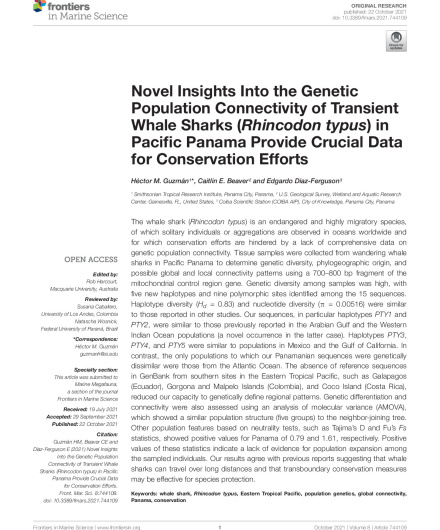
Novel insights into the genetic population connectivity of transient whale sharks (Rhincodon typus) in Pacific Panama provide crucial data for conservation efforts

Monitoreo de especies
Metodologías de monitoreo
Año de la publicación:
2021
Autor:
Héctor M. Guzmán
Caitlin E. Beaver
Edgardo Díaz Ferguson
Lugar de incidencia:
Panamá
Región oceánica:
Pacífico - Sudeste
The whale shark (Rhincodon typus) is an endangered and highly migratory species, of which solitary individuals or aggregations are observed in oceans worldwide and for which conservation efforts are hindered by a lack of comprehensive data on genetic population connectivity. Tissue samples were collected from wandering whale sharks in Pacific Panama to determine genetic diversity, phylogeographic origin, and possible global and local connectivity patterns using a 700–800 bp fragment of the mitochondrial control region gene. Genetic diversity among samples was high, with five new haplotypes and nine polymorphic sites identified among the 15 sequences. Haplotype diversity (Hd = 0.83) and nucleotide diversity (π = 0.00516) were similar to those reported in other studies. Our sequences, in particular haplotypes PTY1 and PTY2, were similar to those previously reported in the Arabian Gulf and the Western Indian Ocean populations (a novel occurrence in the latter case). Haplotypes PTY3, PTY4, and PTY5 were similar to populations in Mexico and the Gulf of California. In contrast, the only populations to which our Panamanian sequences were genetically dissimilar were those from the Atlantic Ocean. The absence of reference sequences in GenBank from southern sites in the Eastern Tropical...
Etiquetas:
© 2021 Guzmán, Beaver and Díaz-Ferguson. This is an open-access article distributed under the terms of the Creative Commons Attribution License (CC BY). The use, distribution or reproduction in other forums is permitted, provided the original author(s) and the copyright owner(s) are credited and that the original publication in this journal is cited, in accordance with accepted academic practice. No use, distribution or reproduction is permitted which does not comply with these terms.
La estructura de clasificación de la lista de especies Blue Five para la biblioteca digital ha sido
elaborada siguiendo criterios tanto científicos como de accesibilidad para facilitar la búsqueda de
información. En primer lugar, se organizaron las especies basándose en la taxonomía aceptada por la
comunidad científica para garantizar precisión y coherencia. Simultáneamente, se han implementado
categorías y subcategorías, considerando características morfológicas, su distribución y el uso de los
nombres comunes, con el fin de optimizar la navegación y búsqueda de datos por parte de los usuarios.
Esta metodología equilibrada asegura que la lista no solo sea científicamente rigurosa, sino también
fácil de consultar para quienes necesiten acceder a información específica de manera eficiente.
ISBN/ISSN/DOI:
doi: 10.3389/fmars.2021.744109
Editor:
Frontiers in Marine Science
Idioma:
Inglés
Fuente:
This article was submitted to Marine Megafauna, a section of the journal Frontiers in Marine Science
Especies mencionadas:
- Categoría Blue Five: Tiburones
- Familia: Tiburones ballena
- Especies: Tiburón ballena (Rhincodon typus)
Documentos relacionados:
Monitoreo de especies
Vulnerability of Eastern Tropical Pacific chondrichthyan fish to climate change
El cambio climático es una emergencia medioambiental que amenaza a especies y ecosistemas en todo el mundo. Los océanos han...
Monitoreo de especies
Imminent risk of extirpation for two bottlenose dolphin communities in...
A long-term study of a common bottlenose dolphin (Tursiops truncatus) population inhabiting the Gulf of Guayaquil, Ecuador (2°33′...
Monitoreo de especies
Cranial variation between coastal and offshore bottlenose dolphins, Tursiops truncatus...
Skull shape analysis provides useful information on wildlife ecology and potential local adaptations. Common bottlenose dolphins (Tursiops truncatus)...